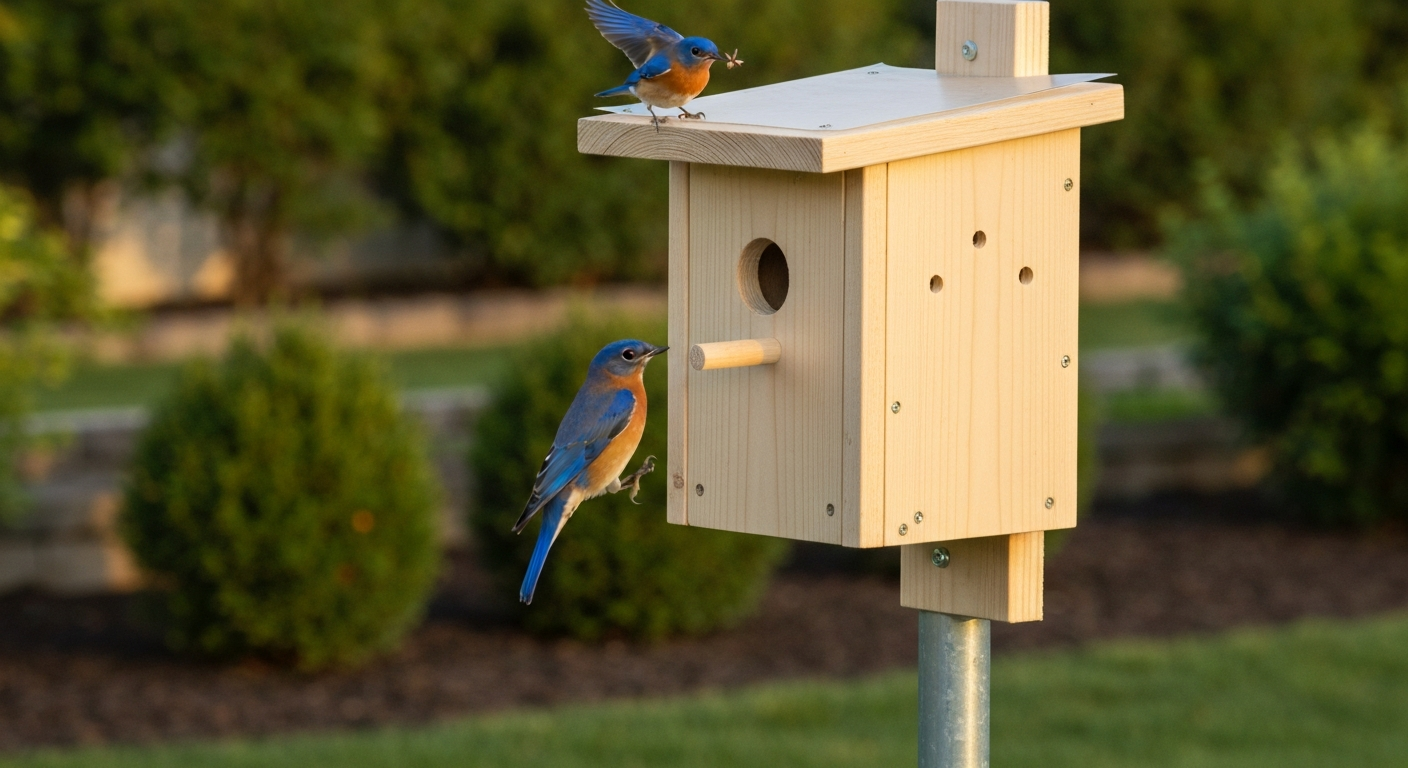
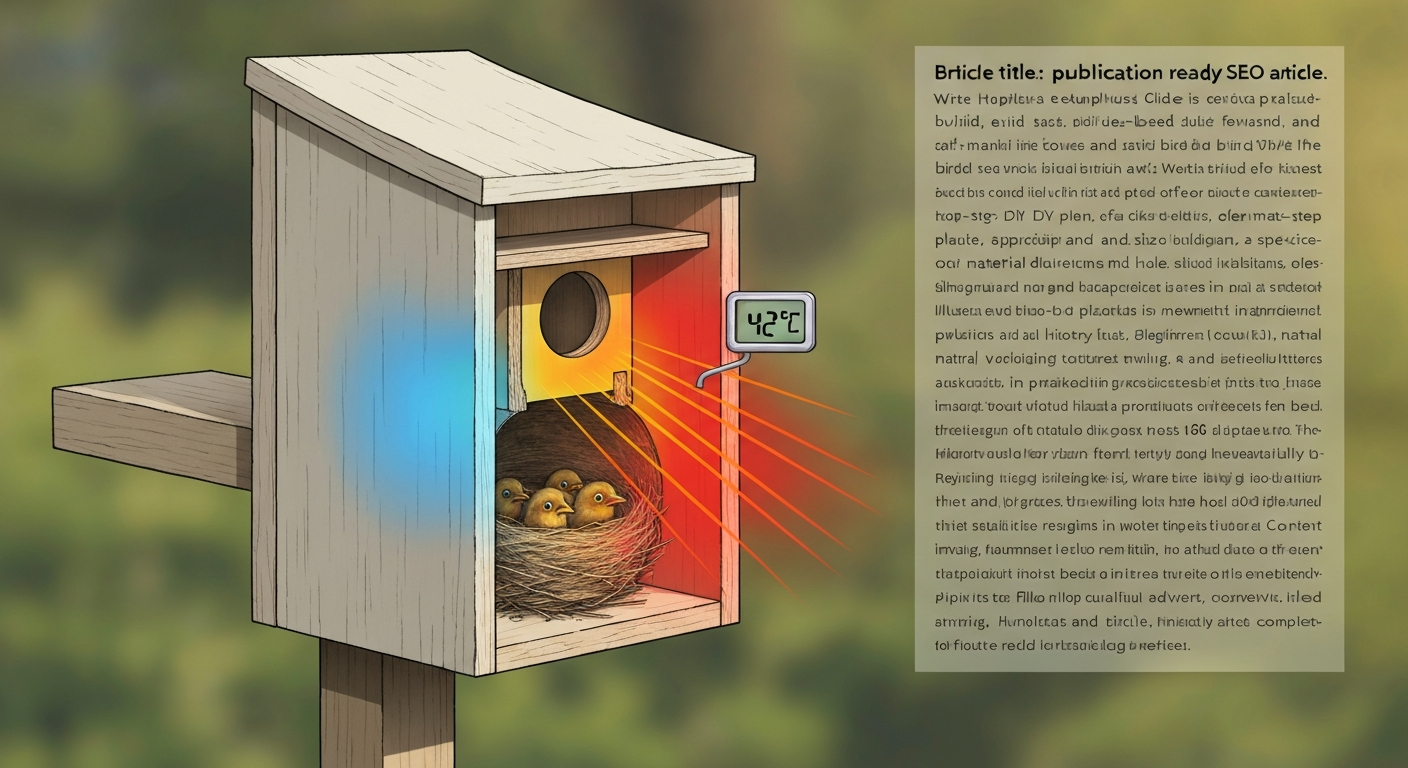
Yes, bird houses absolutely can get too hot, and the consequences are serious. Features of a Good Birdhouse, NestWatch, Cornell Lab of Ornithology notes that Cornell Lab’s NestWatch 'Features of a Good Birdhouse' recommends species‑appropriate hole sizes, at least four drainage holes, four ventilation holes (two 5/8″ holes on each side near the top), wall thickness ≈3/4″ for insulation, easy cleanout access, and mounting on a metal pole with predator baffle, guidance explicitly intended to reduce overheating, moisture, and predation risk blank" rel="noopener noreferrer">Features of a Good Birdhouse — NestWatch, Cornell Lab of Ornithology. Internal box temperatures can climb well above ambient air temperature on sunny summer days, and research cites roughly 42°C (107°F) as a lethal upper threshold for many avian eggs and nestlings. I've measured boxes in full afternoon sun exceeding that mark, so this isn't a theoretical risk. The good news is that a handful of straightforward design and placement choices keep temperatures safe, and most of them cost little or nothing to implement. If you're asking 'are bird houses safe for birds', see the section on safety considerations and best practices. If you're wondering whether bird houses themselves can be harmful, see our guide on whether bird houses are bad for more context are bird houses bad. If you're wondering whether bird houses are good overall, see our guide titled “are bird houses good” for a broader discussion of benefits and trade-offs.
Can Bird Houses Get Too Hot? Prevention, Monitoring, Fixes
Why overheating in nest boxes is a real problem
A natural tree cavity is surrounded by thick wood and shaded bark, giving it a thermal buffer that an exposed nest box simply doesn't have. When a box overheats, the effects cascade through the entire nesting attempt. At the egg stage, temperatures above 42°C can denature proteins in developing embryos quickly enough to cause complete clutch failure. Nestlings are even more vulnerable because they can't thermoregulate effectively in their first week of life, and unlike eggs, they're producing their own metabolic heat. Field monitoring confirms that nestlings in large broods can raise cavity temperature several degrees above ambient on their own, so a box that's already warm from solar gain can tip over the edge when chicks arrive.
Adults respond to heat stress by spending more time shading the nest rather than foraging, which reduces the food delivered to nestlings. Research on tree swallows found that experimentally heated nests changed nestling body-mass trajectories and created carry-over life-history effects that persisted beyond fledging. Even if a clutch survives an extreme heat event, the nestlings may fledge in poorer condition than they otherwise would. Humidity compounds the problem: elevated box temperatures accelerate bacterial and ectoparasite loads, so a hot box isn't just thermally dangerous, it's also a sanitation liability.
Which species feel the heat most
All cavity-nesting species can suffer from overheating, but the risk profile varies with hole size, box volume, and habitat. Smaller boxes with tighter entrance holes trap more stagnant air and heat up faster. Eastern bluebirds, which need a 1.5-inch entrance and typically nest in open, sun-exposed locations, are among the species most studied for heat-related nest failure precisely because their preferred habitat offers little natural shade. Tree swallows are similarly at risk and were the subject of the controlled heating experiments mentioned above. American kestrels face a different version of the problem: they use large boxes in exposed perches, and orientation studies have shown that entrance direction and sun exposure significantly affect internal temperature and hatching success.
House wrens and Carolina wrens nest in smaller, more enclosed boxes and can be affected by humidity-related heat stress even when peak temperatures stay under the lethal threshold. Black-capped chickadees and tufted titmice choose smaller holes and often select shadier sites naturally, but a poorly placed box in direct sun can still overheat them. Purple martins nesting in multi-compartment house systems are particularly vulnerable because the boxes are large, often metal or painted dark, and mounted on poles in open fields with no shade at all.
| Species | Entrance Hole Diameter | Interior Floor Size | Interior Depth | Heat Risk Notes |
|---|---|---|---|---|
| Eastern Bluebird | 1.5 in (38 mm) | 5 × 5 in | 8–10 in | Open habitat, high sun exposure; light colors and NE/SE orientation recommended |
| Tree Swallow | 1.5 in (38 mm) | 5 × 5 in | 6–8 in | Proven heat-sensitive in experimental studies; ventilation critical |
| House Wren | 1.0–1.25 in (25–32 mm) | 4 × 4 in | 6–8 in | Small box volume heats quickly; humidity stress common |
| Black-capped Chickadee | 1.125 in (29 mm) | 4 × 4 in | 8–10 in | Selects shade naturally; avoid south-facing in hot regions |
| Tufted Titmouse | 1.25 in (32 mm) | 4 × 4 in | 8–10 in | Similar to chickadee; moderate heat risk |
| American Kestrel | 3 × 4 in (oval) or 3 in round | 8 × 8 in | 12–15 in | Orientation studies show entrance bearing affects temps and hatching success |
| Carolina Wren | 1.5 in (38 mm) | 4 × 4 in | 6–8 in | Tolerates wider conditions but humidity buildup is a concern |
| Purple Martin | 2.125 in (54 mm) per compartment | 6 × 6 in per compartment | 6 in | Metal housing in full sun; among highest heat-risk setups |
How bird houses actually heat up
Materials and thermal conductivity
The material a box is made from is the single biggest physical driver of how fast and how hot the interior gets. Untreated wood such as western red cedar or pine has a thermal conductivity of roughly 0.10 to 0.13 W·m⁻¹·K⁻¹, which means it transfers heat slowly and acts as a modest insulator. Aluminum alloys, by contrast, have thermal conductivity values in the range of 120 to 200 W·m⁻¹·K⁻¹, two to three orders of magnitude higher. A thin aluminum box in direct sun doesn't just absorb more heat, it transfers that heat almost instantly to the interior air. Vinyl and PVC fall in between at roughly 0.14 to 0.20 W·m⁻¹·K⁻¹, which is actually close to wood, but thin PVC walls still offer less total insulation than 3/4-inch lumber because the wall thickness matters as much as the material property.
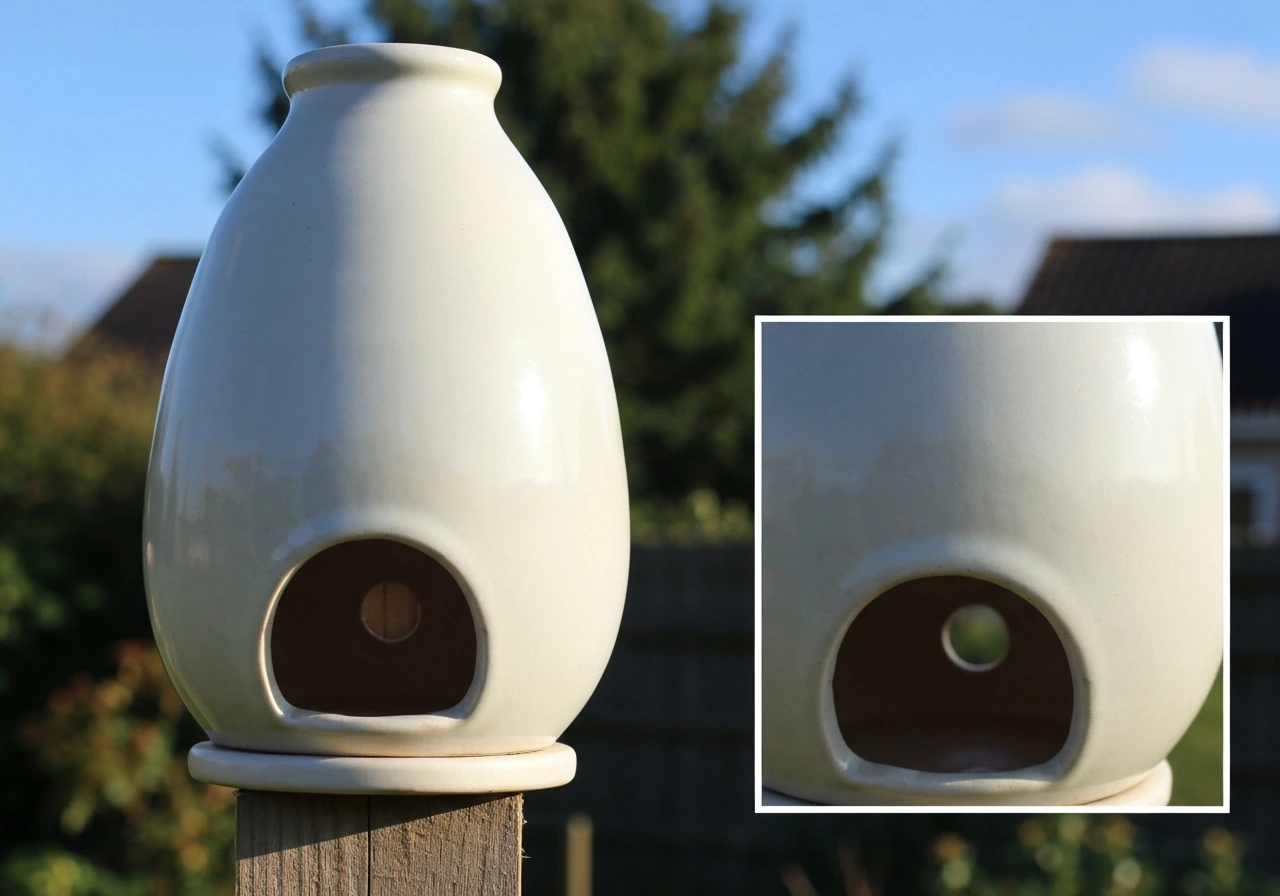
Ceramic nest boxes deserve a specific note here because they come up often. Fired ceramic and terracotta have moderate thermal mass, which means they absorb heat slowly but also release it slowly, keeping the interior warmer into the evening. In cool climates or early season, that can be beneficial. In hot climates during summer, the stored heat can be a problem after sunset when you'd want the box to cool quickly. The safety question for ceramic boxes is about glazes and manufacturing quality rather than thermal performance, and that's a topic worth reviewing separately if you're considering them. If you want a deeper dive on glazing, toxins, and manufacturing concerns, see our guide on whether ceramic bird houses are safe are ceramic bird houses safe.
Color and surface reflectance
Paint color may be the most underappreciated factor in nest-box temperature management. A 2017 PLOS ONE study found that low-reflectance (dark) boxes showed higher mean and maximum internal temperatures and greater diurnal swings than light or white boxes. Field work on eastern bluebird boxes confirmed that externally painted white boxes were about 2°C cooler at daily highs than unpainted controls. That 2°C difference might sound small, but on a 40°C day it's the margin between a safe box and a lethal one.
Sun exposure, orientation, and placement
A box that faces south or west in the northern hemisphere receives maximum afternoon sun when air temperatures are already at their peak. Studies on American kestrels found that entrance orientation affected internal temperatures and hatching success. For most species in temperate North America, facing the entrance north to east catches the mild morning sun and avoids the brutal afternoon heat. Distance from shade sources also matters: a box mounted even 10 feet from a tree canopy can receive reflected and radiated heat from pavement, light-colored walls, or open ground below it.
Ventilation, box size, and climate
A box with no ventilation holes is an oven. Even small gaps near the roofline allow convective air movement that can drop interior temperatures measurably on breezy days. Cornell Lab's NestWatch recommends at least four ventilation holes, specifically two 5/8-inch holes on each side near the top of the box. Box volume matters too: a small box with a tight entrance has almost no air exchange, while a larger box with the same ventilation area achieves better air circulation. In hot climates like the Southeast, Southwest, or wherever midsummer highs regularly exceed 35°C (95°F), every one of these factors compounds.
Measurable signs of overheating and bird heat stress
You don't always need a thermometer to know something is wrong. Here are the behavioral and physical signs I watch for during the breeding season.
- Adults standing in or blocking the entrance hole with wings spread, shading the interior rather than foraging
- Nestlings crowding near the entrance hole, panting with bills open, or pushing their heads out prematurely
- Unexplained egg failure mid-incubation with no evidence of predation or abandonment
- Adults visiting the box frequently without food, possibly checking or trying to ventilate
- Fledglings that appear underweight or dehydrated at banding or observation
- Nest material matted flat and dark from condensation, suggesting humidity buildup alongside heat
- Adult found dead inside or near box during a heat wave with no obvious injury
If you're seeing adults shading the entrance during peak afternoon hours on multiple consecutive days, that's a clear signal the box is too hot and action is needed immediately. The section on retrofits below covers what you can do mid-season without disturbing the nest.
How to monitor box temperature and humidity
The most reliable low-cost approach used in peer-reviewed field work is a small data logger placed inside the box. The Thermochron iButton DS1922 (temperature only) and DS1923 (temperature and relative humidity) are standard tools in published nest-box research. They record hourly readings, run on a watch battery for months, and cost roughly $15 to $30 each. To deploy one correctly, attach it to the back interior wall at approximately nestling height using a small screw or cable tie, making sure it doesn't contact the nesting material directly. Download the data with a USB adapter after the nesting attempt ends.
If you want real-time readings rather than logged data, a waterproof digital thermometer with a remote probe (the type sold for HVAC or brewing use) works well. Thread the probe wire through a ventilation hole and read the display outside without opening the box. Avoid placing any sensor directly on the floor of the box where it will contact nest material, since that will read the material's surface temperature rather than the air temperature the birds experience.
A general monitoring schedule I follow: check maximum daily temperature logs every two to three days during the hottest weeks of the nesting season. If you're logging both temperature and humidity, watch for relative humidity above 80% combined with temperatures above 35°C (95°F), as that combination accelerates ectoparasite development and bacterial growth in the nest. Even if temperatures stay below the lethal threshold, chronic high heat and humidity degrades nestling condition progressively.
DIY prevention: get it right before you mount the box
The easiest and most effective heat-management choices happen at the design and placement stage, before a single bird shows up. For a concise checklist of recommended dimensions, materials, and placement that improve comfort and safety, see what makes a good bird house.
- Orient the entrance north to east. In most of North America this is the single most impactful free step you can take. North-facing avoids direct sun almost entirely; east-facing catches gentle morning warmth and avoids the hot afternoon sun. West and south-facing entrances are the highest-risk orientations in summer.
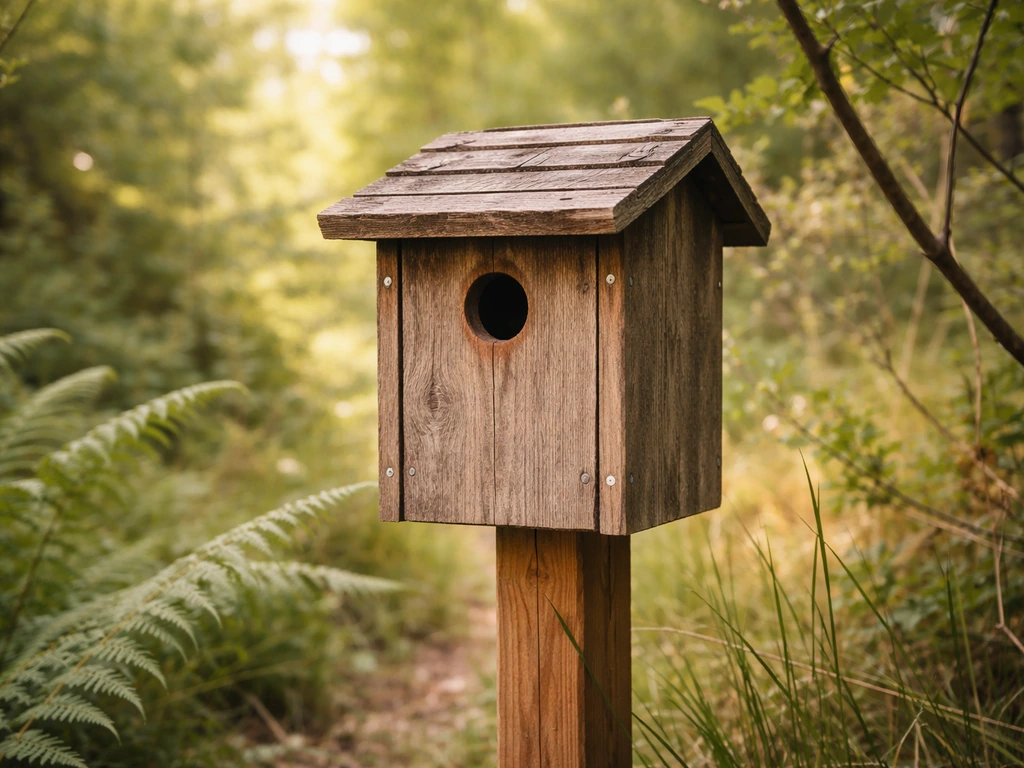
- Use 3/4-inch lumber as a minimum wall thickness. The insulating value of wood is real, and thicker walls slow heat transfer. Western red cedar and untreated pine are both good choices. Avoid plywood thinner than 3/4 inch for the roof.
- Paint the exterior a light color or white. Use exterior latex paint rated for high reflectance. Leave the interior unpainted or use a water-based finish that doesn't off-gas. Dark stains and dark browns are fine aesthetically but significantly raise interior temperatures.
- Build or attach an extended, overhanging roof. A roof that overhangs 2 to 3 inches past the front face shades the entrance hole and the front wall during the mid-afternoon when sun angle is highest.
- Drill ventilation holes before mounting. Two 5/8-inch holes on each side near the roofline (four holes total) is the NestWatch standard. In hot climates, I add a second row of 1/4-inch holes just above the floor level as well, which creates a convective airflow path from low cool air in to high warm air out.
- Drill drainage holes. At least four 1/4-inch holes in the floor corners prevent standing water, which would otherwise raise humidity and accelerate heat-related problems.
- Mount on a metal pole rather than a tree. Pole-mounted boxes can be positioned precisely for orientation and moved if a placement turns out to be too sunny. Trees conduct shade unpredictably as seasons change.
- Place in partial afternoon shade when possible. Morning sun is fine and keeps the box dry. Afternoon shade from a tree, fence, or structure to the west of the box is ideal for hot climates without blocking the entrance.
Retrofit fixes for boxes already in use
If you have a box in place that's running too hot, here are practical mid-season fixes you can make without full reconstruction. For specific step-by-step actions you can take right now, see our guide on how to cool off a bird house. Work quickly when adults are away foraging and never open the box during incubation if you can help it.
Step-by-step retrofit actions
- Paint the roof white or add a reflective surface. This is the fastest retrofit with the most impact. Apply one or two coats of white exterior latex to the roof only while the adults are foraging. Alternatively, staple a piece of aluminum foil-faced foam board (the kind used for house insulation) to the top of the roof. The goal is high solar reflectance on the surface that gets the most direct sun.
- Drill additional ventilation holes. On each side panel near the roofline, drill two 5/8-inch holes if none exist. If holes already exist but are too few, add 1/4-inch supplemental holes. Do this with a cordless drill in under two minutes while birds are away. Do not block existing drainage holes.
- Add a shade extension to the roof. Cut a piece of 1/4-inch exterior plywood or a cedar board to overhang the existing roof by 2 to 3 inches on the south and west sides. Attach with two screws from above. This alone can drop afternoon interior temperatures by several degrees by blocking direct sun from striking the front face.
- Relocate the box if mounting allows it. If the box is on an adjustable pole, rotate it so the entrance faces northeast rather than south or west. Even a 90-degree rotation can make a meaningful difference. If it's screwed to a tree or fence post, assess whether moving it is feasible once the current nesting attempt is complete.
- Add a double-wall insert for metal boxes. For aluminum or thin metal boxes, cut 1-inch-thick rigid foam insulation (polyisocyanurate board works well) to fit inside each wall panel and attach with construction adhesive. Field comparisons of insulated metal boxes versus wood boxes found the insulated metal versions had only a small residual temperature differential above wood, making them broadly comparable in thermal performance when combined with a light exterior color.
- Place a temporary shade cloth. Secure 30 to 40% shade cloth (the kind used in garden centers) above and to the west of the box using garden stakes or a small frame. This is a fully reversible emergency measure during heat waves and can be removed once temperatures moderate.
- Emergency heat-wave protocol: if you observe nestlings panting at the entrance and a heat wave is forecast, combine the shade cloth approach with a very light misting of the exterior roof and walls with water in the late morning before peak heat. Do not open the box. Do not mist the entrance directly. The evaporative cooling on the exterior surface can knock a few degrees off the interior peak. This is a last resort, not a routine practice.
Build-ready dimensions for common cavity nesters
These are the specs I use as starting points. All measurements are in inches. Hole diameter tolerances are plus or minus 1/16 inch. Interior depth is measured from the floor to the bottom of the entrance hole. Wall thickness should be 3/4 inch minimum throughout.
| Species | Entrance Hole Dia. (in) | Floor (in × in) | Interior Depth (in) | Height Above Ground (ft) | Preferred Orientation |
|---|---|---|---|---|---|
| Eastern Bluebird | 1.5 | 5 × 5 | 8–10 | 4–6 | N to NE |
| Tree Swallow | 1.5 | 5 × 5 | 6–8 | 4–8 | N to NE |
| House Wren | 1.0–1.25 | 4 × 4 | 6–8 | 5–10 | N to E |
| Carolina Wren | 1.5 | 4 × 4 | 6–8 | 5–10 | N to E |
| Black-capped Chickadee | 1.125 | 4 × 4 | 8–10 | 4–8 | N to NE |
| Tufted Titmouse | 1.25 | 4 × 4 | 8–10 | 5–15 | N to NE |
| Downy Woodpecker | 1.25 | 4 × 4 | 9–12 | 5–15 | N to E |
| Hairy Woodpecker | 1.5 | 6 × 6 | 12–15 | 8–20 | N to E |
| American Kestrel | 3.0 round or 3 × 4 oval | 8 × 8 | 12–15 | 12–30 | N to E; avoid W |
| Purple Martin (per compartment) | 2.125 | 6 × 6 | 6 | 15–20 | Open; avoid trees within 40 ft |
One build note on the entrance hole: drilling it exactly to spec matters more for predator exclusion than almost any other single dimension. A 1.5-inch hole that drifts to 1.625 inches allows European starlings to enter bluebird and swallow boxes. Use a Forstner bit for clean, precise holes and test the diameter with a hole gauge before assembly. A metal entrance plate (aluminum, 1/16 inch thick) reinforces the hole against woodpecker enlargement and is easy to add as both a predator-proofing measure and a structural fix.
Materials comparison: wood, metal, vinyl, and ceramic
Choosing the right material is one of the most common questions I get from builders, and the thermal data makes the decision fairly straightforward.
| Material | Thermal Conductivity | Heat Risk | Best Use | Notes |
|---|---|---|---|---|
| Western red cedar (3/4 in) | ~0.10–0.13 W·m⁻¹·K⁻¹ | Low | All species, all climates | Best overall; naturally rot-resistant, no treatment needed |
| Untreated pine (3/4 in) | ~0.12 W·m⁻¹·K⁻¹ | Low | All species, all climates | Slightly less durable than cedar; good budget option |
| PVC / vinyl | ~0.14–0.20 W·m⁻¹·K⁻¹ | Moderate | Wren or chickadee in shaded sites | Low maintenance but thin walls reduce insulation; paint white |
| Aluminum (thin sheet) | ~120–200 W·m⁻¹·K⁻¹ | High unless insulated | Kestrel or martin with foam insulation + white paint | Requires double-wall or foam liner and reflective exterior |
| Ceramic / terracotta (thick wall) | ~0.8–1.0 W·m⁻¹·K⁻¹ | Moderate (thermal mass) | Cool climates or shaded sites only | High mass stores and releases heat slowly; not ideal for hot summers |
| Recycled plastic lumber (1 in) | ~0.17–0.25 W·m⁻¹·K⁻¹ | Low-moderate | All species if light-colored | Durable and rot-proof; paint light colors; heavier than wood |
My recommendation for beginners is always 3/4-inch untreated western red cedar painted with white or a very light neutral exterior latex on all outer surfaces. It's the combination that checks the most boxes: low conductivity, high reflectance, natural rot resistance, and easy workability with basic hand tools. If you're working with a metal Peterson-style box, add foam insulation to all four walls and the roof interior before assembly and paint the exterior white. Field comparisons of insulated metal nestboxes to wood nestboxes: temperature differences and bird preferences found that adding foam insulation and a light exterior color reduced internal heating of metal boxes to levels comparable with wood boxes. That combination brings metal box performance close to wood, as field comparisons have confirmed.
Predator-proofing without blocking airflow
Predator-proofing measures and ventilation are not in conflict, but you do need to think through each modification carefully. Mounting on a smooth metal pole with a cone or stovepipe baffle 4 to 5 feet above the ground is the gold standard for predator exclusion and doesn't affect ventilation at all. Noel wire guards (a cylindrical hardware-cloth tunnel around the entrance) can reduce raccoon predation but should be sized to leave at least 1.5 inches of clearance around the hole to avoid trapping heat near the entrance. Metal entrance plates stop squirrels from enlarging the hole; they don't affect airflow.
One thing to watch: some commercial predator baffles attach directly over the entrance and can block or reduce convective airflow through ventilation holes on the front face if those holes are positioned too close to the entrance. Place ventilation holes near the roofline on the side panels rather than the front face so they remain clear regardless of what predator hardware is added to the front.
Sanitation and what to put inside
Clean boxes are cooler boxes in practice, because old nest material is a dense thermal insulator that traps heat and moisture. Remove all old nest material at the end of each breeding season and again between broods if the same pair renests. A quick scrub with a stiff brush and a dilute bleach solution (one part bleach to nine parts water) kills pathogens and ectoparasites; let the box dry completely before closing it.
As for what to put inside at the start of the season: generally nothing. Most cavity nesters are highly motivated to build their own nest and do not need starter material. Adding wood shavings is acceptable for some woodpecker and owl species, but for bluebirds, swallows, and wrens it's unnecessary and can actually increase humidity and heat retention if the birds don't remove it before adding their own nest. The one exception is that a small handful of wood chips (not sawdust) in the bottom of a box intended for woodpeckers mimics natural cavity debris and can encourage occupancy.
Regional and seasonal considerations
Heat risk is not a uniform problem across North America. In the Pacific Northwest, overheating is rarely the primary concern and a south-facing orientation can actually help early-season nesting when temperatures are still cool. In the Desert Southwest, the Gulf Coast, and much of the Southeast, overheating is a genuine threat from May through August, and every mitigation described in this article should be applied simultaneously rather than selectively. The Upper Midwest and Northeast fall in between: heat risk is real during July heat waves but less of a chronic problem than in southern latitudes.
Timing matters too. A box installed in March for early bluebird nesting in the Southeast may face its most dangerous heat conditions during the second or third brood in June and July, not during the first nesting attempt when temperatures are moderate. Plan your monitoring and any retrofit work to be in place before peak summer, not reactive to a crisis during it.
FAQ
Can bird houses get too hot for birds and their eggs?
Yes. Peer‑reviewed studies and long‑standing nest‑box literature show internal temperatures can exceed ambient and that sustained highs (approaching ≈42°C / ≈107°F) are dangerous for many eggs and nestlings. Experimental heating alters nestling condition and survival in some species, so overheating is a real, species‑dependent risk.
What causes a bird house to overheat?
Main causes are solar radiation (direct sun), dark/low‑reflectance exterior color, high‑conductivity materials (thin metal), lack of ventilation or drainage, small internal volume, mounting/exposure (on a sun‑baked pole or roof), and regional climate. Nestlings and adults also add metabolic heat, increasing internal temps when the box is occupied.
Which nest‑box materials and colors are best to reduce heat buildup?
Use untreated wood (cedar, pine) or well‑insulated constructions: wood has low thermal conductivity and buffers temperature swings. Light, high‑reflectance exterior colors (white, light beige) greatly reduce peak temps. Avoid thin metal boxes unless they have thick insulation or double‑wall construction and reflective outer surfaces.
How should I place and orient bird houses to minimize overheating?
Mount boxes facing away from direct afternoon sun — ideally north or east facing in mid‑latitudes — and place them with partial shade from trees or shrubs (especially late‑afternoon shade). Mount on poles rather than metal or dark roofs; keep boxes several meters from flat, heat‑reflecting surfaces. In very hot climates, more shade and higher ventilation are advisable.
What ventilation, drainage and construction features prevent overheating?
Include multiple vents near the top of the box (e.g., two small holes on each side or ridge vents), at least four drainage holes in the floor, wall thickness ~3/4" (≈18–20 mm) for insulation, and a sloped roof with an overhang. Consider double‑wall designs or an insulated air gap for metal boxes. Ensure vents and drain holes cannot be blocked by predator baffles or nest material.
How can I retrofit an existing box that gets too hot?
Simple retrofit steps: 1) Paint the exterior a light, reflective color. 2) Add ventilation holes high on the sides or back (small, predator‑safe). 3) Drill drain holes in the floor. 4) Add a shallow overhang or reflective/light roof material. 5) Create shade with a nearby planted shrub or shade cloth (without restricting predator access). 6) For metal boxes, add an insulating inner lining or build a wood sleeve/double wall. Test after changes.