Yes, bird houses are safe for birds, but only when they are built to the right dimensions, made from appropriate materials, correctly placed, and maintained with regular cleaning. A poorly designed or neglected box can become a death trap through overheating, predator access, parasite buildup, or disease. Get the basics right, however, and nest boxes are one of the most effective, evidence-backed tools available to backyard conservationists. Multiple field studies and long-running citizen-science programs show that properly managed boxes increase breeding success for dozens of secondary cavity-nesting species that have lost natural nest sites to habitat loss and tree removal. If you're asking are bird houses bad, see our dedicated analysis weighing the risks and benefits and offering practical guidelines.
Are Bird Houses Safe for Birds? Practical Guide & Safety Tips
When bird houses help, and when they can harm
Nest boxes genuinely benefit birds when they replace cavities that have disappeared from the landscape. Eastern Bluebirds, Tree Swallows, chickadees, wrens, and American Kestrels are among the species that have shown measurable population rebounds in areas where box programs were installed and actively managed. Systematic reviews of nest-box use in managed forests and agricultural landscapes confirm that well-run programs can increase local breeding density and reproductive output for many cavity-nesting species.
The risks are just as real, though. Research reviews document cases where nest boxes attract invasive competitors like House Sparrows and European Starlings, increase ectoparasite pressure (blowflies, mites, louse flies), concentrate predator activity around a fixed point, and alter community composition in ways that disadvantage native species. Boxes that are too small trap heat, boxes mounted too low invite mammal predators, and boxes that are never cleaned accumulate old nesting material that shortens the effective interior depth and raises parasite loads year over year. The conclusion from the published literature is clear: a nest box is not inherently safe or harmful, management determines the outcome.
- Benefits: supplements lost natural cavities, boosts breeding success for target species, supports conservation monitoring
- Risks: disease and parasite buildup from infrequent cleaning, predation from poorly placed or unguarded boxes, heat stress in poorly ventilated or dark-colored boxes, invasion by non-native competitors when hole sizes are wrong
- Context-dependence: outcomes vary by species, landscape, design quality, and how consistently the box is monitored and maintained
Species-specific design rules: dimensions, floor size, and entrance-hole diameter
Nothing matters more in nest-box design than matching the interior dimensions and entrance-hole diameter to the target species. Too large a hole lets starlings or House Sparrows take over; too small and your target bird can't enter. Interior floor area and cavity depth affect clutch size, nestling condition, and how well parents can defend the nest. The table below pulls together widely used specifications from the North American Bluebird Society, NestWatch (Cornell Lab), and the Purple Martin Conservation Association.
| Species | Floor Size (in) | Interior Depth (in) | Entrance Hole Diameter (in) | Recommended Mount Height (ft) |
|---|---|---|---|---|
| Eastern Bluebird | 5 × 5 | 8–10 (hole ~4½–6 from floor) | 1.5 | 4–6 |
| Western Bluebird | 5 × 5 | 8–10 | 1.5 | 4–6 |
| Tree Swallow | 5 × 5 | 7–8 | 1.5 | 5–6 |
| Black-capped Chickadee | 4 × 4 | 8–10 | 1.125 | 5–15 |
| Carolina Wren | 4 × 4 | 6–8 | 1.5 | 5–10 |
| House Wren | 4 × 4 | 6–8 | 1.0–1.25 | 5–10 |
| Downy Woodpecker | 4 × 4 | 9–12 | 1.25 | 5–20 |
| Northern Flicker | 7 × 7 | 16–18 | 2.5 | 6–20 |
| American Kestrel | 8 × 8 | 12–15 | 3.0 | 10–30 |
| Purple Martin (per compartment) | 6 × 6 (min); 7 × 12 preferred | 6 | 2.125 (round) or SREH* | 15–20 (on dedicated poles) |
* SREH = Starling-Resistant Entrance Hole, a crescent or elliptical shape that admits martins but excludes starlings. Tolerance on hole diameter is roughly ±1/16 inch for small passerines. Use a hole saw and verify the diameter with calipers before installation.
Entrance-hole details, perches, and interior features
Skip the perch. I know it looks welcoming on decorative boxes, but external perches give House Sparrows and starlings a platform to harass nesting birds and block the entrance. Every reputable nest-box organization, including NestWatch and the North American Bluebird Society, recommends omitting exterior perches entirely. The inside of the front panel below the entrance hole is a different matter: roughening that surface with horizontal grooves or shallow kerfs (about 1/8 inch deep, spaced 1/4 inch apart) gives nestlings something to grip as they climb toward fledging.
The entrance hole should be placed high on the front panel, typically 1 to 2 inches from the top of the front board, so the distance from the hole to the floor (called cavity depth) matches the species target. That depth matters because old nest material can fill several inches from the floor, effectively raising the nest platform and bringing eggs and chicks closer to the entrance where predators can reach them. A recessed entrance extender (a block of wood 1 to 2 inches thick placed behind the hole) adds an extra barrier against raccoon arms and makes the box safer without changing the exterior appearance.
- No exterior perches — they aid predators and invasive competitors
- Roughen the interior front panel below the entrance hole with horizontal kerfs so nestlings can climb out
- Recessed entrance extenders (1–2 in thick) reduce raccoon predation
- Hinged or removable panel for easy cleaning and monitoring — side-opening is easiest for monitoring without disturbing adults
- No interior shelves, dividers, or decorative elements that trap moisture or parasites
Ventilation, drainage, and insulation
A sealed box bakes in summer sun and rots from condensation in wet seasons. Standard practice is to drill at least four 1/4-inch ventilation holes near the top of each side panel, and to bevel or notch the four floor corners (removing about a 1/4-inch triangle from each corner) rather than drilling drainage holes in the center, so water flows away from eggs. The gap between the roof overhang and the side walls (if the roof is mounted proud) also contributes passive ventilation. In cold climates, a roof overhang of at least 4 inches over the entrance helps insulate the cavity and keeps rain from driving in.
Insulation matters most at the extremes of the season. Early-nesting species like Eastern Bluebirds begin scouting boxes in late winter when nights are still freezing. A wood thickness of at least 3/4 inch (nominal 1-inch lumber) provides meaningful thermal mass. Roof thickness can go to 1 inch. Never line the inside walls with foam or fiberglass insulation, these trap moisture and can off-gas harmful chemicals. Wood alone does the job.
Can bird houses get too hot? Cooling strategies and placement
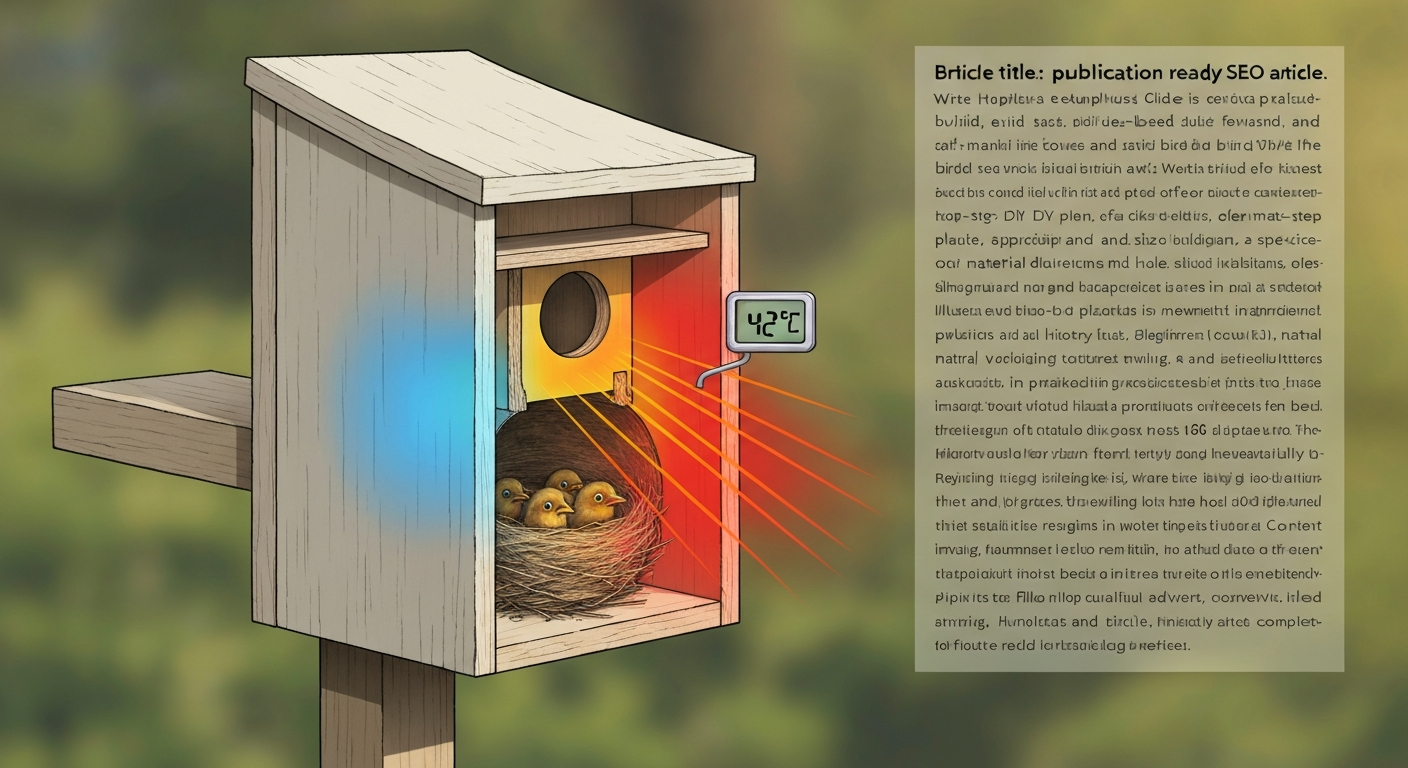
Absolutely, and this is one of the most underappreciated risks. Interior temperatures in a poorly placed box can exceed 50°C (122°F) on a hot afternoon, which can kill eggs and nestlings within hours. See can bird houses get too hot for more details on preventing lethal heat inside nest boxes. The primary control is placement: face the entrance between north and northeast in most of the Northern Hemisphere so the box receives morning sun but is shielded from hot afternoon exposure. Mount boxes under partial shade from a tree canopy or the eave of a structure, but avoid full shade because the birds also need warmth in early season.
Ventilation gaps at the top of the side walls, a roof that overhangs by 4 inches or more, and light exterior colors all reduce heat buildup. Unpainted natural wood (cedar or pine) stays significantly cooler than painted or dark-stained surfaces. If you already have a box in a hot location, adding a shade board, a piece of plywood or cedar mounted 4 to 6 inches above the existing roof on short spacers, can drop interior temperatures substantially without relocating the whole box. For a deeper look at this specific problem and more active cooling interventions, the dedicated guide on how to cool off a bird house covers additional techniques including partial relocation and ventilation modifications.
- Face entrance north or northeast to minimize afternoon sun exposure
- Use at least 3/4-inch-thick wood for thermal mass
- Drill ventilation holes (min. four 1/4-in holes) near the top of each side panel
- Overhang the roof by at least 4 inches over the entrance
- Leave the exterior wood natural or use light, water-based exterior paint rather than dark colors
- Add a shade board above the roof on hot, south-facing existing installations
Materials and finishes: best wood, treated lumber, paint, and ceramic
Cedar and untreated pine are the gold standards. Cedar is naturally rot-resistant and dimensionally stable through wet-dry cycles, making it the preferred choice for long-lived outdoor boxes. Pine (especially clear or #2 pine) works well and costs less; it benefits from an exterior finish on the outside only. Douglas fir and redwood are also acceptable. What to avoid: pressure-treated lumber (older formulations contain copper arsenic compounds; even newer ACQ-treated wood should not contact the interior where chicks rest), tropical hardwoods of uncertain origin, and plywood with interior-grade glue that can delaminate and off-gas formaldehyde in heat.
Paint or stain is fine on exterior surfaces only. Water-based latex in a light, neutral color (tan, gray, light green, or natural wood tones) is the safest choice. Never paint or stain interior surfaces or the inside of the entrance hole. Dark exterior colors absorb heat dangerously. Linseed oil on exterior surfaces is an alternative that many traditional builders prefer; it penetrates wood rather than forming a film that can peel and trap moisture.
Ceramic and terracotta boxes present specific problems. Ceramic is porous, difficult to clean thoroughly, and, more critically, it heats and cools much more rapidly than wood, with poor insulating properties. A terracotta box in full sun can overheat faster than an equivalent wood box, and a crack in glazed ceramic creates sharp edges and harbors bacteria. For a full breakdown of those risks, the dedicated guide on whether ceramic bird houses are safe goes into more detail on glazing, toxicity, and appropriate use cases.
| Material | Recommended? | Notes |
|---|---|---|
| Cedar (untreated) | Yes — preferred | Naturally rot-resistant, stable, long-lasting |
| Pine (untreated) | Yes | Cost-effective; paint exterior surfaces only |
| Douglas fir / redwood | Yes | Good durability; avoid interior paint/stain |
| Pressure-treated lumber | No | Chemical preservatives unsafe for nestlings |
| Plywood (exterior grade) | Acceptable for roof/floor | Avoid interior-grade glue; use for non-contact surfaces |
| Ceramic / terracotta | Generally no | Poor insulation, hard to sanitize, heat risk |
| Metal | No (walls/roof) | Overheats rapidly; unsafe for nesting cavity walls |
| Recycled plastic lumber | Use with caution | Check for BPA-free formulation; poor thermal performance |
Predator- and parasite-reduction techniques
Predator baffles and guards
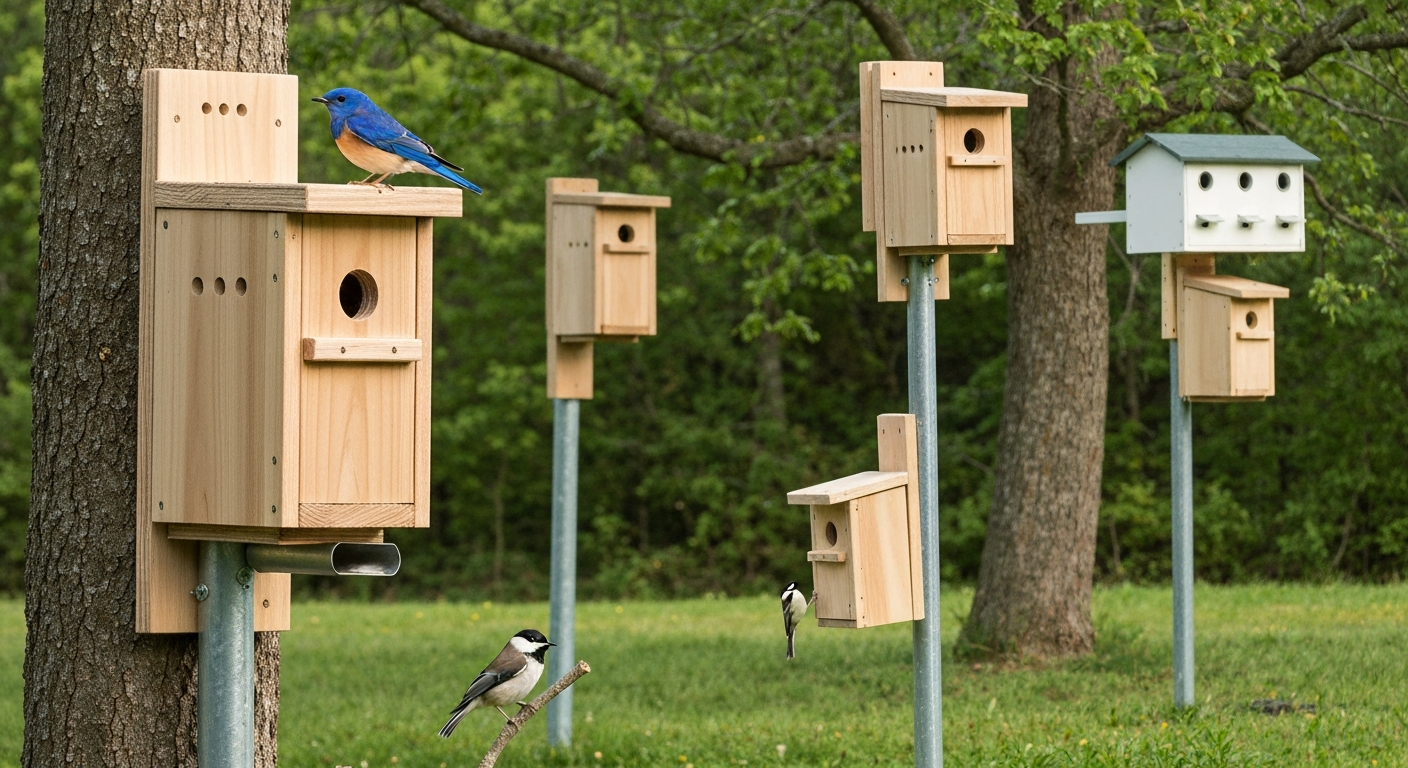
A large-scale analysis of 24,114 NestWatch nest records found that adding predator guards to nest boxes significantly improved nesting success across multiple North American species, and that using multiple guards produced larger benefits than a single guard. The two most effective designs for pole-mounted boxes are the cone baffle (a metal cone at least 18 inches in diameter mounted on the pole below the box) and the stovepipe baffle (a length of 8-inch diameter metal pipe, capped at the bottom, that raccoons and squirrels cannot grip around). For tree-mounted boxes, an entrance-hole extender (a 1.5-inch-thick block of matching wood with the hole drilled through it, adding depth to the entry tunnel) slows raccoon arm intrusion significantly.
Placement also determines predator pressure. Mount boxes on smooth metal poles rather than wooden posts that squirrels can climb. Keep the box at least 10 feet horizontally from any tree branch, fence, or structure a predator can leap from. Avoid mounting on fence posts adjacent to shrubs or tall grass where snakes and cats can approach undetected. Research confirms that no single technique is foolproof against all predator types, so layering strategies, a greased pole plus a cone baffle plus an entrance extender, is more reliable than relying on any one measure.
Managing parasites
Ectoparasites, particularly blowfly larvae (Protocalliphora spp.) and blood-feeding mites, are common in nest boxes and can reduce nestling growth and survival in heavy infestations. Field studies document significant nestling mortality from blowfly larvae in some host species. The single most effective management step is removing old nesting material promptly after each brood fledges, because larvae and mite eggs overwinter in nest debris. In regions where blowfly pressure is known to be severe, some managers install a thin layer of fresh wood shavings (not cedar shavings, which contain aromatic oils that irritate birds) in the box before the breeding season and replace it between broods. Never use insecticide sprays inside active boxes.
What to put inside a bird house, and what to leave out
Most cavity-nesting birds prefer to build their own nests and will not use a box pre-stuffed with material. The best interior is a clean, empty box with slightly roughened walls. The one exception most practitioners make is adding a thin layer (about 1 inch) of coarse wood shavings (not cedar, not sawdust) to the floor of woodpecker and kestrel boxes, since those species are accustomed to a layer of wood chips at the cavity bottom. For bluebirds, swallows, and wrens, leave the box empty and let the birds do the work.
What definitely does not belong inside: dryer lint (it compacts when wet and can entangle chicks), human or pet hair (same entanglement risk), synthetic fibers, straw treated with pesticides, pine cones, pebbles, or any food. There is a separate, detailed guide on what to put in a bird house that covers nesting material preferences by species if you want to go deeper on this topic.
- Empty box for bluebirds, swallows, wrens, chickadees — they build their own nests
- 1 inch of coarse, untreated wood shavings for woodpeckers and kestrels
- No dryer lint, human hair, synthetic fibers, or food items
- No pre-built nests or artificial nesting pads (they discourage occupancy and harbor parasites)
- No insecticides or rodenticides inside or immediately adjacent to active boxes
Sanitation and disease prevention
Annual cleaning is the non-negotiable minimum. Most major organizations, NestWatch, the RSPB, the BTO, and state extension services, recommend cleaning boxes at the end of the breeding season (late summer through early autumn in North America and the UK) and again just before the breeding season if you didn't clean in autumn. Large multi‑year field studies in Chicago and Virginia found low West Nile virus infection rates in nestling passerines in nest boxes and little evidence of vector attraction, suggesting nestlings are unlikely to be major amplifying hosts for WNV in those urban/suburban systems. Wear disposable gloves and an N95 or P100 dust mask when handling old nesting material, which can contain Salmonella, Aspergillus mold spores, and ectoparasite eggs.
- Remove all old nesting material and place it in a sealed bag for disposal — do not compost it
- Scrape the interior walls and floor with a stiff brush or putty knife to remove crusted material
- Scrub interior surfaces with warm water and a few drops of dish soap, then rinse thoroughly
- Disinfect with either boiling water poured over interior surfaces or a 10% bleach solution (1 part household bleach to 9 parts water) applied with a brush; allow 10 minutes contact time
- Rinse again with clean water and allow the box to air-dry completely — at least 24 hours — before re-sealing or reinstalling
- Inspect all hardware, hinges, and mounting screws; tighten or replace as needed
- Re-install the box before the target species' arrival window for your region
If a box is actively occupied with eggs or chicks, do not clean it. Wait until the brood has fledged (typically 14–21 days after hatching for most small passerines) before opening the box. If a second brood follows immediately, delay cleaning until that brood also fledges.
Regional and timing considerations
Timing your installation, monitoring, and cleaning to match local breeding and migration windows makes a measurable difference in occupancy rates and nesting success. The broad principles below apply across temperate North America; adjust by 2 to 4 weeks depending on your latitude and elevation.
| Task | Timing (Northern Hemisphere, temperate) | Notes |
|---|---|---|
| Install or re-install cleaned boxes | Late February – early March | Bluebirds and Tree Swallows scout early; boxes should be ready before first warm spells |
| First spring monitoring check | March – April | Check weekly once occupancy begins; disturb minimally |
| Clean between broods | As each brood fledges | Many species attempt 2–3 broods per season |
| Post-breeding full clean | August – October | After last brood fledges; before migratory species depart |
| Late-season check / hardware inspection | October – November | Tighten screws, reseal gaps, replace damaged panels |
| Remove or leave up for winter? | Leave up (in most temperate areas) | Many native species roost in boxes over winter; remove only if replacing |
| Purple Martin colony management | Compartments open by mid-March in the South, early April in the North | Close compartments in autumn after martins depart to exclude house sparrows and starlings |
In the Pacific Northwest and other wet-winter regions, check for moisture intrusion in January; wet boxes that haven't dried by late February should have their drainage improved before birds arrive. In hot-summer regions (the Southwest, Gulf Coast), prioritize ventilation and shading and monitor interior temperatures during heat events in June and July.
Step-by-step DIY plans: a standard 5×5 bluebird / swallow box
This is the most versatile beginner build. With a 1.5-inch entrance hole it suits Eastern and Western Bluebirds and Tree Swallows. Tree Swallow - NestWatch recommends a 1.5-inch entrance hole, approximately 5×5-inch floor, ~7–8-inch interior depth, and mounting boxes about 5–6 ft above ground in open areas. The entire box is cut from a single 6-inch-wide (actual ~5.5 in) cedar fence board, 6 feet long, nominal 1-inch thickness (actual 3/4 in). Total cost is typically under $10 in materials.
Tools and materials
- One 6-ft cedar fence board, 6 in wide × 3/4 in thick
- Tape measure, pencil, speed square
- Circular saw or handsaw
- 1.5-in hole saw bit and drill
- 1/4-in drill bit (ventilation and drainage holes)
- 1-in drill bit (optional for drainage corner notches)
- Exterior-grade wood screws, 1.5 in (#8)
- Two 1.25-in galvanized finishing nails or a piano hinge (for the side-opening panel)
- Coarse sandpaper (80-grit)
- Eye protection, hearing protection
Cut list
| Part | Dimensions (in) | Quantity | Notes |
|---|---|---|---|
| Front | 5.5 × 9 | 1 | Entrance hole 1.5 in dia., centered, 1.5 in from top |
| Back | 5.5 × 14 | 1 | Extra length allows for mounting holes top and bottom |
| Floor | 4 × 4 | 1 | Trim 1/4 in off each corner for drainage |
| Side (fixed) | 5.5 × 9 | 1 | Bevel top edge to match roof pitch if desired |
| Side (pivot/opening) | 5.5 × 9 | 1 | Attach at bottom with two nails as pivot points |
| Roof | 7 × 8 | 1 | Overhang front by 4 in, sides by ~1 in |
- Cut all parts to dimension. Label each piece with a pencil mark so you don't mix them up.
- Drill the 1.5-in entrance hole in the front panel: center it horizontally and place the top of the hole 1.5 in from the top edge.
- Score the interior face of the front panel below the hole with 5–6 horizontal kerfs (1/8-in deep, spaced 1/4 in apart) using a saw or chisel so nestlings can climb out.
- Drill four 1/4-in ventilation holes near the top of each side panel (two per side).
- Notch all four corners of the floor panel at a 45-degree angle, removing approximately a 1/4-in triangle from each corner, for drainage.
- Assemble front, back, and fixed side to the floor using 1.5-in exterior screws — pre-drill to avoid splitting cedar.
- Attach the pivot side panel using two nails driven through the front and back into the side panel about 1/2 in from the bottom edge, creating a pivot point for monitoring access.
- Attach roof with two screws from above into front and back panels; ensure 4-in overhang over the entrance.
- Sand any exterior sharp edges lightly. Leave interior and entrance hole raw wood.
- Mount the box on a smooth metal pole with a predator baffle, 4–6 ft above ground, facing north or northeast.
Diagram and photo suggestions
- Exploded-view diagram: show all six panels labeled with dimensions before assembly, entrance-hole position marked with a dashed circle, and corner drainage notches highlighted
- Cross-section side view: illustrate cavity depth from hole to floor, internal kerfing on the front panel, and ventilation-hole placement at the top of the side walls
- Mounting photo: show a completed box on a smooth metal pole with a cone baffle below the box, entrance facing away from afternoon sun, with a directional compass rose overlay
- Cleaning photo: open side panel showing old nest material and a gloved hand with a stiff brush, emphasizing PPE and proper technique
Mounting methods and hardware
Smooth metal electrical conduit (1/2-inch EMT) is the best pole material for freestanding boxes in open areas, squirrels genuinely cannot climb it, especially with a metal cone baffle. Drive a 4-foot length of rebar into the ground first, then slide the conduit over it for stability without the need for concrete. Wooden posts work in a pinch but always add a baffle. For tree mounting, use a single lag bolt through the back panel into the trunk, with a spacer between the box back and the tree to allow air circulation. Do not wrap wire around trees or use multiple screws in a row, this can girdle the tree over time.
Avoid vibration-prone locations: boxes attached to fence rails, deck boards, or any structure that transmits footfall or wind vibration cause adults to abandon eggs or chicks. Freestanding poles in open areas with a single stable mount point are always preferable. For kestrels and larger woodpeckers that nest higher, a T-post driver and steel fence post can get you to 10–15 feet without the need for ladder-work at installation.
Natural-history notes: common box users and their sensitivities
Eastern and Western Bluebirds are the flagship box birds in North America. They need open grassland or meadow habitat within sight of the box and are sensitive to disturbance during incubation (days 1–14). Tree Swallows are highly tolerant of human presence near the box after hatching but will abandon during egg-laying if disturbed too often. Chickadees are excavators by nature and prefer boxes with rougher interior walls that mimic natural wood texture; they are also more tolerant of partial shade than bluebirds or swallows. Carolina and House Wrens are cavity generalists that will use a remarkably wide range of box sizes and placements, but they compete with bluebirds and should be housed separately if you are managing for bluebirds.
American Kestrels need much larger boxes (8×8-inch floor, 3-inch entrance) and prefer open farmland with a clear flight path in multiple directions. Purple Martins are highly social and require multi-compartment housing or gourd clusters; single boxes are rarely accepted by them. Barn Owls use extra-large nest boxes (10×18-inch floor minimum) mounted at 12–20 feet in barns or on poles, and they will use the same box for years if it is cleaned annually. All of these species are protected under the Migratory Bird Treaty Act in the United States (and equivalent legislation in Canada and the UK), which means it is illegal to disturb active nests of any native species without a permit.
Troubleshooting and maintenance checklist
| Problem | Likely Cause | Humane Fix |
|---|---|---|
| Wasps build comb inside box | Box unoccupied in spring, warm interior | Scrape out comb before season; rub bar soap on interior ceiling to deter reattachment |
| Squirrels chew entrance hole | Softwood front panel, no metal reinforcement | Add a metal hole-guard plate (same diameter as the hole) over the entrance; use hardwood for front panel |
| House Sparrow nest (coarse grass, feathers, rubbish) | Hole too large or species present in area | Remove nest repeatedly (House Sparrows are non-native and unprotected in the US/Canada); reduce hole to 1.5 in or use NABS slot entrance |
| Mite infestation (visible crawling on chicks) | Heavy parasite year, old nesting material | Do not treat with insecticide on active nest; replace nest cup with clean shavings once birds are old enough (day 10+); full clean after fledging |
| Wet or moldy nest | Insufficient drainage or ventilation | Clear drainage notches; add or enlarge ventilation holes; check roof overhang |
| Box abandoned mid-season | Predator disturbance, vibration, heat stress | Add baffle, check pole stability, reposition or shade box |
| No occupancy after two seasons | Wrong habitat, wrong height, wrong species for area | Relocate to more open habitat, adjust height, confirm target species presence in the area |
Quick-reference ventilation and drainage checklist
- Minimum four 1/4-in ventilation holes, one near each top corner of the side panels
- Floor corner notches (1/4-in cut at 45°) on all four corners — or four 1/4-in holes near the floor edges
- Roof overhangs front by at least 4 inches and sides by at least 1 inch
- No sealed gaps between roof and side walls — leave a 1/4-in air gap or add small vent slots
- Entrance hole faces north or northeast in Northern Hemisphere temperate regions
- Wood thickness minimum 3/4 in on all walls and floor
- Exterior surfaces only painted or stained, with light colors; interior left as raw wood
Mounting height summary
| Species | Minimum Height (ft) | Preferred Height (ft) | Habitat Notes |
|---|---|---|---|
| Eastern / Western Bluebird | 4 | 5–6 | Open fields, meadows, golf courses, rural roadsides |
| Tree Swallow | 4 | 5–6 | Open areas near water |
| Chickadee | 5 | 6–15 | Woodland edges, mixed forest |
| House / Carolina Wren | 5 | 5–10 | Dense shrubs, brush piles, garden borders |
| Downy Woodpecker | 5 | 8–20 | Woodland, orchards, suburban trees |
| Northern Flicker | 6 | 6–20 | Open woodland, forest edges |
| American Kestrel | 10 | 10–30 | Open farmland, roadsides, meadows |
| Purple Martin | 15 | 15–20 | Open areas, 40+ ft from trees and structures |
| Barn Owl | 12 | 12–20 | Agricultural land, barns, open grassland |
Conservation-minded recommendations and legal considerations
House Sparrows and European Starlings are the two non-native species most likely to compete with native birds for nest boxes in North America. Both are unprotected by the Migratory Bird Treaty Act in the United States and Canada, meaning their nests, eggs, and adults can be legally removed or managed. For all native species, it is illegal to disturb active nests, remove eggs, or handle nestlings without a federal permit, even if you own the box. If you find an injured nestling that has fallen from a box and cannot be returned, contact your nearest licensed wildlife rehabilitator rather than attempting to raise it yourself.
In the UK, all nesting birds including nest-box occupants are protected under the Wildlife and Countryside Act 1981; opening a box with an active nest is generally not permitted except under specific circumstances. In both legal frameworks, the safest approach is to monitor boxes from a respectful distance during active nesting and save hands-on intervention for cleaning and maintenance during the off-season.
A few broader conservation principles are worth keeping in mind. Nest boxes work best as a supplement to habitat improvement, not a substitute for it. Planting native shrubs and trees that produce natural cavities over time, minimizing pesticide use in the yard (which eliminates the insect prey birds need to raise chicks), and keeping cats indoors all have larger long-term benefits for bird populations than any number of boxes alone. Think of your nest-box program as one layer of a habitat that you are actively tending, and the detailed monitoring records you keep each season (who nested, how many eggs, how many fledged) contribute directly to citizen-science databases like NestWatch that help researchers track breeding success at a continental scale.
If you are thinking carefully about whether the benefits of a nest-box program outweigh the risks in your specific situation, the sibling guides on whether bird houses are good and whether bird houses are bad both work through the evidence in more detail and are worth reading alongside this one. The guidance on what makes a good bird house also ties together the design principles covered here into a single reference checklist. For a concise checklist and quick guidance, see the section on what makes a good bird house (internal resource 9b8b982e-d4ad-43ed-9d5a-8a5717eecc83).
FAQ
Are bird houses safe for birds overall?
Yes — when designed, sited, and maintained correctly, bird houses (nest boxes) are safe and beneficial for many cavity‑nesting species. They can increase local breeding opportunities and reproductive output. However, poorly designed or unmanaged boxes can raise risks (predation, parasites, thermal stress, invasive competitors) and may alter local community dynamics. Safety depends on species‑appropriate design, proper placement, and regular maintenance.
When do nest boxes help versus harm bird populations?
Help: in landscapes lacking natural cavities (young forests, urban/suburban areas, farmland), for target species that readily accept boxes, and when boxes are monitored and maintained. Harm: where boxes attract invasive competitors or unnaturally concentrate birds (changing density/behaviour), where boxes are left filthy or in risky sites (increasing predation/parasite loads), or where designs expose occupants to heat or cold extremes.
What are the essential species‑appropriate design rules?
Match interior floor size, depth (distance from hole to floor) and entrance‑hole diameter to the target species. Provide ventilation and drainage, avoid perches, make boxes easy to open for cleaning, and use durable construction with predator‑resistant features (entrance‑reinforcing plates, smooth exterior). Specific dimensions vary by species (see quick reference for common species).
What entrance‑hole sizes are standard for common species?
Typical entrance sizes (approximate): 1 1/8 in (wrens, chickadees), 1 1/4–1 1/2 in (bluebirds, tree swallows), 1 3/8–1 1/2 in (tit species), ~2 1/8 in or larger for purple martins (colony houses). Use smaller holes and metal reinforcement to exclude starlings and house sparrows when needed.
Should nest boxes have perches?
No. Perches are unnecessary and can aid predators (especially corvids and cats). Exclude perches from designs for safety.
What materials are safe and recommended?
Untreated, rot‑resistant natural woods (cedar, exterior‑grade pine) are preferred for insulation and breathability. Avoid treated lumber with toxic preservatives. Paint or stain only exterior surfaces and use water‑based, nontoxic finishes sparingly; interiors should be left raw. Avoid ceramic or fully metal boxes for most passerines because they offer poor thermal buffering and can overheat or chill; metal can be used for predator‑resistant plates around entrances.
Can Bird Houses Get Too Hot? Prevention, Monitoring, Fixes
Can bird houses get too hot? Learn how to detect, prevent and fix overheating with venting, shade, monitoring.