Most cavity-nesting birds are territorial enough that putting two houses less than 25 to 30 feet apart will cause real problems, from outright fighting to one box sitting empty all season. The safe spacing depends almost entirely on the species you are targeting. Colonial nesters like Purple Martins are the big exception and actually prefer houses clustered close together, while solitary nesters like Tree Swallows need at least 100 feet between boxes. Get the spacing right and you can run multiple houses in even a modest backyard. Get it wrong and you will get a lot of aggression and very few fledglings.
How Close Can You Put Bird Houses Together Safely

Maya Thompson
9 Jun 2026
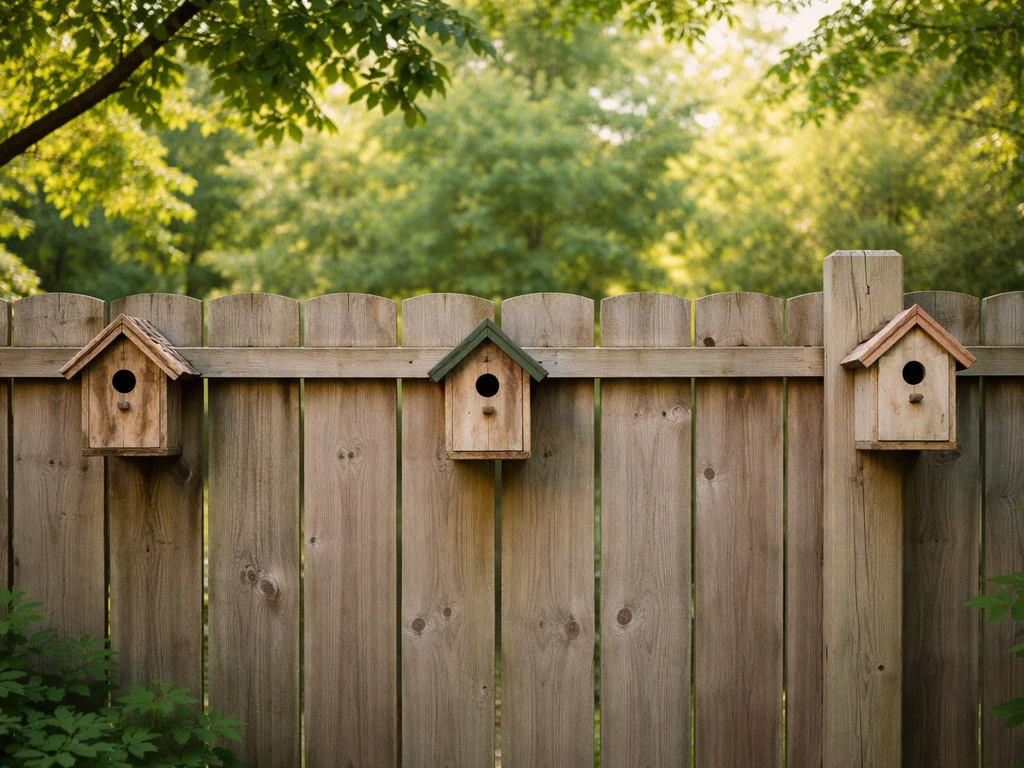
How birds respond to multiple houses nearby
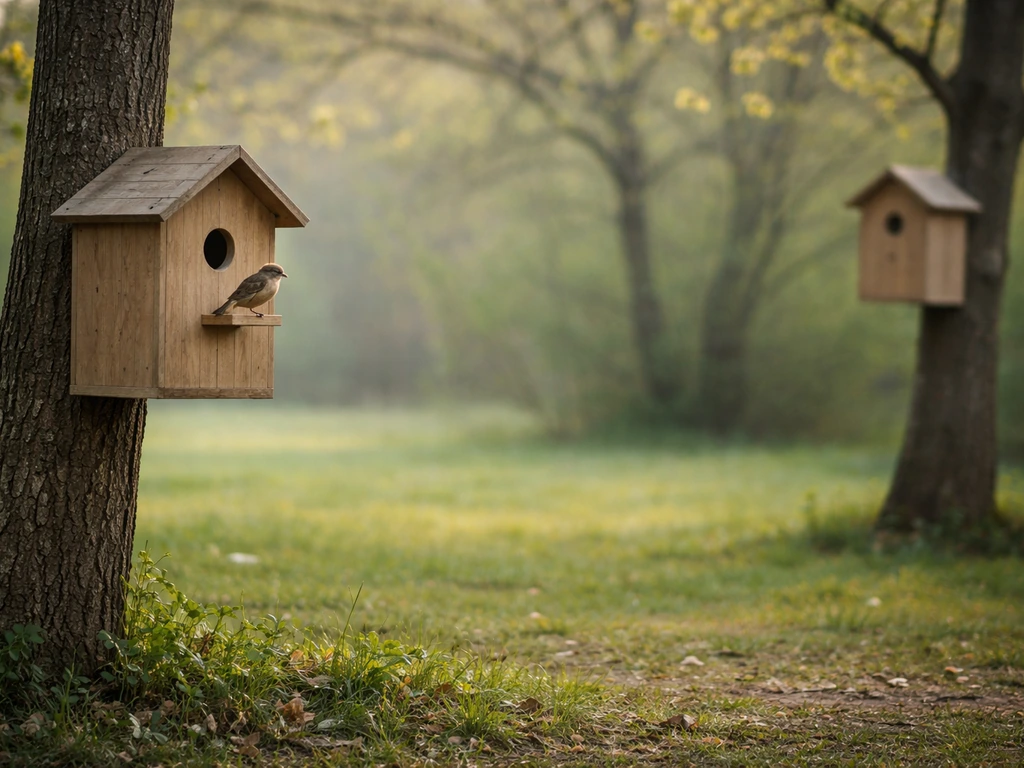
When a male cavity nester scouts your yard in early spring, he is not just looking for a hole to stuff some grass into. He is claiming a territory, and that territory includes a buffer zone around the nest site. If another bird of the same species sets up inside that buffer, one of three things happens: the resident male spends most of his energy fighting instead of feeding his mate, the subordinate pair abandons the site entirely, or a dominant bird monopolizes both boxes and uses one to store nesting material while blocking the other. None of these outcomes help your nesting success rate.
Different species draw that buffer at wildly different distances. Some, like House Wrens, defend territories that cover an entire backyard and part of the neighbor's. Others, like Purple Martins, evolved to nest in colonies and are stressed by isolation. Understanding which camp your target species falls into is the single most important thing you can do before hammering a post into the ground.
Distance guidelines for placing bird houses close together
These are the practical minimums. Going further than these distances never hurts. Going shorter almost always does.
| Species | Minimum spacing between boxes | Notes |
|---|---|---|
| Tree Swallow | 100 feet (30 m) | Tennessee Wildlife Resources Agency recommendation; pairs are aggressive toward conspecifics |
| Bluebird (Eastern, Western, Mountain) | 100–150 feet (30–45 m) | Often paired with one Tree Swallow box as a 'bluebird pair'; 100 ft between the two |
| Chickadee / Titmouse | 200–300 feet (60–90 m) | Strongly territorial; rarely tolerate same-species neighbor at shorter range |
| House Wren | 200+ feet (60+ m) | Males will pierce eggs in competing boxes; give maximum distance possible |
| Downy / Hairy Woodpecker | 150–200 feet (45–60 m) | Excavators by instinct; often reject pre-made boxes near each other |
| Purple Martin | 0–6 feet between gourds/rooms | Colonial nester; multi-room houses and gourd racks are the standard approach |
| Barn Swallow | 6–10 feet between nest cups | Semi-colonial; tolerates close neighbors but needs visual separation of sites |
One widely used strategy for bluebirds is the 'bluebird trail pair': mount one bluebird box and one Tree Swallow box about 15 to 25 feet apart. The two species do not meaningfully compete because they eat differently and have slightly different hole-size preferences, so they coexist at close range. This is one of the few cases where two solitary nesters can share a tight space, and it works specifically because they are different species. Same-species pairings at that distance will almost always fail.
Species-specific spacing by entrance size and territory behavior
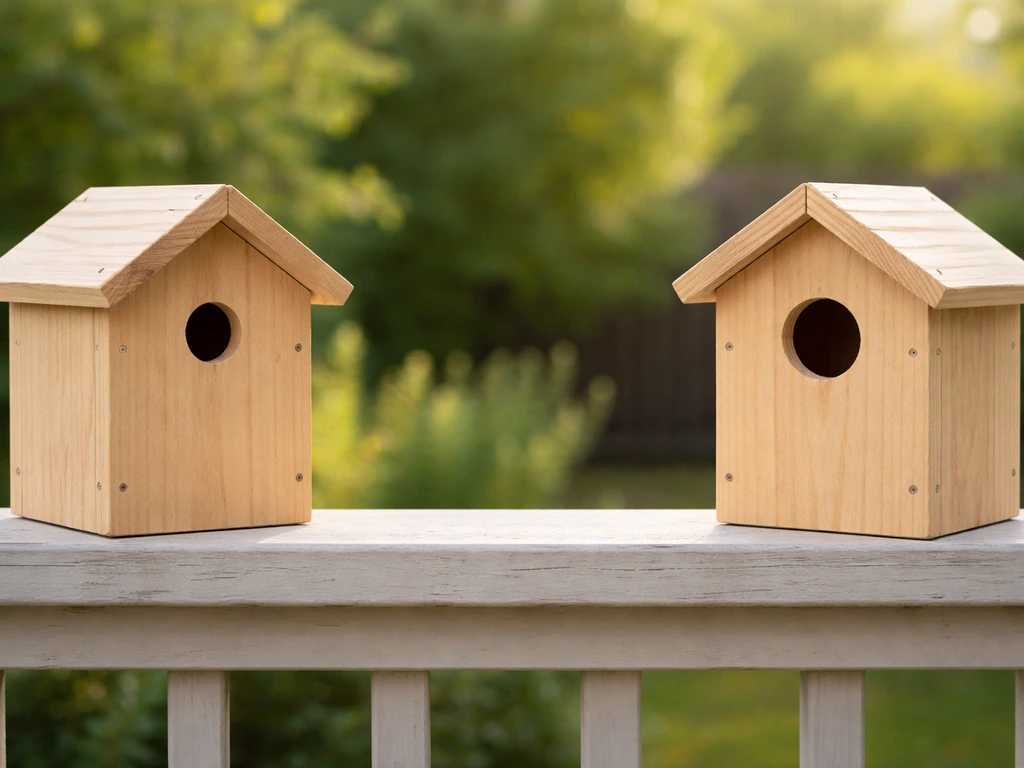
Entrance hole size is more than a dimension for keeping predators out. Bird houses have small holes because the entrance size and hole location help select for the right cavity-nesting species and improve safety for eggs and nestlings why bird houses have small holes. It is the primary filter that determines which species even considers your box. [A 1-1/8 inch hole is designed for chickadees](https://scvbirdalliance.
org/backyard-nest-boxes), but if you install two of those boxes 50 feet apart, one chickadee pair will spend the whole season chasing the other away instead of raising chicks. For chickadees, use the entrance hole size they prefer, and then plan spacing based on their territory needs chickadee entrance hole size. A 1-1/2 inch hole opens the box to Tree Swallows and bluebirds; a 2-1/8 inch hole invites starlings if you are not careful.
Matching the hole to the target species and then spacing for that species' territory size is the complete formula. Matching the hole to the target species and then spacing for that species' territory size is the complete formula, and you also want to make sure how big should a bird house be for that species before you finalize placement. blank" rel="noopener noreferrer">A study of tree swallows used nest boxes placed in grids with distances of 1, 2, 4, 8, and 16 meters from a central box to determine preferred spacing Tree Swallow spacing for that species' territory size.
Chickadees and titmice are worth calling out specifically. They are extremely site-faithful, meaning a pair that nests in your yard one year will return to the same box next spring. They are also aggressive enough that a second box for the same species within 200 feet will almost certainly stay empty. If you want two chickadee boxes producing chicks, you need the width of a generous yard between them, ideally with a fence line, shrub row, or structure creating a visual break.
House Wrens are a special case. Males are notorious for filling every nearby cavity with sticks to prevent competition, and they will puncture eggs in bluebird and swallow boxes within their territory. If you have House Wrens in your yard, keep all other songbird boxes at least 200 feet from wooded or brushy edges where wrens set up. This is less about box-to-box distance and more about habitat placement, but it is the same territorial logic at work.
Layout tips: orientation, staggered heights, and spacing from feeders and trees
Orientation and facing direction
Face the entrance hole away from the prevailing wind direction for your region. In most of North America that means orienting the hole toward the east or southeast. This keeps rain from blowing in and gives the nestlings morning sun without baking them in afternoon heat. If you are placing two boxes within sight of each other, angle them so neither entrance faces the other directly. Birds are less likely to feel threatened by a neighbor they cannot see head-on.
Staggered heights
Mounting boxes at different heights does reduce some visual competition, but do not use height variation as a substitute for proper horizontal spacing. A bluebird box at 5 feet and another at 8 feet that are only 30 feet apart will still generate territorial conflict. Staggering heights is a useful secondary tool, not a primary spacing strategy. The practical benefit of varied heights is that it lets you match each box to the species' preference: bluebirds typically do well at 4 to 6 feet, Tree Swallows at 5 to 8 feet, and woodpeckers at 10 to 20 feet.
Distance from feeders and trees
Keep nest boxes at least 10 to 15 feet from your bird feeders. Feeders attract a constant stream of House Sparrows, starlings, and squirrels, all of which stress nesting birds or directly threaten eggs and nestlings. Open-country nesters like bluebirds and Tree Swallows actually prefer boxes positioned in the open, 50 to 100 feet from the nearest tree line. Woodland species like chickadees want the opposite: a box near the forest edge with canopy cover within 10 to 15 feet. If your yard is mostly lawn, an open-country species will do far better than a woodland one, regardless of how carefully you space the boxes.
Common mistakes and signs of conflict or poor use
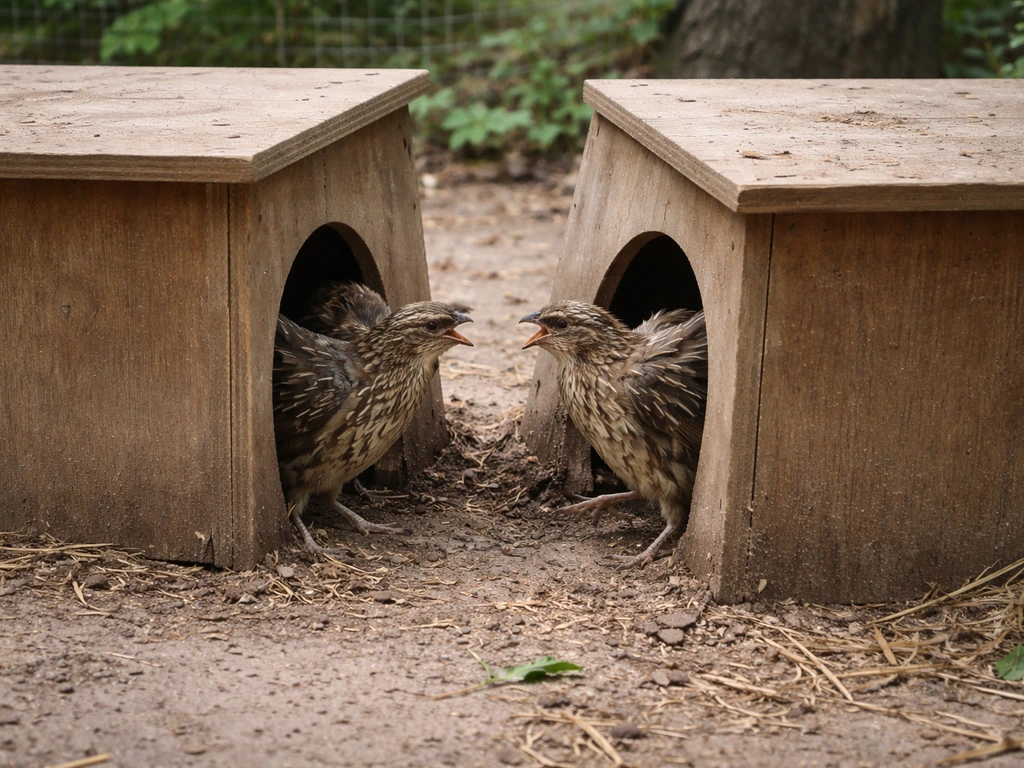
The most common mistake is simply placing boxes too close together because they looked good on a fence post. The second most common is putting multiple boxes of the same species in a small yard without accounting for territorial overlap. Here is what to watch for once your boxes are up:
- Persistent chasing near or between boxes: two males of the same species fighting repeatedly is a clear sign the spacing is too tight
- One box always empty: if the same box sits unused season after season while the adjacent one succeeds, the occupied territory is likely covering both sites
- Nest building started then abandoned: a half-built nest that gets suddenly deserted often means a competitor moved in nearby and stressed the pair into leaving
- Sticks stuffed in the entrance of an inactive box: classic House Wren behavior; the male is 'dummy nesting' to block competitors
- Eggs or nestlings found dead at the entrance: House Sparrows and House Wrens will kill nestlings; this is a predator/competition problem, not a spacing issue alone, but overcrowded boxes make it worse
- One pair spending more time at the perch of the neighboring box than their own: territorial surveillance that cuts into foraging time and reduces feeding rates for chicks
If you observe persistent aggression, the simplest fix is to remove the less-used box for the remainder of the season and relocate it before next spring. Moving a box mid-season rarely solves the problem because territories are already established. Plan the correction for the off-season.
Practical next steps: planning your setup today
Before you buy a second box or grab the post digger, spend ten minutes walking your yard and doing a quick audit. Here is a simple process to get it right the first time:
- Identify the species you realistically expect: look at your habitat type (open lawn, woodland edge, mixed), then match species to that habitat before worrying about spacing
- Measure your usable space: if you have less than 100 feet of open area, plan for one box of any solitary nesting species, or consider a multi-room Purple Martin house if your yard is open and near water
- Mark out minimum spacing on the ground: use a tape measure or pacing (roughly 2.5 feet per step) to mark where a second box could go without violating the minimums in the table above
- Choose posts over trees where possible: freestanding posts let you add a baffle to stop predators and let you relocate the box next season if needed
- Point entrances in different directions: if two boxes are within visual range of each other, angle the entrances at least 90 degrees apart
- Install baffles on every post before nesting season: a smooth metal cylinder or cone baffle at 4 to 5 feet stops raccoons and snakes and is more important than any spacing adjustment
- Schedule a mid-season check: open each box at the 2-week and 4-week mark to check for House Sparrow nests (remove them immediately), parasites, or signs of abandonment
- Clean boxes every fall: remove old nesting material, scrub with a 10 percent bleach solution, rinse, and let dry completely before the next season
If you are working with a small suburban yard and want to attract more than one nesting pair, the most practical approach is to target two different species with different hole sizes and different habitat preferences. A bluebird box in the open part of your yard paired with a chickadee box near the shrubby edge gives each species its own territory without overlap.
That combination works far better than two identical boxes of the same species crammed into the same lawn. How many boxes your yard can actually support depends on its size and structure, which is worth thinking through carefully before you commit to a full installation. If you are wondering how many bird houses you should have, start by choosing your target species and then scale the number up only as your yard size and layout allow.
How much does a bird house cost depends on the material, size, and whether you buy ready-made or build it yourself. A good starting point for sizing a bird house is to match the dimensions to the species you want to attract how big should a bird house be.
FAQ
How close can you put bird houses together if the boxes are for different species but you still see them fighting over the entrance area?
Even with different hole sizes, some species will defend territory based on nest-site location and line-of-sight. If you observe repeated chase behavior near one box, increase the horizontal spacing, and also change orientation so neither entrance points directly at the other. If aggression continues for the same species, remove one box for the rest of the season rather than waiting it out.
What spacing should I use if I am not sure which species will move in first?
Use the largest practical spacing for cavity nesters in your yard (at least 30 to 50 feet if you are aiming for multiple pairs of similar-sized cavity birds), then choose entrance hole sizes that target only one or two likely species. The safest strategy in uncertainty is to avoid same-species clustering, since same-species overlap is the most common reason boxes end up empty.
Does bird house spacing work the same way if the boxes face each other versus being perpendicular?
No. Boxes facing each other can increase perceived threat because birds can see the rival entrance head-on. When two boxes are within sight, angle them so the entrances do not face directly toward each other, and consider placing them on opposite sides of a shrub line or fence to reduce direct visual contact.
Can I put two bird houses closer together if I mount them at very different heights?
Not reliably. Height variation can reduce visual competition, but it does not eliminate territorial overlap. If the boxes are within the horizontal distance where the species defends a buffer zone, you can still get one box blocked or left empty. Treat horizontal spacing as the primary rule, height as a secondary tool.
How do I handle spacing when my yard is small and I want more than one pair of the same bird?
For same-species pairs, the practical fix is to rely on yard-wide separation (often far more than 25 to 30 feet) and to add visual breaks like fences, dense shrubs, or a structure that interrupts sight lines. If your yard cannot provide that separation, switch to two different species with different habitat preferences rather than forcing two identical boxes close together.
If one box stays empty, should I assume the spacing was fine and just wait longer?
Often, an empty box means the territory dispute is decided early. Because territories get established in spring, waiting rarely changes the outcome. If you see aggression around one box, plan to remove the less-used box after the breeding attempt and relocate it for the next season.
Is it okay to place a bird house near a feeder if the bird is away from the entrance?
Usually no. Feeders create a constant stream of aggressive nest-site competitors like House Sparrows and starlings, and they can disrupt nesting even if the nest entrance is not directly beside the feeder. Keep nest boxes at least 10 to 15 feet from feeders, and if your yard is small, prioritize the nest box distance over adding extra boxes.
How does habitat placement affect how close you can put bird houses together?
Habitat placement can matter as much as box-to-box distance. For example, House Wren activity often concentrates near brushy or wooded edges, and wrens can target nearby cavities even if the boxes are farther apart in open lawn. If your yard has both lawn and edge habitat, keep other species boxes away from wren-favored edge areas.
Do cloudy or rainy regions change how you should orient entrances when boxes are close together?
Orientation still matters. A wind-driven rain pattern can increase wetting of eggs and nestlings, and it can also amplify perceived competition if entrances face prevailing weather and predators at the same time. Aim entrances away from prevailing rain wind, and when boxes are close, orient them so neither entrance points directly at the other.
What should I do about a box that gets claimed by a dominant pair and blocks another box?
If you see one box being used to store nesting material while another remains inactive, it is a sign the species is monopolizing territories. The most effective adjustment is off-season planning: remove the blocked box, reposition it farther away, or swap it to a different species with a different habitat preference and entrance requirement.
Next Article
How Big Should a Bird House Be? Species Size Guide
Species-specific birdhouse sizes, entrance hole diameters, and mounting guidance for safe, successful nesting.