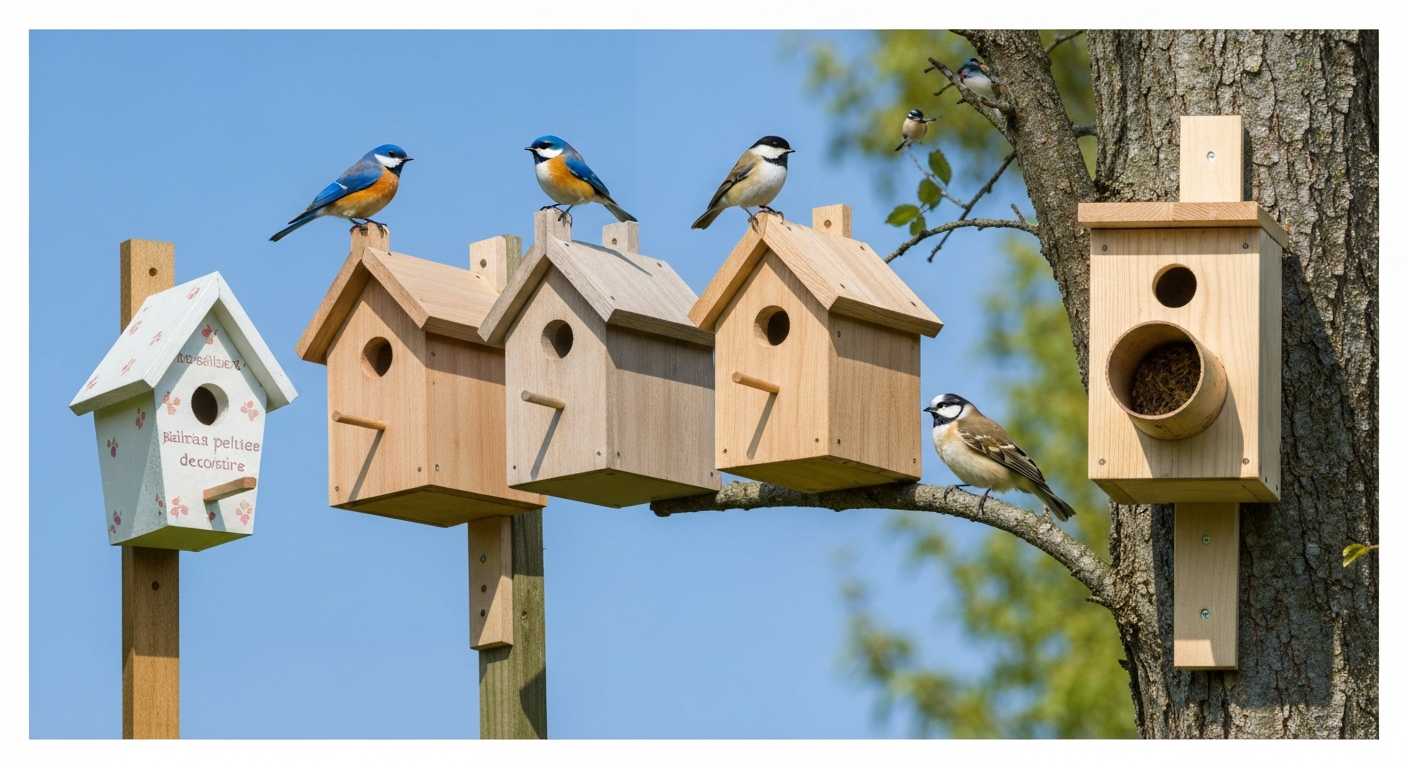
For most cavity-nesting backyard birds, keep nest boxes at least 300 feet apart when housing the same species. That number comes from Cornell Lab's NestWatch program, and it reflects real territorial behavior: bluebirds, for example, need roughly 300 feet between boxes, chickadees need around 650 feet, and white-breasted nuthatches can require up to 1,040 feet. If you have a small yard, that does not mean you are stuck with one box. You can house different species much closer together, and colonial nesters like Purple Martins actually prefer tight clusters. This guide walks you through the exact numbers, explains the biology behind them, and shows you how to mount, predator-proof, and maintain your boxes for the best possible nesting results.
How Far Apart Should Bird Houses Be Placed: Spacing Guide

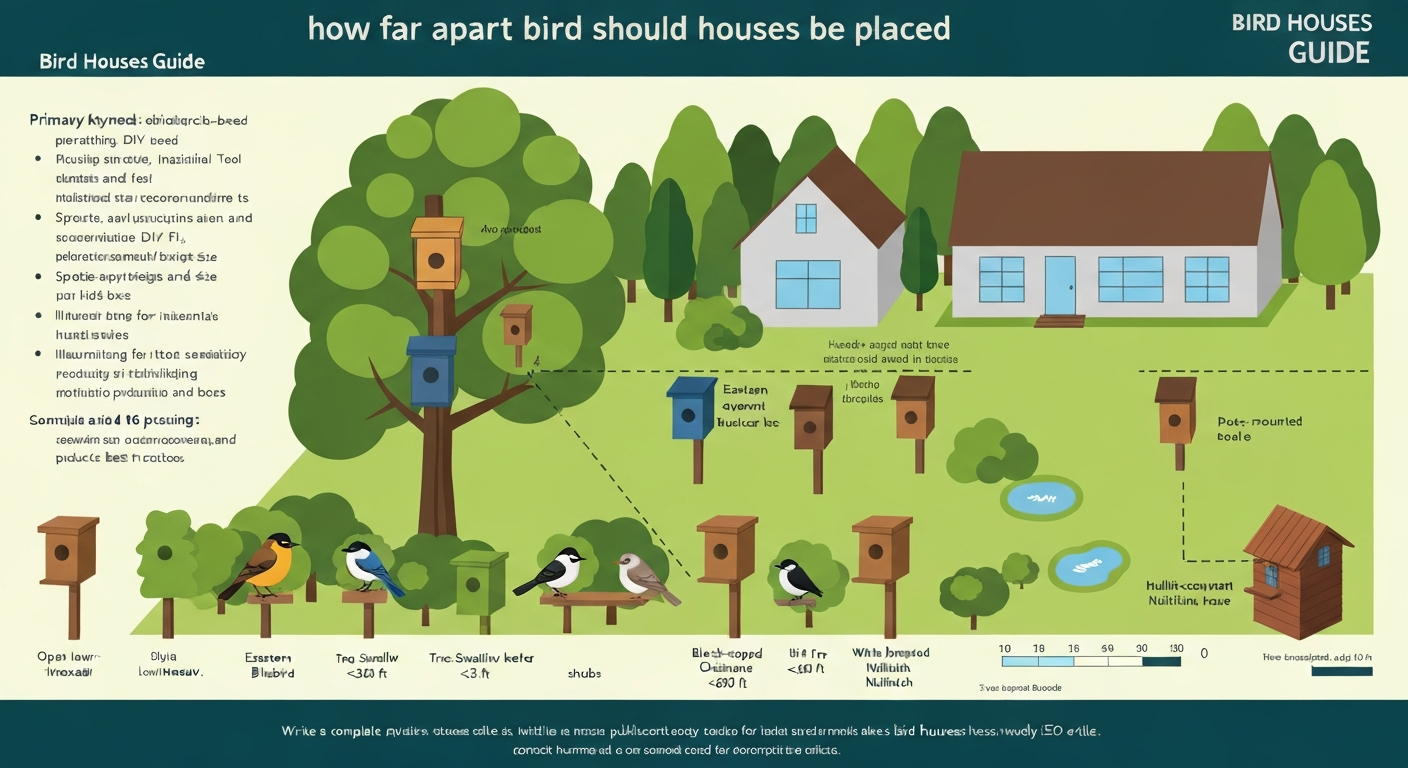
At a Glance: Minimum, Typical, and Maximum Spacing
Spacing recommendations span a wide range depending on species, yard size, and whether you are housing the same or different species. Here is a practical summary to orient you before diving into the details.
| Scenario | Minimum Spacing | Typical Spacing | Notes |
|---|---|---|---|
| Same species (most cavity nesters) | 100 ft | 300–650 ft | Prevents territory overlap and direct competition |
| Bluebird box pair (bluebird + tree swallow) | 15–20 ft | 15–20 ft | Interspecific pairing tactic to reduce conflict |
| Tree swallow clusters | 35 ft | 35–50 ft | Tree swallows tolerate closer spacing than most |
| House wren vs. other species | 100 ft | 100–150 ft | Wrens destroy nearby nests of other species |
| White-breasted nuthatch | 1,000 ft | 1,040 ft | Largest territory of common backyard cavity nesters |
| Purple Martin colony | Compartments are adjacent | 60–100 ft from tall trees | Colonial nester; space colony from obstructions, not from other compartments |
| Different species (non-competing) | 15–30 ft | Varies by species combo | Check for aggressive interactions before committing |
Why Spacing Matters: Territory, Competition, Predation, and Disease
Birds that use nest boxes are almost all obligate cavity nesters, meaning they cannot build their own cavities from scratch. Natural cavities are scarce, so competition for them is fierce. When you install two boxes for the same species too close together, you are essentially placing two resource hotspots inside one bird's defended territory. The resident pair will spend energy chasing the intruders instead of raising chicks, and one or both nests will likely fail.
The predation angle is less obvious but equally important. High nest-box density concentrates scent, activity, and adult bird visits in a small area, which can cue predators like raccoons, snakes, and house cats to patrol that zone. A 2017 Wildlife Society Bulletin analysis by Bailey and Bonter found that installing predator guards raised nest success by a mean of 6.7 percent across species, and that multiple guards performed better than a single one. Overly dense installations without guards essentially create a smorgasbord for local predators.
Disease and parasite load are the third factor. Old nesting material harbors mites, blowfly larvae, and bacteria. When boxes are packed closely and not cleaned between broods, parasites can spread from box to box. Research reviews on artificial nest box effects have documented that high box densities can lower fledging rates through exactly this kind of density-dependent parasite buildup. Proper spacing combined with regular cleaning breaks the cycle.
Finally, interspecific aggression is real and destructive. House Wrens are a notorious example: they will puncture the eggs and destroy the nests of other species in boxes within about 100 feet of their own territory. Keeping wren boxes at least 100 feet from bluebird or swallow boxes is not a suggestion, it is a genuine safety measure for those other nests.
Species-Specific Spacing and Nesting Behavior
Each species has a different territory size, tolerance for neighbors, and sensitivity to nearby activity. Here is how the most common backyard box nesters compare, based on NestWatch and USDA wildlife habitat guidance.
Eastern Bluebird
Bluebirds defend a roughly 2-acre territory around the nest site. NestWatch recommends spacing bluebird boxes at least 300 feet apart on an established trail. The well-known exception is the pairing tactic: place one bluebird box and one tree swallow box just 15 to 20 feet apart. Because the two species are not direct competitors for the same nest, they tend to tolerate each other as neighbors, and the tree swallow actually drives off other bluebirds that might try to claim the second box. It is an elegant way to get both species nesting in the same yard.
Tree Swallow
Tree swallows are unusual among cavity nesters in that they tolerate relatively close box spacing, down to about 35 feet between boxes. NestWatch recommends about 35 feet between tree swallow boxes and suggests pole-mounted boxes 5–6 ft high facing south or east (Tree Swallow - NestWatch (Cornell Lab of Ornithology)). This matches their natural behavior of nesting in loose colonies near water. NestWatch recommends pole-mounted boxes 5 to 6 feet high, ideally facing south or east. If you are running a trail primarily for bluebirds, alternating bluebird and tree swallow boxes at roughly 35-foot intervals along the trail is a widely used and effective strategy.
House Wren
House Wrens are small, energetic, and aggressively territorial. Keep wren boxes at least 100 feet from boxes intended for bluebirds, swallows, or chickadees. NestWatch suggests mounting wren boxes 5 to 10 feet high near the edge of brushy habitat or shrubs. NestWatch advises mounting wren boxes about 5–10 ft high near brush and keeping them roughly 100 ft from bluebird or swallow boxes, House Wren - NestWatch (Cornell Lab of Ornithology). If you install a wren box closer than 100 feet to a bluebird box, expect egg destruction.
Black-capped Chickadee
Chickadees hold large territories relative to their size. NestWatch recommends spacing chickadee boxes about 650 feet apart. They prefer boxes mounted 5 to 15 feet high in or near woodland edges, and they strongly prefer boxes filled partway with wood shavings (not sawdust) to mimic a freshly excavated cavity. The entrance hole for a black-capped chickadee should be exactly 1 1/8 inches in diameter, which also fits Carolina Chickadees.
Tufted Titmouse
Tufted Titmice need roughly 580 feet of spacing between boxes of the same species. They share habitat with chickadees and accept similar box dimensions. Mount titmouse boxes 5 to 15 feet high in deciduous woodland or at woodland edges.
White-breasted Nuthatch
Nuthatches have the largest territory of the common backyard cavity nesters, needing approximately 1,040 feet between boxes. They use the same entrance hole size as titmice (1 1/4 inches) and prefer boxes mounted 5 to 20 feet high on mature trees in mature deciduous forest. If your yard is less than a quarter mile wide, you realistically can only support one nuthatch pair.
Purple Martin
Purple Martins are colonial nesters and the rules are completely different. They want multi-compartment houses or gourd clusters mounted 10 to 20 feet high in the most open spot you have, with no tall trees or buildings within 40 to 60 feet. The compartments themselves are adjacent, sharing walls or hanging just inches apart. What you are spacing here is the colony from obstructions, not from other boxes. If you have a martin colony already, focus on keeping the flight path open rather than worrying about box-to-box distance.
Quick Reference: Spacing, Dimensions, and Hole Sizes by Species
| Species | Box Spacing (same species) | Floor Size | Cavity Depth | Entrance Hole | Mount Height |
|---|---|---|---|---|---|
| Eastern Bluebird | ~300 ft | 5×5 in | 6–8 in | 1 3/8 in | 4–6 ft |
| Tree Swallow | ~35 ft | 5×5 in | 8 in | 1 3/8 in | 5–6 ft |
| House Wren | ~100 ft | 4×4 in | 6–8 in | 1 1/8 in | 5–10 ft |
| Black-capped Chickadee | ~650 ft | 4×4 in | 8–9 in | 1 1/8 in | 5–15 ft |
| Tufted Titmouse | ~580 ft | 5.5×5.5 in | ~8 in | 1 1/4 in | 5–15 ft |
| White-breasted Nuthatch | ~1,040 ft | 5.5×5.5 in | ~8 in | 1 1/4 in | 5–20 ft |
| Screech Owl | Varies (large territory) | 8×8 in | 12–15 in | 3 in | 10–30 ft |
| Purple Martin (per compartment) | Adjacent (colony) | 7×12 in | 5–7 in room height | 2 1/8 in (SY entrance) | 10–20 ft |
House Dimensions and Entrance Holes Explained
Getting the entrance hole right is arguably more important than any other dimension on the box. If you're wondering why do bird houses have small holes, that short guide explains how correct hole size admits target species while excluding larger invasive birds and many predators. For specifics on overall box sizes and interior dimensions, see our guide on how big should a bird house be. For specific hole diameters for different species and tips on drilling and retrofitting, see our guide on what size hole for bird house. A hole that is too large lets in European Starlings and House Sparrows, both of which outcompete and kill native cavity nesters. A hole that is exactly 1 1/8 inches will admit a chickadee or house wren but physically exclude a starling. A 1 3/8-inch hole is the bluebird and tree swallow standard. Go even a fraction over 1 1/2 inches and you are inviting starlings.
For chickadees specifically, 1 1/8 inches is the number to hit. Drill it cleanly, sand the inside edge smooth, and do not add a perch below it. Perches help predators, not birds. The internal cavity depth matters too: chickadees and most small songbirds need 8 to 9 inches of depth below the entrance hole so chicks cannot be snatched from above before they fledge. The floor size of 4×4 inches is enough for a chickadee brood but too cramped for a bluebird family, which needs at least 5×5 inches.
Floor area, cavity depth, and entrance hole all work together as a system. A box that is too shallow and too large is essentially an open tray that predators can raid easily. A box that is too deep may discourage adults from entering or cause chicks to overheat in warm climates. The dimensions in the table above reflect NestWatch and USDA Wildlife Habitat Council guidance and have been validated through large-scale nest monitoring across North America.
How Many Bird Houses Should You Have?
The honest answer is: as many as your yard can support without boxes competing with each other. See our detailed how many bird houses should i have guide for a step-by-step calculation tailored to your lot size and species choices. For a typical suburban lot of a quarter acre or less, one or two boxes for different species is usually the realistic ceiling. A half-acre yard with a mix of open lawn, shrub edges, and some trees can potentially support three to four boxes if you choose non-competing species strategically. For a full acre with varied habitat, you might get five or six boxes occupied, especially if you include a bluebird-tree swallow pair, a wren box well away from them, and a chickadee box near woodland.
On larger properties of 5 to 10 acres, a proper bluebird trail of 8 to 12 boxes spaced 300 feet apart is reasonable and has a proven conservation impact. At that scale, pairing each bluebird box with a swallow box 15 to 20 feet away effectively doubles your occupancy without doubling the spacing footprint. Purple Martin colonies on open rural properties can contain 12 to 24 compartments or more in a single colony.
The critical rule is: do not install more boxes than you can actively monitor and clean. An unmaintained, parasite-laden box is worse than no box at all. More boxes, more responsibility.
Placement Details: Height, Orientation, and Habitat
Height above ground is species-specific, but most small songbird boxes do well in the 5 to 10 foot range. That height is also convenient for monitoring and cleaning without a ladder. Bluebirds are often cited at 4 to 6 feet, which works well on fence posts along field edges. Chickadees and titmice prefer 5 to 15 feet, ideally on a post or small-diameter tree at a woodland edge. Screech owl boxes need 10 to 30 feet. Keep boxes at least 6 to 8 inches away from any branch or surface a raccoon could use as a bridge.
Orientation of the entrance hole matters more in hot climates than cold ones. Facing the hole north or east shades the box from the hottest afternoon sun, which can overheat chicks. In cold northern climates, a south-facing box is slightly warmer early in the season. NestWatch recommends south or east facing for tree swallows and most small songbirds as a practical default. Avoid west-facing entrances in any climate.
For habitat features around the box, think like the bird you are targeting. Bluebirds want open meadow or lawn within foraging distance, with a clear sightline from the box entrance to the ground below. Tree swallows want open air above with water nearby if possible. Chickadees want a woodland edge with deciduous trees within 30 to 50 feet. Wrens want scrubby shrubs and brush piles nearby. Placing a box in habitat that does not match the target species is the single most common reason boxes stay empty.
Vertical spacing between boxes on the same structure is rarely necessary for most backyard setups, but if you are stacking boxes on a multi-arm pole (sometimes done for martin gourds or experimental trails), keep vertically adjacent boxes at least 18 to 24 inches apart and angled to face different directions to reduce visual contact between pairs.
Mounting and Installation: Step-by-Step
There are three common mounting approaches: a freestanding pole, a living tree, and a wall or fence post. Each has trade-offs.
Pole Mount (Best Option for Predator Proofing)
- Choose a smooth metal or PVC conduit pole, 1 to 1.5 inches in diameter, long enough to reach your target height plus at least 18 inches into the ground.
- Dig or drive the pole into the ground so it is stable with no wobble. For soft soil, use a ground anchor or set the base in a short length of concrete.
- Slide a metal stovepipe or cone baffle over the pole before attaching the box. Position the baffle so its top edge is at least 4.5 feet above the ground.
- Attach the box to the top of the pole using a pre-drilled mounting plate or two galvanized lag screws through the box floor. Make sure the box is level or tilted very slightly forward (about 5 degrees) so rain drains out.
- Check that no branches, fences, or structures are within 8 to 10 feet horizontally of the pole top.
Tree Mount
- Select a tree trunk with a diameter large enough to be stable but not so wide that a raccoon can hug it easily (6 to 10 inches is ideal).
- Mount the box using two stainless steel or galvanized lag screws through the back panel of the box directly into the tree. Do not use wire or strapping that will girdle the tree.
- Install a metal wrap-around baffle below the box, at least 4 feet above the ground.
- Angle the box so the entrance faces slightly downward (5 degrees) to shed rain.
- Note: tree-mounted boxes are harder to predator-proof than pole-mounted ones. Consider pole mounts for species like bluebirds in open areas.
Wall or Fence Post Mount
- Use a wooden fence post or exterior wall stud as your anchor point.
- Attach the box with two lag screws at the correct height for your target species.
- Add a cone baffle on the post below the box if the post is smooth enough to accept one, or wrap the post with a sheet-metal guard.
- Ensure there are no horizontal surfaces directly below the box that a cat or raccoon could use as a launch platform.
For mounting diagram reference: the key measurements to show are the baffle position (bottom of baffle at least 4 ft off ground), box height above baffle (typically 6 to 12 inches of clear pole above baffle to box base), entrance hole height from ground, and clearance to nearest branch or surface. A simple side-view sketch with these four measurements labeled covers everything a beginner needs.
Predator-Proofing: Baffles, Guards, and Smart Placement
The Bailey and Bonter 2017 study published in the Wildlife Society Bulletin is unambiguous: predator guards work, and multiple guards work better than one. The three most practical options are the stovepipe baffle, the cone baffle, and the entrance hole extender (sometimes called a Noel guard or portal extender).
A stovepipe baffle is a 24-inch length of 6-inch diameter metal stovepipe pipe centered on the mounting pole. Raccoons cannot grip a smooth pipe that wide, and snakes struggle with the smooth metal surface. A cone baffle is a sheet-metal cone 18 to 24 inches in diameter that flares outward and downward around the pole, making it physically impossible for a climbing animal to get above it. Both types are available pre-made or easy to fabricate from sheet metal.
An entrance hole extender adds 1.5 to 2 inches of depth to the entrance tunnel, making it much harder for a raccoon to reach in and hook eggs or chicks. For bluebird boxes especially, this is a simple and cheap modification: glue a short section of 1 3/8-inch ID wooden dowel or hardwood block with a matching hole to the outside face of the box over the existing entrance.
Placement itself is your first line of defense. A box on a smooth metal pole in open ground with a stovepipe baffle and no branches within 10 feet is far more secure than any box mounted on a fence post near shrubs, regardless of how nice the box is. Never add a perch rod below the entrance: it gives predators a handhold and offers birds no benefit, since cavity nesters do not need a perch to enter their own box.
Sanitation and Maintenance: When and How to Clean
Clean every box at least once a year, after the last brood has fledged and before the next nesting season begins. In practice, that means late fall or early winter in most of North America. If you are monitoring actively and see a brood fledge mid-season, clean the box within a week or two so a second pair can move in.
NestWatch recommends this cleaning process: remove all old nesting material and dispose of it away from the box (do not compost it, as it may carry mites and bacteria). Scrub the interior with a stiff brush. If the nest was heavily soiled, infested with mites, or used by a bird that died in the box, wash the interior with a solution of 1 part household bleach to 10 parts water. Let it air dry completely before closing the box up. Never seal a box with residual moisture inside.
During the breeding season, do not remove an active nest. It is illegal under the Migratory Bird Treaty Act to disturb active nests of native species. You can monitor by opening the box briefly for a few seconds on your monitoring schedule, but do not clean or alter the box while eggs or young are present.
Check your boxes in early spring before birds arrive to verify there are no wasp nests, debris, or winter damage. A quick once-over with a flashlight and a handful of clean wood shavings added to chickadee boxes is all the prep most boxes need.
Regional Timing: When to Install and When to Clean
The timing of box installation varies by region and species migration schedule. The general rule is to have boxes clean and ready before the earliest-arriving target species begins scouting for nest sites. Getting caught one week late can mean losing a whole season of occupancy.
| Region | Install / Clean By | Key Species Arriving | Notes |
|---|---|---|---|
| Southeast / Gulf Coast | Late January – February | Eastern Bluebird (resident), Tree Swallow (Feb–Mar) | Bluebirds may begin nesting as early as February |
| Mid-Atlantic / Midwest | Early to mid-March | Eastern Bluebird (Mar), Tree Swallow (Mar–Apr) | Clean and inspect before March 1 if possible |
| Northeast / Great Lakes | Mid-March – early April | Tree Swallow (late Mar), Chickadee (Apr) | Purple Martins arrive late April to May |
| Pacific Northwest | February – March | Violet-green Swallow (Mar), Chickadee (Mar–Apr) | Western Bluebird: have boxes ready by February |
| Northern Plains / Canada | April | Tree Swallow (Apr), Bluebird (Apr–May) | Late ice-out years may push timing back |
For Purple Martins, timing is especially critical. Martin scouts arrive weeks ahead of the main colony, and if your housing is not up and ready, they will move on. First-year landlords should have their pole raised and housing open by the date of first expected scout arrival in their region, which ranges from late January in Florida to mid-May in Canada. Check the Purple Martin Conservation Association's Scout Arrival Study maps for your specific region.
Materials and Tools Checklist for DIY Builds
A basic nest box for chickadees, bluebirds, or wrens requires very few materials and tools. Cedar and untreated pine are the top two choices: cedar is naturally rot-resistant and will last 10 to 15 years outdoors; pine is cheaper and easier to find at any hardware store, though it benefits from a coat of exterior paint on the outside surfaces only (never the interior or around the entrance).
- Lumber: 1×6 or 1×8 cedar or untreated pine board, at least 6 feet long for one box
- Fasteners: 1.5 to 2-inch galvanized or stainless deck screws (corrosion-resistant; avoid regular zinc screws outdoors)
- Drill with bits: spade or Forstner bit in the correct diameter for your target species entrance hole
- Saw: circular saw, jigsaw, or hand saw for crosscuts and rip cuts
- Sandpaper: 80-grit to smooth the entrance hole interior and exterior edges
- Measuring tape, square, and pencil for marking cuts
- Exterior wood glue (optional but extends joint life)
- Mounting hardware: two 3-inch galvanized lag screws and washers, or a pre-drilled mounting plate
- Predator guard: 6-inch stovepipe section or commercial cone baffle
- Eye and ear protection for all cutting and drilling
Avoid pressure-treated lumber for any interior surfaces or around the entrance hole. The preservative compounds are toxic to nestlings. Do not use plywood with interior-grade glue; it delaminates quickly outdoors. OSB (oriented strand board) is not suitable at all. Stick with solid cedar or pine and you will build a box that can outlast a decade of seasons.
DIY vs. Prebuilt: Cost Comparison
You can build a functional bluebird box for roughly 5 to 10 dollars in materials if you already own the tools and have scrap lumber. A new cedar board at a hardware store costs around 8 to 15 dollars and yields enough wood for two boxes. That puts your per-box material cost at 4 to 8 dollars for a DIY build. Prebuilt boxes from reputable sources range from about 15 to 35 dollars for basic songbird boxes, up to 60 to 120 dollars for owl boxes or premium cedar designs with predator guards included. For more detailed price ranges and guidance on buying versus building, see our guide on how much does a bird house cost.
| Option | Typical Cost Range | Pros | Cons |
|---|---|---|---|
| DIY basic pine box | $5–$12 per box | Cheapest, customizable, teaches the dimensions | Requires tools, time, some skill |
| DIY cedar box | $8–$18 per box | Durable, longer-lasting than pine | Slightly more expensive lumber |
| Prebuilt basic box (pine/cedar) | $15–$35 per box | No tools needed, ready to mount | Dimensions may not match target species exactly |
| Prebuilt premium box (with guard) | $40–$80 per box | Best fit, often comes with baffle hardware | Higher cost, may still need pole separately |
| Multi-compartment Purple Martin house | $80–$250+ | Serves entire colony | Significant upfront investment, requires open habitat |
The biggest cost-saving tip: buy one good cedar board and a proper Forstner bit, then build three or four boxes at once. Your per-box cost drops sharply, and you end up with boxes cut to the exact dimensions your target species needs rather than a generic off-the-shelf design.
DIY Plans and Templates for Key Species
The plans below are starting points. Each one uses a single 6-foot length of 1×6 lumber and a basic tool set. Adjust dimensions based on the species table earlier in this article.
Standard Bluebird Box
- Cut the back panel: 5.5 in wide × 13 in tall (this extends below the floor for pole mounting).
- Cut the floor: 5 in × 5 in. Drill four 1/4-inch drainage holes at the corners.
- Cut the two side panels: 5.5 in wide × 10 in tall. Bevel or notch the upper inside edges for ventilation.
- Cut the front panel: 5.5 in wide × 9 in tall. Drill a 1 3/8-inch entrance hole centered 2 inches from the top edge.
- Cut the roof: 5.5 in wide × 9 in long. This will overhang the front by 1.5 to 2 inches.
- Assemble sides to floor first, then attach the back. Attach the front to the sides but leave one side panel hinged or screwed with a single pivot screw for monitoring access.
- Attach the roof with two screws at the back. The front edge of the roof should overhang the entrance hole.
- Sand the interior of the entrance hole smooth. Do not paint the interior. Paint or stain exterior surfaces only with a light color.
Chickadee or Wren Box
- Floor: 4 in × 4 in with corner drainage holes.
- Side panels: 4 in wide × 9 in tall.
- Front panel: 4 in wide × 8.5 in tall. Drill a 1 1/8-inch hole (chickadee or wren) centered 1.5 inches from the top.
- Back panel: 4 in wide × 12 in tall (extra length for mounting).
- Roof: 6 in wide × 7 in long, overhanging the front.
- Assemble the same way as the bluebird box above. Fill the cavity halfway with wood shavings before first use for chickadees.
Full printable cut-list templates and illustrated step-by-step plans for these and other species are available in the DIY build section of Bird Houses Guide, including plans for screech owl boxes, wood duck boxes, and tree swallow trail boxes.
Troubleshooting: Low Occupancy, Aggressive Neighbors, Parasites, and Failures
Box Stays Empty All Season
The most common cause is habitat mismatch. A bluebird box in dense shade will never attract bluebirds. A wren box in the middle of a mowed lawn will sit empty. Before you move the box, spend ten minutes watching which species actually visit your yard and what habitat they use. Then match the box to the bird, not the other way around. Also check that the entrance hole is the correct size and has not been enlarged by woodpeckers, and that the interior is clean and dry.
House Sparrows or European Starlings Taking Over
House Sparrows and European Starlings are invasive species with no protection under the Migratory Bird Treaty Act. You are legally and ethically permitted to remove their nests and eggs. For starlings, the simplest fix is to reduce your entrance hole to 1 3/8 inches or smaller. A properly sized hole physically prevents starling entry. House Sparrows are harder to exclude by hole size alone since they fit through a 1 3/8-inch hole. Active monitoring and nest removal combined with a slot-style or NABS (North American Bluebird Society) trap on the box are the most effective controls.
Wren Destroying Other Nests
If you see punctured eggs in a bluebird or swallow box, a House Wren is the likely culprit. Move the affected box at least 100 feet away from any shrubby, brushy habitat. This is the most reliable solution. You can also try relocating the wren box to the far edge of your property near brush and moving your open-habitat boxes to the most open part of the yard.
Ectoparasites (Mites, Blowflies)
If you see pale larvae or dark mites in an old nest, that is blowfly or mite infestation. Clean the box thoroughly with the 1:10 bleach solution after fledging. Research shows that ectoparasite loads increase when boxes are packed closely together and not cleaned between broods. Spacing boxes appropriately and cleaning after each brood are your two most effective controls.
Nest Abandoned Mid-Incubation
Abandonment during incubation usually means the adult was predated, disturbed repeatedly by humans or pets, or the weather event caused a temperature extreme in the box. Check for signs of predation at the box (scratch marks, disturbed soil around the pole). If the predator-proofing was inadequate, upgrade the baffle and consider moving the box to a more isolated location. Minimize monitoring visits during incubation to once every four or five days.
Conservation-Minded Practices
Running even a small nest box trail is a meaningful conservation act. Cavity-nesting birds in North America have declined significantly in recent decades partly because old-growth trees with natural cavities have been removed from suburban and agricultural landscapes. Every well-maintained, correctly placed box helps offset that habitat loss.
The most valuable thing you can do beyond proper installation is monitor your boxes and record your data. NestWatch (nestwatch.org) accepts nest monitoring data from backyard observers and uses it in continent-scale analyses of bird population trends. You do not need special training: you just record what species used the box, how many eggs were laid, and how many chicks fledged. That data, multiplied across thousands of citizen monitors, has already changed how researchers understand nest box effectiveness and predator guard performance.
A few legal and ethical reminders: never disturb an active nest of a native species. Do not handle eggs or chicks unless you are a trained bander with a federal permit. Remove non-native species nests promptly but humanely. If you find a dead adult bird in or near a box, report it to your state wildlife agency if it looks unusual, as it may indicate disease or pesticide exposure in your area.
Avoid using pesticides on the plants and lawn immediately around your boxes. Cavity-nesting birds feed largely on insects, and a pesticide-treated lawn produces far fewer insects for parents to feed their chicks. Native plantings within foraging distance of your boxes are one of the highest-value habitat improvements you can make.
Quick Setup Checklist and Decision Guide
Use this checklist when planning a new installation or auditing your existing boxes.
- Identify which cavity-nesting species are present in your area and what habitat they use (open field, woodland edge, shrubby areas, near water).
- Match box dimensions and entrance hole size to your target species using the table in this article.
- Count the boxes you can realistically space: use the species spacing distances from the table and map your yard to see how many territories fit.
- Choose your mounting method: freestanding metal pole (best), tree-mounted, or post-mounted. Plan your predator guard at the same time.
- Install boxes before the target species arrives in your region. Use the regional timing table as a guide.
- Face the entrance hole east or south (away from prevailing storms and afternoon sun).
- Confirm no branches, wires, or structures are within 8 to 10 feet horizontally of the box.
- Install a stovepipe or cone baffle on the mounting pole before placing the box.
- Clean and inspect all boxes each fall or early winter, and again in early spring before birds arrive.
- Register as a NestWatch monitor and record your occupancy and nest outcome data each season.
Next Steps and Further Reading on Bird Houses Guide
If you are still deciding on the right entrance hole size for your target species, the detailed hole-size guide on Bird Houses Guide covers tolerances, drill bit choices, and how to retrofit an existing box with a hole reducer. For overall box sizing beyond the entrance, the box dimensions guide goes deeper on floor area, ventilation slot placement, and drainage design for different climates.
If you are trying to decide how many boxes your specific yard can realistically support, the how-many-bird-houses guide works through the math for different lot sizes and species combinations in more detail. For help determining appropriate spacing and species pairings, see our guide on how close can you put bird houses together. And if you are weighing the cost of building versus buying, the bird house cost breakdown covers price ranges, where to source materials cheaply, and which prebuilt designs are actually worth the premium.
For species-specific DIY plans with illustrated cut lists, printable templates, and step-by-step photos, the build section of Bird Houses Guide has individual project pages for bluebirds, chickadees, tree swallows, wrens, screech owls, and Purple Martins. Each plan includes the correct dimensions, recommended materials, and a checklist for predator-proofing and installation so you can go from a board at the hardware store to a mounted, ready-to-occupy box in an afternoon.
FAQ
How far apart should bird houses be placed for common backyard species?
Recommended spacing varies by species and nesting behavior: - Eastern Bluebird: ~300 ft between boxes (pair a bluebird box with a tree swallow box 15–20 ft apart to reduce conflict). - Tree Swallow: ~30–40 ft between boxes (they can nest in relatively close clusters). - House Wren: ~100 ft; keep wrens away from bluebird/swallow boxes because they may destroy nearby nests. - Black‑capped Chickadee: ~650 ft between boxes. - Tufted Titmouse: ~580 ft. - White‑breasted Nuthatch: ~1,040 ft. - Purple Martin: colony species — use multi‑compartment houses (rooms are adjacent) and place the colony as a unit 10–20 ft high and 40–100 ft from tall trees/buildings. These distances are based on species territory sizes and best practices from NestWatch and wildlife guidance.
Why does spacing matter?
Spacing affects territory defense, competition, predation, and disease: - Territorial species need distance so pairs can defend nesting areas (reduces aggressive evictions and nest destruction). - High density can increase competition and interspecific conflict (e.g., wrens vs. bluebirds). - Closely spaced boxes can attract more predators or make predator access easier; predator guards help. - Unmanaged high density increases parasite and disease transmission if nests are not cleaned.
What spacing rules should I follow when I want multiple species in the same yard?
Use species-appropriate spacing and pairing tactics: - Pair bluebird and tree swallow boxes 15–20 ft apart to allow coexistence. - Place wren boxes at least ~100 ft from bluebird/swallow clusters. - Put colonial species (purple martins) in dedicated multi‑compartment houses placed 40–100 ft from trees/buildings. - For small cavity nesters (chickadees, titmice), follow their larger inter‑box spacing (hundreds of feet) or accept that only one territory may use boxes in smaller yards.
How many nest boxes should I install per yard or per acre?
Depends on species and habitat: - Small suburban yards: 1–2 well-placed boxes tailored to target species (e.g., a bluebird box plus one for swallows). - Larger yards (1–5 acres): 2–10 boxes spaced by species rules; avoid crowding. - Open rural properties: follow species spacing (e.g., bluebirds ~300 ft so ~5 boxes per 5 acres may be reasonable). - Purple martins: one multi‑compartment house per colony site (number of compartments determines how many pairs can nest). Prioritize quality placement, predator protection, and maintenance over high quantities.
What are recommended box dimensions and entrance (hole) sizes for common species (including chickadees)?
Common recommended internal floor, depth, and entrance sizes (typical authoritative guidance): - Black‑capped Chickadee: floor ~4×4 in, depth 8–9 in, entrance 1 1/8 in. - Tufted Titmouse: floor ~5.5×5.5 in, depth ~8 in, entrance 1¼ in. - Eastern Bluebird/Tree Swallow: floor ~5×5 in, depth 6–8 in (bluebird) to ~8 in (swallow), entrance 1 3/8 in. - House Wren: floor ~4×4 in, depth 6–8 in, entrance 1 1/8 in. - White‑breasted Nuthatch: floor ~5.5×5.5 in, depth ~8 in, entrance ~1¼ in. - Screech Owl: floor ~8×8 in, depth 12–15 in, entrance ~3 in. - Purple Martin: compartment roughly 7×12 in with 5–7 in internal height (multi‑compartment systems). Use species-specific plans from trusted guides for exact dimensions.
Is there a compact reference of holes/opening sizes and spacing I can use?
Yes—use a small chart summarizing species, recommended hole diameter, height above ground, and spacing: - Chickadee: 1 1/8 in hole; 5–15 ft; ~650 ft spacing. - Titmouse: 1¼ in; 5–15 ft; ~580 ft spacing. - Bluebird: 1 3/8 in; 4–6 ft (or 4–6 ft on poles); ~300 ft spacing. - Tree Swallow: 1 3/8 in; 5–6 ft; ~35 ft spacing. - House Wren: 1 1/8 in; 5–10 ft; ~100 ft spacing. - Nuthatch: 1¼ in; 5–20 ft; ~1,000+ ft spacing. - Purple Martin: multi‑compartment with small entrance holes per PMCA guidance; colony placement 10–20 ft high and 40–100 ft from tall trees. (Refer to local NestWatch/USDA tables for precise floor/depth specs.)
How Much Does a Bird House Cost: Prices, DIY & Buy Guide
How much does a bird house cost? Compare retail, custom, DIY prices, species examples, and buy-vs-build checklist.