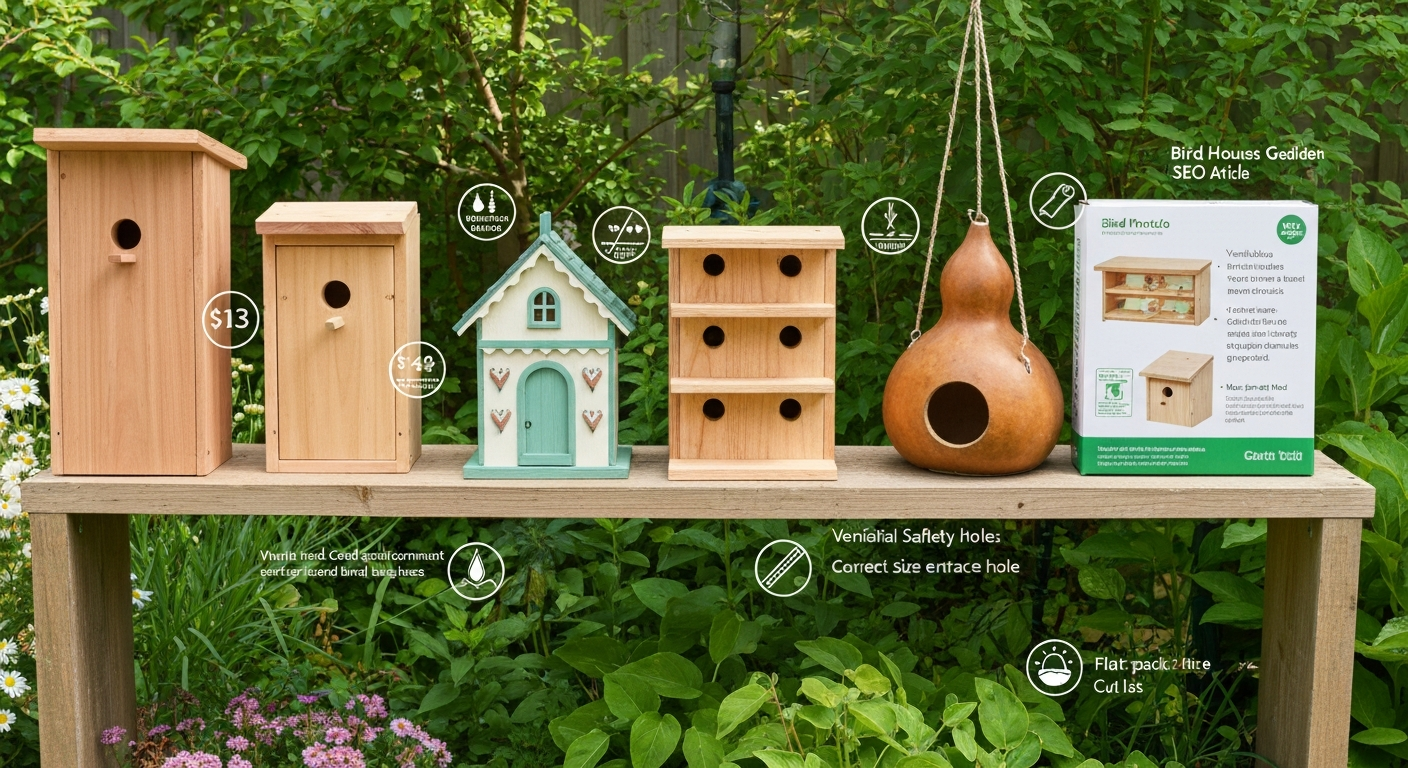
The best-selling bird houses at any major retailer are usually inexpensive cedar or pine single-compartment boxes priced around $13–$40, plus decorative wooden houses and the occasional multi-compartment martin setup. They sell well because they are affordable and look the part on a shelf, but sales rank and bird safety are two very different things. What backyard stewards actually need is a house matched to a specific species, built from safe materials, with the right entrance hole, correct internal dimensions, ventilation, drainage, and a clean-out panel. Get those things right and you will attract birds; get them wrong and you will either attract nothing or, worse, create a trap.
Best Selling Bird Houses: Practical Guide for Backyard DIY
Maya Thompson
7 Aug 2026
What 'best selling' really means for backyard stewards
When retailers like Home Depot, Lowe's, and Walmart badge a bird house as a bestseller, they are measuring units sold, not nesting success. The highest-volume products are almost always the cheapest items in the category, think unfinished pine boxes or lightly stained cedar bluebird houses at the $13–$20 mark. Decorative houses (cottage shapes, barn replicas, folk-art paintwork) also move in large numbers, mostly as garden ornaments rather than functional nest boxes. At the higher end, multi-compartment purple martin houses and camera-equipped boxes sell in smaller quantities but hold steady positions in mid-to-upper sales tiers.
On Etsy, the picture shifts: small-batch handcrafted cedar boxes and bespoke painted houses dominate, with pricing in the mid-to-upper range depending on finish and species specificity. UK retailers like B&Q mirror the same tiers, basic tit and wren boxes at roughly £10–£30, with woodcrete and metal-reinforced options sitting higher. Knowing this breakdown matters whether you are buying, building, or thinking about selling your own boxes.
How I evaluate bird houses: popularity vs. bird safety
Sales figures tell you what people buy; they say nothing about whether birds actually use the box or raise chicks successfully. My evaluation criteria come from NestWatch (Cornell Lab of Ornithology), the RSPB, the BTO, and peer-reviewed research on cavity-nester occupancy and breeding outcomes. Here is what I check for in any bird house, bought or built.
- Correct entrance hole diameter for the target species (even a few millimetres off can exclude the bird you want or admit predators)
- Appropriate internal floor area and cavity depth — too shallow overheats eggs; too cavernous makes the nest vulnerable
- No external perch beneath the entrance hole (perches give predators a foothold and are not needed by cavity-nesters — NestWatch and RSPB both flag this)
- Ventilation holes near the top of the side walls to prevent heat build-up
- Drainage holes (at least four, roughly 6 mm / 1/4 inch) at the base corners
- Roughened or grooved interior surface below the entrance so fledglings can grip and climb out
- A front overhang of at least 5 inches to reduce reach-in predation attempts
- A hinged or removable panel for seasonal cleaning and monitoring
- Untreated wood or exterior-only non-toxic finish (no pressure-treated timber, no interior paint)
Peer-reviewed research reinforces why these details matter. A study on Tree Swallows in British Columbia found that internal dimensions, entrance height, and surrounding habitat all affected both occupancy rates and reproductive output. Separate comparative literature warns that poorly designed boxes can become ecological traps, altering microclimate, increasing parasite loads, and raising predation risk compared with natural cavities. One recent study (Increased microclimatic variation in artificial nests does not create ecological traps for a secondary cavity breeder, PMC (Ecology & Evolution)) found that, for at least one species, greater microclimatic variation in boxes did not by itself create an ecological trap, underscoring that outcomes can be species- and context-specific Increased microclimatic variation in artificial nests does not create ecological traps for a secondary cavity breeder — PMC (Ecology & Evolution). Good design prevents those outcomes.
Top-selling and popular bird-house types, and why they are widely used
These are the categories you will see leading the bestseller lists across US and UK retailers, along with the practical reason each one sells well.
- Cedar bluebird/wren single boxes: the volume leader in US retail ($13–$40). Cedar is naturally rot-resistant, weathers well, and requires no finish. These sell because they are affordable, species-appropriate when correctly dimensioned, and recognisably functional.
- Decorative painted wooden houses: high unit volume, mostly purchased as garden decor. Many lack drainage, ventilation, or a clean-out panel. Birds occasionally use them; treat any decorative house as a bonus rather than a primary nesting option.
- Multi-compartment purple martin houses: a dedicated niche with loyal buyers. Purple martins in the eastern US are almost entirely dependent on human-provided housing, which drives steady demand. Effective compartments need to be at least 6×6 inches, though 7×12 inches is the Purple Martin Conservation Association's preferred size for better thermal protection and nestling comfort.
- Hanging or gourd-style houses: popular for wrens, chickadees, and martins (gourds). The hanging category has its own loyal following among gardeners who prefer a naturalistic look. They work well when they are stable enough not to spin in wind.
- Bird-house kits (flat-pack or pre-cut): a growing segment across both retail and Etsy. Kits appeal to first-time DIYers and families. Quality varies significantly — the best kits use cedar or pine with pre-drilled correct-size entrance holes and include assembly instructions.
- Open-front and robin-style boxes (UK-focused): robins, wrens, and spotted flycatchers will not use enclosed tit-box designs. Open-fronted boxes with a low partial front panel are a staple of UK garden bird keeping.
- Wren-specific small boxes: house wrens need a small (28–32 mm) entrance hole that blocks starlings and larger competitors. Dedicated wren boxes are a consistent seller in both the US and UK because wrens are among the most willing and accessible cavity nesters for beginners.
Species-appropriate dimensions and entrance hole sizes
This is the single most important table to bookmark. Even a well-made box will sit empty if the hole is the wrong diameter. The figures below draw on NestWatch plans, RSPB guidance, and BTO-referenced data from UK wildlife trusts. I have included a UK-specific note where hole sizes and species differ from North American standards.
| Species | Entrance Hole (mm) | Entrance Hole (inches) | Internal Floor (cm) | Internal Floor (inches) | Cavity Depth to Entrance (cm) | Region / Notes |
|---|---|---|---|---|---|---|
| House Wren (US) | 28–32 mm | 1 1/8 in | 10×10 cm | 4×4 in | 15–20 cm | US. Smaller hole excludes starlings |
| Carolina Wren (US) | 32–38 mm | 1 1/4–1 1/2 in | 10×10 cm | 4×4 in | 15–20 cm | US. Slightly larger than House Wren |
| Eastern Bluebird (US) | 38 mm | 1 1/2 in | 13×13 cm | 5×5 in | 20–25 cm | US. Face box east toward open habitat |
| Tree Swallow (US) | 38 mm | 1 1/2 in | 13×13 cm | 5×5 in | 15–20 cm | US. Near open water/grassland |
| Black-capped Chickadee (US) | 28–29 mm | 1 1/8 in | 10×10 cm | 4×4 in | 20–25 cm | US/Canada |
| Purple Martin (US) | 45–60 mm (round) or crescent | 1 3/4–2 1/4 in | 15×15 cm min, 18×30 cm preferred | 6×6 in min, 7×12 in preferred | 15 cm | US (eastern). Colonial; use multi-compartment housing or gourds |
| Blue Tit (UK) | 26–29 mm | approx. 1 1/8 in | 15×12 cm | ~6×5 in | 15 cm | UK. RSPB: 26 mm ideal; BTO/SWT: up to 29 mm accepted |
| Great Tit (UK) | 29–32 mm | approx. 1 1/4 in | 15×12 cm | ~6×5 in | 12–15 cm | UK. RSPB: 29 mm; SWT/BTO: 32 mm |
| House Sparrow (UK) | 32 mm | 1 1/4 in | 15×15 cm | ~6×6 in | 15–20 cm | UK. Also suits North American Tree Sparrow |
| Starling (UK) | 45 mm | 1 3/4 in | 15×15 cm | ~6×6 in | 20–25 cm | UK/US. Needs higher mounting (3–6 m) |
| Robin / Spotted Flycatcher (UK) | Open front (low panel) | Open front | 12×12 cm | ~5×5 in | 8–10 cm front panel | UK. Open-front style; sheltered, semi-hidden placement |
A note for UK readers: the RSPB publishes its own hole-size guidance (Blue Tit 26 mm, Great Tit 29 mm, House Sparrow 32 mm, Starling 45 mm) and the BTO nest-box guides referenced by local wildlife trusts add slightly wider tolerances. Both sources agree that open-fronted boxes are essential for robins, wrens nesting in sheltered spots, and flycatchers, these species simply will not enter an enclosed box with a round hole. If you are based in the UK, the dedicated best bird houses UK guidance on this site covers regional species in more depth.
Buying vs. building: a practical comparison
This is the question I get asked most often. The honest answer is that both routes can produce a safe, effective nest box, it depends on your time, confidence with tools, and whether you need a specific species matched to your habitat right now or can wait a few weekends.
| Factor | Buying a commercial box | Building your own |
|---|---|---|
| Cost | $13–$150+ (US); £10–£60+ (UK) depending on tier | Typically $8–$25 in materials for a single box if you buy wood; less if you use offcuts |
| Time to completion | Immediate | 1–3 hours for a basic nest box once you have plans and materials |
| Species match | Varies — check hole size carefully; many retail boxes are labelled 'bluebird' but cut to approximate sizes | Exact — you drill the hole to the millimetre for your target species |
| Material quality control | Variable; cedar boxes tend to be reliable; decorative boxes often use thin, unrated wood | Full control — you choose untreated cedar or pine, correct thickness (minimum 3/4 in / 19 mm) |
| Design safety features | Many retail boxes lack ventilation, proper drainage, or a clean-out panel — inspect before buying | You build all Cornell/NestWatch-recommended features in from the start |
| Skill required | None beyond inspection and installation | Basic saw, drill, and measuring skills — manageable for most beginners |
| Repairability | Difficult once joints fail | Easy to replace individual boards or re-drill a different entrance hole |
| Best for | Gardeners who want a functional box quickly; good option when buying a well-reviewed cedar kit | DIYers who want species-precise dimensions, a learning project, or multiple boxes at low cost |
If you go the buying route, the safest commercial choices are plain cedar or pine boxes from reputable wildlife-focused suppliers rather than purely decorative lines. For vetted suppliers and comparisons, see our guide to high quality bird houses. Bird-house kits, pre-cut flat packs you assemble yourself, sit in a useful middle ground: you get correct dimensions and pre-drilled holes, but you still do the assembly and finish it with an exterior-only non-toxic stain if desired. The best bird house kits guide on this site walks through what to look for in kit quality. See our best bird house kits guide for vetted kit recommendations and assembly tips. For recommendations and reviews, see our guide to the best outdoor bird houses for top-rated models and buying tips.
High-quality commercial houses, hanging vs. mounted models, and kits, what to look for
Mounted (post or tree) houses
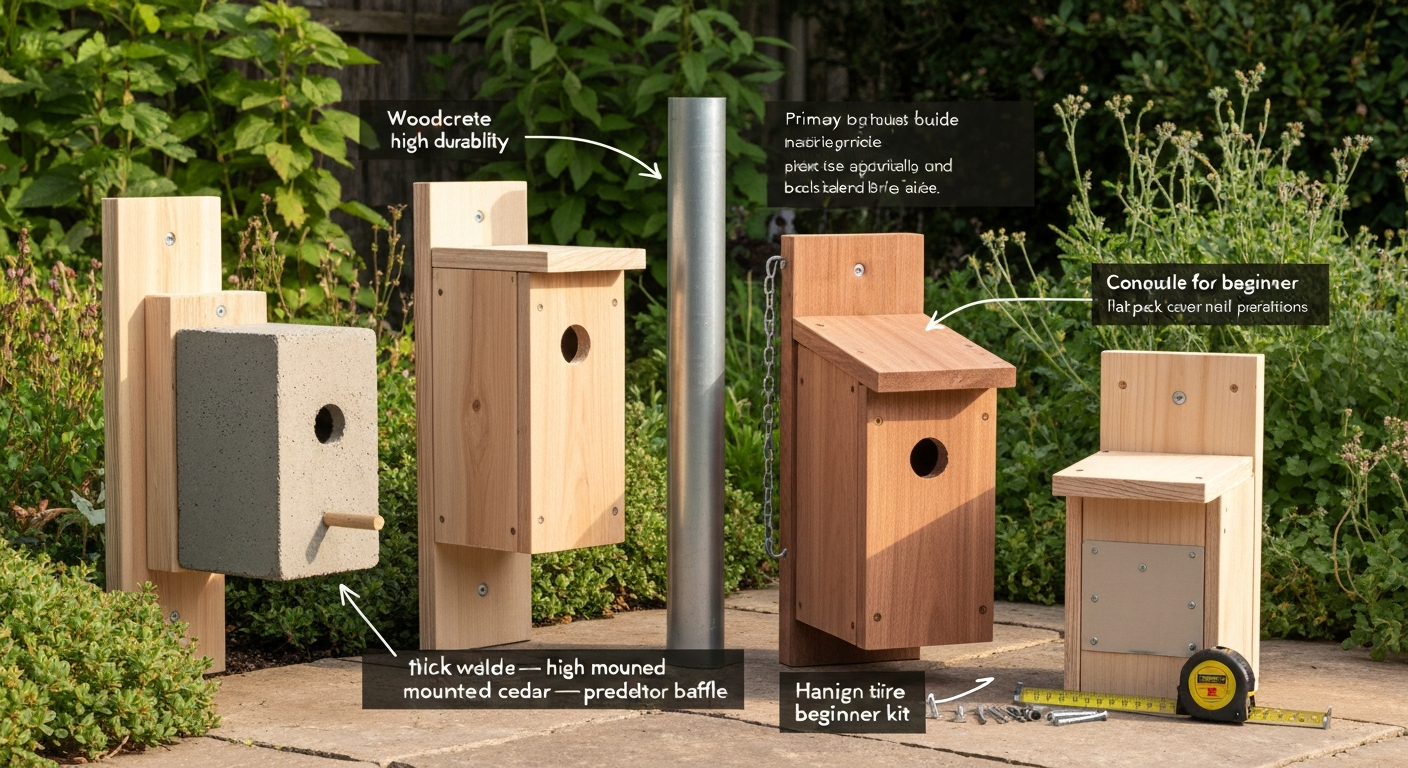
Pole-mounted boxes are the gold standard for bluebirds and tree swallows because you can add a baffle (a cone or tube below the box) to block climbing predators like raccoons and snakes. A smooth steel pole 1.5–1.8 m (5–6 ft) tall with a stovepipe baffle below the box is one of the most effective predator-proofing setups available. Tree-mounted boxes are easier to install but harder to baffle effectively, use them for species like nuthatches and chickadees that are less targeted by climbing predators in your specific region.
Hanging houses
Hanging boxes work well for wrens and chickadees, and gourd-style hanging housing is traditional for purple martins. The main consideration is stability: a box that spins or swings excessively in wind can deter nesting. Use a short, stiff hanging length (15–20 cm of chain or wire) rather than a long rope, and site the box where it is partially sheltered from prevailing winds. Hanging models are harder to baffle against predators, so placement away from climbable surfaces matters more. If you want to explore the full hanging category in more depth, the best hanging bird houses section of this site covers it.
What to look for in any commercial box or kit
- Wood thickness at least 3/4 inch (19 mm) — thinner boards overheat in summer sun
- No perch peg below the entrance hole
- Drilled ventilation holes (two or more) near the top of the side walls
- Four drainage holes at the base corners, each roughly 6 mm (1/4 inch)
- A hinged lid, swing-out side, or removable front panel for cleaning
- Entrance hole matching the labelled species (measure it yourself — retail labelling is not always accurate)
- Untreated or exterior-only finished wood; avoid boxes with interior paint or varnish
- Roof overhang of at least 5 inches at the front
Materials, tools, safe finishes, and construction tips
Best wood choices
Cornell Lab's NestWatch recommends untreated cedar and white pine as the top choices for nest boxes. Both are widely available, easy to work, and safe for birds. Cedar is the more durable option outdoors, it resists rot and insects naturally without any treatment. White pine is slightly less rot-resistant but is cheap, lightweight, and easy to cut precisely. I use 3/4-inch (19 mm) cedar boards for most of my boxes. Avoid pressure-treated lumber entirely: the preservative compounds are toxic and should never be used in a box where birds will live and raise chicks.
Finishes and paint
If you want to paint or stain, apply finish to the exterior only and allow it to off-gas fully before mounting, NestWatch recommends painting in autumn so boxes have months to air before spring occupancy. NestWatch (Cornell Lab) recommends using untreated wood (e.g., cedar or white pine), advises against pressure‑treated lumber, and says if paint is needed apply it only to the exterior and allow fumes to dissipate (paint in fall) Should I use treated wood or paint on a nest box? — NestWatch (Cornell Lab). Use a light colour on the exterior in hot climates (pale grey or tan) to reflect heat; avoid black or dark exterior finishes where summer temperatures are high. Never paint or varnish the interior, rough, unfinished wood inside is exactly what fledglings need to grip.
Basic tool list
- Hand saw or circular saw (for cutting boards to length)
- Power drill with standard bits plus a spade or Forstner bit set for entrance holes (28 mm to 50 mm range covers most species)
- Tape measure and pencil
- Square (for marking right angles)
- Hammer and 1 1/2-inch galvanised nails, or a brad nailer
- Exterior wood glue (optional but adds joint strength)
- Sandpaper (120 grit for smoothing edges; roughen interior below entrance with 60 grit or a chisel)
- Safety glasses and hearing protection
Easy substitutions: if you do not own a Forstner bit, a sharp spade bit leaves a clean enough hole for most species. If you do not have a circular saw, most hardware stores will crosscut boards to your specified lengths at low or no cost.
Construction tips worth knowing
- Cut the roof panel slightly oversized (add 1 inch / 25 mm front overhang beyond the front board) to shed rain and reduce predator reach
- Angle the back board 10–15 degrees at the top so the roof sheds water away from the wall, or simply slope the roof board itself
- Drill four drainage holes (6 mm) in the base corners before assembling — it is much harder after the box is together
- Rough up the interior wall below the entrance hole with 60-grit sandpaper or shallow chisel cuts to give fledglings a grip — this is often overlooked but genuinely affects fledging success
- Use a hinge or a pivot screw on one side panel rather than nailing it shut, so you can open it for monitoring and cleaning
- Pre-drill nail holes near board ends to prevent splitting, especially in pine
Step-by-step DIY plan: a basic nest box for wrens or chickadees
This plan produces a small enclosed nest box suitable for house wrens, Carolina wrens, or black-capped chickadees. For more species-specific options see our guide to the best wren bird houses. The finished internal floor is approximately 10×10 cm (4×4 inches) with a 28–29 mm entrance hole for wrens (drill to 32 mm for Carolina wrens or chickadees). Total build time is around 60–90 minutes for a first-timer. Full illustrated diagrams and a downloadable cut list template are available in the illustrated plans section of this site.
What you will need
- One 1×6 cedar or pine board, 1.2 m (4 feet) long — this yields all six panels
- Galvanised 1 1/2-inch nails or screws
- One small hinge or two screws for a pivot side panel
- Drill with 28 mm (or 29 mm / 32 mm) spade or Forstner bit
- Saw, tape measure, square, pencil, sandpaper (120 grit and 60 grit)
Cut list
| Panel | Dimensions (cm) | Dimensions (inches) | Notes |
|---|---|---|---|
| Floor | 10×10 cm | 4×4 in | Drill four 6 mm drainage holes at corners |
| Front | 10×25 cm | 4×10 in | Drill entrance hole centred, 5 cm from top |
| Back | 10×35 cm | 4×14 in | Extra length for mounting screws at top and bottom |
| Two sides | 10×20 cm each | 4×8 in each | Angle top edge to match roof slope; drill one or two 6 mm vent holes near top |
| Roof | 14×15 cm | 5.5×6 in | Overhang 4 cm / 1.5 in at front; slight bevel at back to shed water |
Build stages
- Mark and cut all panels to the dimensions above. Pre-drill nail holes 1 cm from board ends to prevent splitting.
- Drill the entrance hole in the front panel: centre it horizontally, position it so there is roughly 5 cm (2 inches) of wood above the hole to the roof line. Use a Forstner or spade bit at the correct diameter for your target species.
- Roughen the interior face of the front panel below the entrance hole using 60-grit sandpaper or shallow horizontal chisel cuts. This helps fledglings climb out.
- Drill four 6 mm drainage holes at the corners of the floor panel.
- Drill one or two 6 mm ventilation holes near the top of each side panel, on the interior face side.
- Nail or screw the floor to the back board first, then attach the two side panels. Keep the side that will be your clean-out access unglued — fix it with a pivot screw top and bottom so it swings open.
- Attach the front panel between the two sides. Check that everything is square before the glue or nail sets.
- Attach the roof with a small overhang at the front (at least 4 cm / 1.5 inches) and a slight bevel or gap at the back to allow warm air to escape and rain to drain away.
- Sand all exterior edges smooth. If you are applying an exterior stain or paint, do it now and allow at least 48 hours drying time before mounting — or better still, paint in autumn and mount in late winter before spring nesting season.
Timing and placement
Mount boxes by late February in the southern US, by early to mid-March in the northern US and UK, before birds begin territory establishment. For wrens and chickadees, mount the box on a post or tree at roughly 1.5–2 m (5–7 ft) high, facing away from prevailing wind and rain (south or east-facing is common in northern hemisphere gardens). Clear a roughly 1-metre radius of brush around the entrance hole so birds can approach freely but are not exposed to open-sky predators. For bluebirds, open habitat, a garden edge facing a lawn or meadow, is essential; for chickadees and wrens, light woodland edges or shrubby gardens work well.
Mounting, placement, predator-proofing, and sanitation
Predator-proofing
A stovepipe baffle or conical metal baffle mounted on the post below the box is the most effective deterrent against raccoons, cats, and snakes. Position the baffle so its bottom edge is at least 45 cm (18 inches) below the box floor and at least 1.2 m (4 feet) above the ground. If the box is tree-mounted, a metal collar around the trunk at 1.5 m height helps but is less effective than a free-standing baffled pole. Adding a metal hole guard (a metal plate with the correct hole diameter) around the entrance prevents squirrels from gnawing the hole wider. Do not add an external perch: NestWatch and the RSPB are both explicit on this point, a perch gives predators a grip point and provides no benefit to cavity-nesting birds.
Sanitation and maintenance schedule
Clean boxes at least once a year. The safest window is after the breeding season ends (late summer or autumn in most regions) or in late winter before birds return in spring. Wear gloves and a dust mask when removing old nesting material, dried droppings and nest debris can carry pathogens. Remove all material, scrub the interior with a stiff brush, and disinfect with a 1:10 bleach-to-water solution (one part household bleach to nine parts water, per CDC disinfection guidance). Rinse thoroughly and leave the clean-out panel open for 24–48 hours to dry completely before closing. NestWatch notes that the evidence on whether cleaning reduces parasite loads is mixed across species and regions, but it recommends cleaning as standard practice, particularly for eastern bluebirds where studies have shown a benefit.
During the breeding season, do a brief external check monthly, look for wasp nests at the entrance, signs of woodpecker damage, or loose roof panels. Never open a box with eggs or very young chicks unless you have a specific reason to do so and are familiar with local wildlife regulations about disturbing active nests.
Ethical guidance for small sellers
If you are considering selling bird houses, whether at a local market, on Etsy, or through a small woodworking business, there are a few practical and ethical points that distinguish conservation-minded makers from purely decorative ones. This connects to the broader how to sell bird houses guidance on this site, but here is the short version of what matters most.
- Use safe materials: untreated cedar or pine only; no pressure-treated timber; exterior-only finish with non-toxic paint or stain if used at all. Label your materials in your product listings so buyers know what they are getting.
- Drill correct species-specific entrance holes, not approximate ones. A buyer who installs your box expecting bluebirds will be disappointed if the hole is 35 mm instead of 38 mm — and may harm a wren if they end up with a hole that is slightly undersized. If you are selling a 'multi-species' box, be honest about what that means.
- Include a clean-out panel and basic mounting instructions with every sale. Buyers who do not know to clean boxes will inadvertently cause harm.
- Price honestly for your materials and time: a single cedar bluebird box from 3/4-inch boards costs roughly $8–$15 in materials; a fair retail price in the $25–$45 range is consistent with what conservation-focused makers charge and reflects real labour. Competing purely on price with mass-market boxes is not a sustainable position for a small maker.
- Use conservation-honest messaging: market your boxes on the strength of correct dimensions, species specificity, and safe materials — not on decorative features alone. Buyers who want a safe house for birds will pay for that story.
- Check any applicable standards in your country. In the UK, if you are selling nest boxes commercially, ensure compliance with material and chemical safety standards; the RSPB and BTO both provide free guidance on nest-box design that you can reference in your product descriptions.
A final note worth keeping in mind: artificial nest boxes are a genuine conservation tool, but the scientific literature is clear that design and placement quality determines whether they help or harm. Whether you are buying, building, or selling, the standard you hold your boxes to should be the one that puts the bird first. Sales rankings are a lagging indicator, the leading indicator is a pair of birds raising a successful brood.
FAQ
What primary authoritative sources should I consult to ensure bird‑safe design and species‑appropriate recommendations?
Core authorities: Cornell Lab of Ornithology / NestWatch (nest‑box features, species plans, cleaning guidance), RSPB (UK hole sizes and species notes), British Trust for Ornithology (BTO) or local UK nest‑box guides, and species‑specific conservation groups (e.g., Purple Martin Conservation Association). These provide vetted, species‑specific dimensions, placement rules and safety recommendations.
Which peer‑reviewed research topics are necessary for evidence‑based guidance?
Search for studies on nest‑box occupancy, reproductive success, predation rates, microclimate effects of artificial nests, and parasite dynamics. Key topics: how box dimensions and entrance size affect occupancy; effects of placement and habitat on breeding success; impacts of box materials on microclimate; and whether cleaning reduces parasites. Include regional case studies (e.g., Tree Swallow box studies) to support recommendations.
What practical public‑health and sanitation guidance should be referenced for cleaning nest boxes?
Cite NestWatch on recommended cleaning timing (annually, at season end or before spring) and caution around active nests. For disinfection protocols, reference CDC guidance for surface disinfection (e.g., 1:10 bleach dilution), and advise PPE (gloves, mask), thorough rinsing, drying, and outdoor ventilation after using chemicals.
What retail and market data sources are useful to identify 'best‑selling' bird‑house types?
Use major retailer 'best seller' pages (Home Depot, Lowe’s, Walmart, B&Q) and marketplace trends (Etsy) to identify high‑volume categories and price tiers. Note limitations: these show popularity indicators, not raw unit sales; combine with local shop inventories and seasonal catalogues for a fuller market picture.
Which design features and construction materials should I check with experts and sources?
Verify recommendations for untreated natural woods (cedar, white pine) from NestWatch; avoid pressure‑treated lumber. Confirm features: correct internal volume, appropriate entrance‑hole size per species, ventilation near the top, 1/4" (~6 mm) drainage holes in corners, roughened interior below entrance, 5+ inch front overhang, no external perches, and a hinged clean‑out panel. Cross‑check with RSPB/BTO for UK specifics.
What species and dimension data are essential to include (and where to source them)?
Provide a table of species, entrance‑hole diameter, internal floor dimensions and recommended box depth. Source values from NestWatch (US species), RSPB and BTO/Shropshire Wildlife Trust (UK). Include common backyard species (wrens, bluebirds, tree swallows, tits, sparrows, starlings) and colony species guidance (Purple Martins) with compartment sizes.
Next Articles
Best Bird House Kits: Top Picks, Sizes, Build & Mounting
Find the best bird house kits with species-appropriate sizes, assembly steps, mounting tips, and predator-proofing.
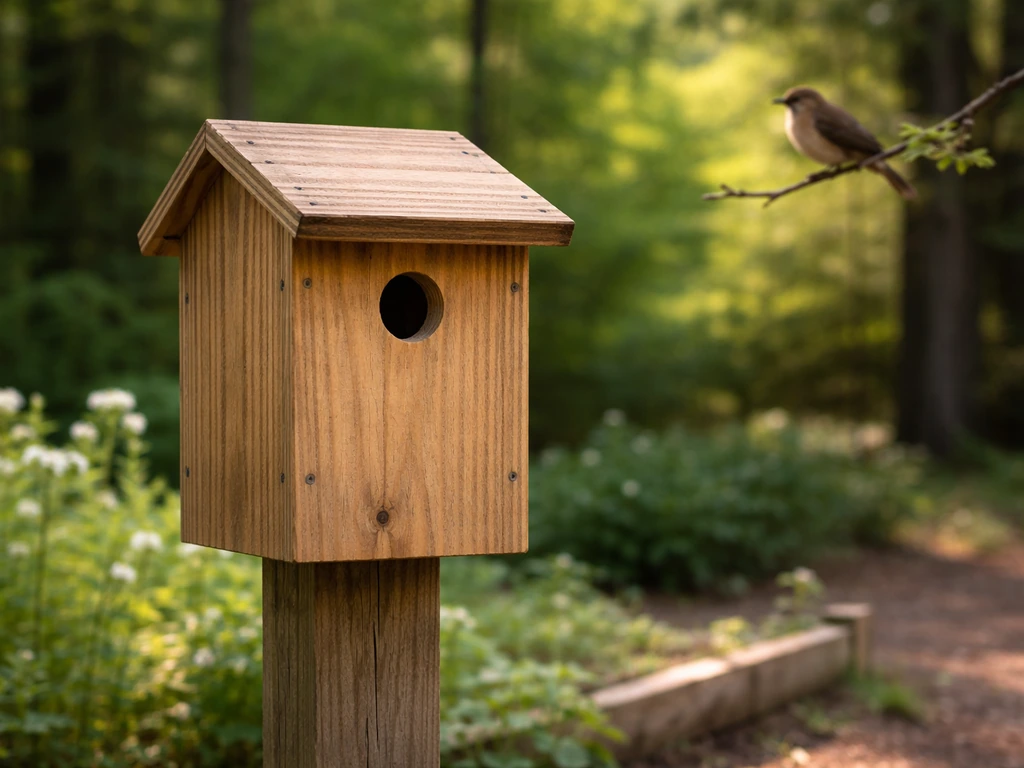
Best Wren Bird Houses: How to Choose, Build, and Install
Choose and build the best wren bird houses with correct hole size, dimensions, placement, predator-proofing, and cleanin
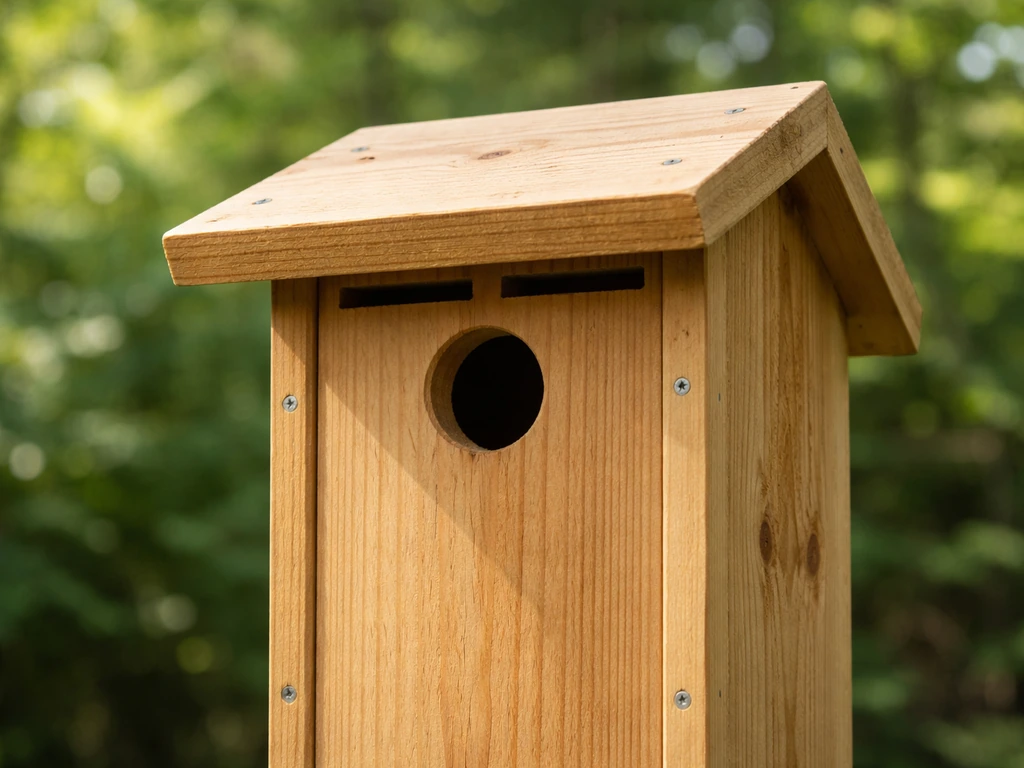
High Quality Bird Houses: How to Choose, Build, and Maintain
Choose, build, and maintain safe, durable bird houses with species-correct design, ventilation, drainage, and easy clean