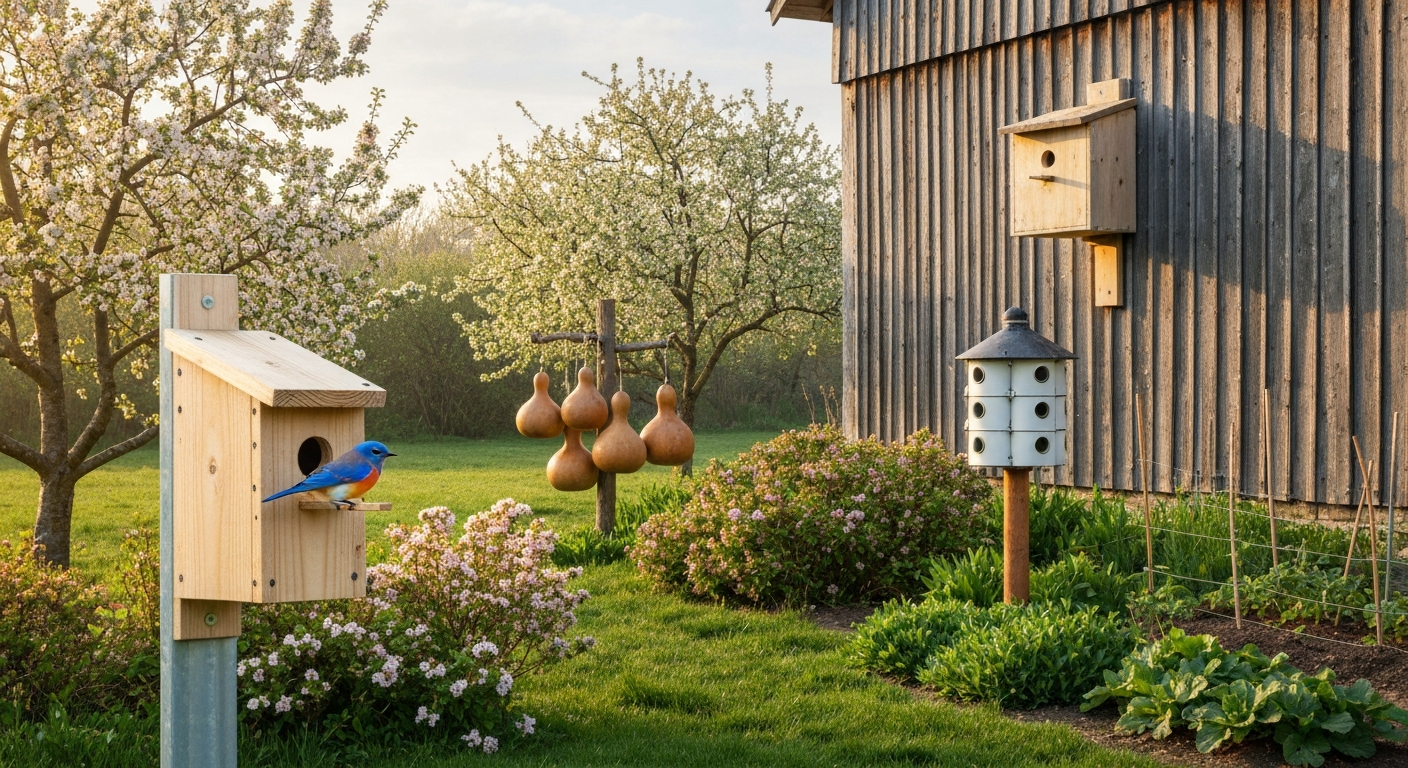
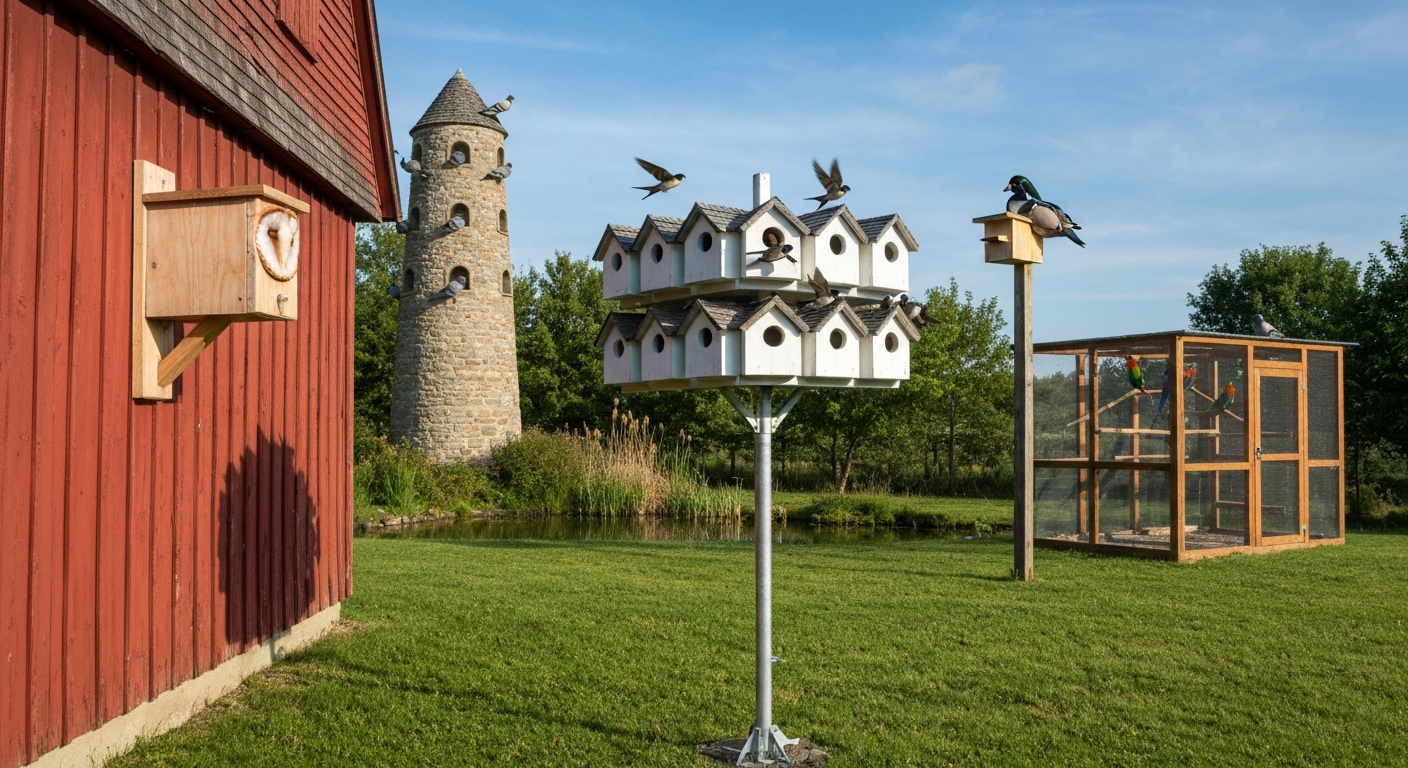
A large bird house goes by several names depending on its purpose: an aviary (an enclosed flight space for confined birds), a dovecote or pigeon loft (housing for doves or pigeons), a purple martin house or colony house (a multi-compartment structure for colonial nesters), or simply a large nest box or roost box (for solitary cavity nesters like owls, kestrels, and wood ducks). Which name applies depends almost entirely on the species you want to attract and what you need the structure to do.
What Is a Large Bird House Called: Aviary, Dovecote Nest Box
Maya Thompson
9 Aug 2026
Why the name actually matters
If you search for plans, lumber, or advice using the wrong term, you can end up with a structure that completely misses the mark. An aviary is built to keep birds inside; a martin house is designed to attract wild birds from the outside. A dovecote suits domestic pigeons but will sit empty if you want to attract barn owls. Getting the terminology right from the start means you buy the right materials, cut the right hole sizes, and mount the structure at the right height, and your backyard birds actually use it. It also matters legally: keeping certain wild bird species confined in an aviary requires permits in the US and Canada, while putting up a passive nest box for native cavity nesters does not.
The common names and what each one means
Aviary
An aviary is a large enclosure, anything from a walk-in wire cage to a purpose-built room or building, designed to house birds in a contained environment. The defining feature is confinement: birds live, fly, and often breed inside without leaving. Aviaries are used for exotic species, captive research populations, zoos, and the private keeping of non-native birds like parrots, finches, or softbills. Building or running one for native wild species in North America requires federal and state permits under the Migratory Bird Treaty Act.
Dovecote (also dovecot)
A dovecote is a structure specifically for housing domestic doves or pigeons. Historically, these were raised towers or cupolas with internal compartments for roosting and breeding. The classic design keeps birds semi-free: pigeons fly out and return on their own, but the cote provides nest cubbies, protection from predators, and a home base. A pigeon loft is the modern working version of the same concept, typically a shed-like building used by fanciers for breeding, showing, or racing pigeons.
Purple martin house (colony house)
A purple martin house, sometimes called a colony house, is a multi-compartment structure mounted on a tall pole, purpose-built for purple martins, which are highly colonial cavity nesters. Each compartment is a small room sized specifically for a martin pair. These structures are placed in very open areas with clear flight approaches, near human activity, on poles typically 12 to 20 feet high. They are not cages: martins are wild, free-flying birds that choose to nest in them.
Large nest box and roost box
A large nest box is simply an oversized single-compartment box built to the specifications of a larger cavity-nesting species: a barn owl, screech-owl, American kestrel, wood duck, or chimney swift tower. 'Roost box' refers to the same type of structure when used primarily for winter communal roosting rather than active nesting. Both are passive structures: you mount them and let wild birds find and use them on their own. These are the most practical option for most backyard birders and beginner DIYers.
When to use each type
| Type | Best situation | Key advantage | Main limitation |
|---|---|---|---|
| Aviary | Keeping captive, non-native, or rescue birds in a flight space | Full control over bird welfare and environment | Requires permits for native species; high build cost |
| Dovecote / loft | Housing domestic pigeons or doves for fanciers or heritage projects | Traditional design; birds return on their own | Not suitable for attracting wild native species |
| Purple martin house | Attracting colonial purple martins in open, sunny backyards east of the Rockies | Supports dozens of pairs; excellent insect control | Needs very open site; requires active management |
| Large nest box / roost box | Attracting solitary large cavity nesters (owls, kestrels, wood ducks) | Simple to build; low cost; no permit needed for native species | One pair per box; site-dependent success |
How to choose the right structure for your situation
Work through these questions in order and you will land on the right structure almost every time.
- Do you want to keep birds contained, or attract free-flying wild birds? If contained: build an aviary (and check permit requirements first). If free-flying: continue.
- Are the birds domestic pigeons or doves? If yes: a dovecote or loft is the right structure. If no: continue.
- Are you targeting purple martins in an open, sun-exposed yard at least 40 feet from trees? If yes: a multi-compartment martin house on a 12-to-20-foot telescoping pole is the answer. If no: continue.
- Are you targeting a single large cavity-nesting species such as a barn owl, screech-owl, kestrel, or wood duck? If yes: build or buy a species-specific large nest box sized to that species' exact specifications (see the table below). If you want to support chimney swifts, build a chimney swift tower instead.
- Still unsure? A large nest box is the lowest-cost, lowest-risk starting point for most backyard birders.
Which species use large bird houses, by region
Not every large cavity nester lives everywhere. Here is a practical regional breakdown to help you match your structure to birds that actually live near you.
| Species | Region | Structure type | Notes |
|---|---|---|---|
| Purple Martin | East of Rockies (primary); Pacific coast (secondary) | Colony house / martin house | Highly dependent on human-provided housing in the east |
| Barn Owl | Coast-to-coast US, southern Canada | Large deep nest box | Open farmland, grassland; needs rodent prey nearby |
| Eastern Screech-Owl | Eastern US and Great Plains | Large nest box | Wooded edges, suburban yards with mature trees |
| Western Screech-Owl | Western US and Pacific coast | Large nest box | Similar habitat to Eastern; tolerates drier conditions |
| American Kestrel | Coast-to-coast US and Canada | Large nest box on pole or building | Open fields, farmland, roadsides; declining in many areas |
| Wood Duck | Eastern US, Pacific coast, central regions near wetlands | Large nest box over or near water | Needs water within 1 mile; benefits from wood shavings inside |
| Chimney Swift | Eastern US east of Rockies | Chimney swift tower | Declining due to loss of old chimneys; towers help significantly |
| Common Merganser / Hooded Merganser | Northern US, Canada near forested water | Large deep water nest box | Similar needs to wood duck; larger entrance required |
| Large parrots / non-native species | Captive situations only | Aviary | Requires permits; not a backyard box scenario |
Exact specs for each large-house species
These dimensions come from Cornell Lab's NestWatch, the Purple Martin Conservation Association, Ducks Unlimited, and Penn State Extension. Treat them as targets, not rough estimates: getting the entrance hole wrong by even a quarter inch can let in predators or exclude your target species entirely.
| Species | Floor (W x D) | Interior height | Entrance hole | Mounting height | Facing direction |
|---|---|---|---|---|---|
| Purple Martin (per compartment) | 6" x 6" (min); 7" x 12" preferred | 6" | 2-1/8" round (range 1-3/4" to 2-1/4") | 12–20 ft on pole | Open sky; 40–60 ft from trees |
| Barn Owl | 10" x 18" | 15–18" (high interior drop from entrance) | 6" x 6" square or 6" round | 8–25 ft on barn, pole, or tree | Faces open field or grassland |
| Eastern/Western Screech-Owl | 6–8" x 6–8" | 15–18" | 3" round | 10–30 ft on pole or tree | South or east in most regions |
| American Kestrel | 8" x 8" | 14–16" | 3" round | 10–30 ft on pole or building | South or east; open habitat |
| Wood Duck | 10" x 18" | 22–24" | 4-1/2" x 3-1/2" oval | 6+ ft above water or ground | Faces open water or clearing |
| Chimney Swift Tower | Inside diameter 6–8" | 6–10 ft tall | No entrance hole (open top or side slot) | Free-standing; 10–12 ft total height | Open sky; away from trees |
A few critical notes on the table above: wood duck boxes need the interior walls scored or fitted with a hardware cloth ladder below the entrance so ducklings can climb out. For exact construction details, see Ducks Unlimited’s Build a Wood Duck Box plan which lists the recommended oval entrance size, interior scoring for duckling toe‑holds, drainage hole count, and materials Ducks Unlimited's step‑by‑step wood duck box plan specifies a 4.5" × 3.5" oval entrance, recessed toe‑holds, five 1/2" drainage holes, and a cedar 1×10 (3/4") board in the materials list.. Screech-owl and kestrel boxes need the interior wall under the entrance grooved for the same reason. Barn owl boxes need a deep internal drop from the entrance to the floor, as the Barn Owl Trust recommends roughly 450 mm (about 18 inches) to prevent owlets from falling out prematurely. Purple martin compartments should never have an outside perch, which makes it easier for European starlings and house sparrows to stage an invasion.
Materials: what to build with and why
The safest, longest-lasting large nest boxes and martin houses are built from untreated, naturally rot-resistant wood with walls at least 3/4 inch thick. Thick walls buffer temperature extremes and add structural rigidity, both critical for large structures exposed to wind and weather. Never use treated lumber inside a box where birds will nest: the preservatives are toxic. Exterior hardware and fasteners should be rust-resistant to avoid staining and structural failure over time.
| Material | Best use | Why it works | Notes / substitutions |
|---|---|---|---|
| Cedar (western red or eastern) | Nest boxes, martin house frames | Naturally rot-resistant, lightweight, easy to cut | Best all-around choice for DIY boxes |
| Cypress | Nest boxes, roost boxes | Extremely rot-resistant, stable in humidity | Excellent in humid southeastern US climates |
| Pine (exterior grade) | Nest boxes, aviary framing | Widely available, affordable, easy to work | Must be unfinished or painted exterior-only; not treated |
| Exterior plywood (ACX or better) | Aviary panels, martin house bodies | Strong, flat, good for large panels | Use exterior-rated glue; seal all edges |
| Galvanized screws (1-5/8" to 3") | All assembly | Rust-resistant, strong hold in wood | Prefer screws over nails for disassembly during cleaning |
| Stainless steel mesh (1/2" hardware cloth) | Aviary panels, predator guards | Durable, bird-safe, no sharp edges after cutting | Wear gloves when cutting; file sharp edges |
| Exterior latex paint (white or light) | Martin house exteriors | Reflects heat; UV-resistant white reduces lethal interior temps | Never paint interior of nest box; use only exterior surfaces |
| Raw linseed oil or tung oil | Cedar and pine exteriors | Preserves wood without toxic chemicals | Not necessary on cedar; optional for pine in wet climates |
Avoid pressure-treated wood entirely inside any nest box or compartment. Avoid metal roofs without adequate ventilation beneath them: they turn boxes into ovens in summer. Never use particle board or MDF outdoors; they disintegrate quickly and can harbor mold. If you want the exterior of a large box to last longer in harsh climates, a coat of exterior latex on the outside only is a simple, safe solution.
Tools and workshop prep
You do not need a fully equipped shop to build a large nest box or even a multi-compartment martin house. A basic tool set covers most builds. Here is what is genuinely essential versus what just makes the job faster.
Essential tools
- Circular saw or hand saw: for cutting lumber to length and width
- Drill and drill bits (including a 3" and a 2-1/8" spade or Forstner bit for entrance holes): the entrance hole is the most critical cut you will make
- Jigsaw: for cutting oval entrance holes (wood duck) or irregular shapes
- Tape measure and pencil: measure twice, cut once, especially on large panels
- Square (combination or speed square): keeps box walls perpendicular so panels seat correctly
- Screwdriver or impact driver: for assembly with galvanized screws
- Clamps (at least two): holds panels while you drive screws solo
- Safety glasses and hearing protection: required any time you run power tools
Helpful but optional tools
- Miter saw: speeds up repetitive cross-cuts on martin house compartment dividers
- Router with roundover bit: smooths exterior edges for a cleaner look and better paint adhesion
- Band saw: safer and more precise for cutting entrance hole inserts and hardware cloth
- Workbench with vise: stabilizes large panels for drilling and cutting
- Tin snips: for cutting hardware cloth in aviary or predator-guard projects
Workshop and safety checklist before you start
- Clear a flat, stable work surface at least 4 feet by 8 feet for large panel layouts.
- Check that all blades and bits are sharp: dull bits tear wood fibers and cause grain blowout on entrance holes, which leaves rough edges that can trap birds.
- Pre-drill pilot holes near edges of cedar and pine to prevent splitting, especially on pieces 3/4 inch thick.
- Keep a fire extinguisher accessible and never run power tools near sawdust piles.
- Sand any interior surfaces that will contact eggs or young birds: rough interior walls on the floor area can trap moisture and bacteria.
- Wear a dust mask when cutting MDF, plywood, or any treated wood scraps in the same shop session, and dispose of offcuts from treated lumber separately.
- Label all cut parts before assembly: martin house compartment dividers are easy to mix up once cut.
Predator-proofing and ventilation: do not skip these
Cornell Lab's NestWatch analysis found that nest boxes fitted with predator guards had roughly 6.7 percent higher nest success rates compared to unguarded boxes. For large boxes mounted on poles, a cone baffle or stovepipe baffle below the box is the single most effective addition you can make. Entrance-hole extenders (a wooden or metal block that extends the entrance tunnel by 1.5 to 3 inches) make it significantly harder for raccoons to reach inside with a paw. For boxes on trees or buildings, Noel guards (a wire cone over the entrance) are an effective option.
Ventilation is equally non-negotiable in large boxes. Drill at least two 5/8-inch holes on each side near the top of the box, and cut drainage holes (at least four, 3/8 to 1/2 inch) in the floor or recess the floor 1/4 inch above the base to keep it dry. A sloped, overhanging roof protects the entrance from rain and direct sun. These are not optional extras: a box without drainage and ventilation will lose eggs to overheating and fungal growth.
Mounting, placement, and timing
Placement is where most large nest box projects succeed or fail. Get the height and habitat right and birds find the box within a season or two. Get them wrong and you can have a well-built box sit empty for years. Purple martin houses must go up on a telescoping pole in very open areas, 40 to 60 or more feet from trees, and within about 100 feet of human activity. Wood duck boxes need to be within a reasonable flight distance from water and ideally face an open clearing or the water itself. The US Forest Service species review for Aix sponsa (wood duck) recommends entrance holes larger than 3.5 inches and mounting boxes roughly 6 feet or more above the water or ground to accommodate ducklings and compensate for scarce natural cavities Aix sponsa (wood duck) — US Forest Service species review. Screech-owl and kestrel boxes do best on poles or lone trees at the edge of open land, not deep inside a woodland.
Timing matters too. Put up owl boxes in late fall or winter before the January-to-February start of barn owl courtship, and before screech-owls start scouting cavities in February or March. Wood duck boxes should be in place by early February in the southern US and by March in northern states and Canada. Purple martin houses should go up in late winter (late January to February in the deep south, late March to early April in the northeast and midwest) to catch the first scouts returning from South America. A telescoping pole lets you lower the house for cleaning and adjustments, which is essential for martin houses.
Sanitation and seasonal maintenance
Every large nest box and martin house needs to be cleaned at least once a year, and active martin houses benefit from checks every one to two weeks during the nesting season to monitor for invasive species like European starlings and house sparrows. After each nesting season ends, remove old nesting material completely, scrub the interior with a stiff brush and a 10 percent bleach solution (one part bleach to nine parts water), rinse well, and let the box dry fully in the sun before storing or closing it up for winter. This step prevents mite, parasite, and bacterial loads from carrying over into the next season.
For wood duck boxes specifically, add 3 to 4 inches of dry wood shavings (not sawdust, which compacts and holds moisture) each spring before the nesting season. Do not use hay or straw, which introduce mites. For barn owl boxes, leave the old nest material unless it is heavily parasitized: barn owls often reuse the same box for multiple years and the compacted material provides a stable egg cup.
Legal and conservation notes
In the United States and Canada, all native migratory birds are protected under the Migratory Bird Treaty Act and equivalent Canadian legislation. This means you cannot legally keep a native wild bird in an aviary without specific federal and state or provincial permits, regardless of the size of the structure. Putting up a passive nest box or martin house to attract free-flying native birds requires no permit and is actively encouraged by conservation organizations. If you’re wondering what are bird houses for, they provide nesting and roosting sites for cavity-nesting species, offer protection from predators and weather, and support local bird conservation when properly sited and maintained. If you want to keep non-native species (such as exotic parrots or domestic pigeons) in an aviary, check your local zoning rules as well, since some municipalities restrict aviary structures by size or proximity to property lines.
From a conservation standpoint, every correctly placed and maintained large nest box genuinely helps. American kestrel populations have declined sharply across much of North America as old-growth trees and farm buildings with natural cavities disappear. Chimney swift towers are actively helping a species that lost its primary nesting habitat when old brick chimneys were capped or demolished. Purple martins east of the Rocky Mountains are now almost entirely dependent on human-provided housing. Building and maintaining these structures is one of the most direct, measurable contributions a backyard birder can make to local bird conservation. For more on the wider benefits of bird houses for wildlife and people, see our guide to the benefits of bird houses. Learn more about why are bird houses important and how proper nest-box placement and maintenance directly support native bird populations and local biodiversity.
FAQ
What is a large bird house called — what are the correct names and when is each term used?
Common names and uses: aviary — large caged or enclosed flight space for keeping or exhibiting live birds (containment/husbandry). Dovecote/dovecot or pigeon loft/loft — buildings for housing domestic pigeons or doves (breeding/lofting). Martin house/colony house — multi‑compartment housing built for colonial species such as purple martins. Large nest/roost box (or loft for some species) — single or multi‑compartment nest boxes sized for large cavity nesters (wood ducks, barn owls, kestrels, screech owls). Choose the term by intended function: aviary for containment and display, dovecote/loft for pigeon husbandry, martin house for colonial aerial insectivores, and nest/roost box for wild cavity‑nesting species.
How do I decide: aviary vs martin house vs a large nest/roost box?
Decision rules: choose an aviary only if you intend to keep birds in captivity (containment, husbandry, veterinary care) or need free‑flight training — check local regulations and husbandry best practices. Choose a dovecote/loft only for pigeons/doves or racing birds. Choose a martin house when targeting colonial aerial insectivores (purple martins) — they need multiple small compartments and very open flight approaches. Choose a single large nest/roost box (or multi‑chamber nestbox cluster) for wild solitary cavity nesters (wood ducks, kestrels, owls). Match the structure’s internal volume, entrance size, social design (colonial vs solitary), maintenance access, predator defenses and placement to the target species.
Which species typically use “large” bird houses and what are key species‑specific specs?
Common targets and quick specs (authoritative consensus): Purple martin — compartment interior ~6"×6" minimum; research favors ~7"×12" depth; round entrance ~2‑2.125"; pole height 12–20'; place in very open area away from trees. Wood duck — oval entrance ~4.5"×3.5"; floor/toe‑holds for ducklings; mount ~6'+ near water. Barn owl — deep tall box with a high drop from entrance to floor (follow Barn Owl Trust plans; larger interior than small owls); mount 8–25' in open fields. American kestrel — floor ~8"×8", box height ~14–16", entrance ~3"; mount 10–30' in open habitat. Screech owl — internal floor 6–8", box height 15–18", entrance ~3"; mount 10–30' in wooded edges. Chimney swifts — vertical hollow tower or converted chimney; follow chimney swift tower plans. Always consult species pages (NestWatch, PMCA, state extensions) and adjust slightly by local climate.
What are proven materials and construction features for safe, durable large bird houses?
Preferred materials and features: untreated exterior‑grade wood (cedar, cypress, or pine) ≥3/4" thick; sloped overhanging roof; drainage holes (several 3/8"–1/2" holes or corner cutouts); ventilation (two ~5/8" holes per side near top); recessed floor to limit moisture wicking; no external perches; predator‑resistant entrance geometry (where needed); exterior painted white for heat control on species like purple martins; interior roughening or grooves beneath entrance to help nestlings climb; easy-clean access (hinged side or roof). Avoid pressure‑treated wood that leaches chemicals; plastics may be acceptable for some martin gourds/housings if UV‑resistant.
What tools and materials will I need for a DIY large nest box (example materials table)?
Concise materials table (common for many large boxes): lumber — 1×10 or 1×12 cedar/pine/cypress (3/4"); galvanized or stainless screws and hinges; exterior wood glue; exterior paint or stain (white for martins); hardware cloth or predator guards (stovepipe, cone); pole or mounting bracket; drill and bits (hole saws sized to entrance diameter), jigsaw or circular saw, tape measure, square, pencil, screwdriver/driver, sandpaper. Optional: telescoping pole for martins, coated hardware for wet sites, non‑toxic sealant for exposed end grain. Species‑specific items: oval hole template for wood duck, entrance‑hole baffle parts for kestrels/owls.
Can you give at least one complete DIY plan or link to reliable site plans for large bird houses?
Yes. Authoritative free plans: Cornell Lab NestWatch “Right Bird, Right House” and species pages include downloadable step‑by‑step plans for kestrels, wood ducks, screech owls, chimney swift towers and more: https://nestwatch.org/learn/all-about-birdhouses/. Purple Martin Conservation Association housing standards and plans: https://www.purplemartin.org/housing/. Ducks Unlimited wood duck box plan with materials and dimensions: https://www.ducks.org/conservation/waterfowl-research-science/build-a-wood-duck-box. For chimney swift towers, Audubon NC tower recommendations and build details: https://nc.audubon.org/sites/default/files/static_pages/attachments/chimney_swift_tower_recommendations_audubon_nc.pdf. Use these as primary plans and adapt for local conditions.