Bird houses deliver a surprisingly wide range of real, measurable benefits: they give cavity-nesting birds safe places to breed when natural tree hollows are scarce, they pull insectivorous birds into your yard where those birds actively reduce pest pressure on plants, they support local biodiversity, and they hand you a front-row seat to wildlife behavior right outside your window. Field research in orchards and vineyards confirms the pest-control effect is not just anecdotal. If you build one correctly, mount it right, and clean it between seasons, a single nest box can host successful broods for decades.
Benefits of Bird Houses: DIY Conservation Guide for Gardeners
Maya Thompson
29 Jul 2026
What you will get from this article
This guide is written for beginner-to-intermediate DIYers, home gardeners, and anyone who wants evidence-backed reasons to put up a bird house and the practical knowledge to do it well. You will find the ecological and personal benefits explained with reference to real studies, clear answers to common questions (what bird houses are for, what they are called, why they matter), species-appropriate sizing and hole-diameter tables, complete cut lists for three common builds, materials and tool guidance, predator-proofing methods, and a maintenance schedule. Everything here is conservation-minded: the goal is healthy birds and a healthy backyard ecosystem, not product promotion.
The benefits at a glance
Before diving into construction, it helps to understand exactly what a well-placed bird house does. The benefits split cleanly into ecological gains (things that improve your garden and the broader environment) and personal gains (things that improve your experience as a homeowner or gardener).
| Benefit category | Specific benefit | Evidence base |
|---|---|---|
| Pest control | Insectivorous cavity nesters reduce arthropod pest abundance near nest boxes | García et al. 2021 (apple orchards); Kross et al. 2011 (California vineyards: ~3.5× larval removal beneath boxes) |
| Pollination support | Insect-eating birds reduce competition from pest insects on pollinator-attracting plants, indirectly supporting pollinators | Inferred from arthropod suppression studies |
| Cavity habitat | Replaces declining natural tree hollows lost to development and forest management | Summarized across >600 nest-box studies (ScienceDirect overview) |
| Biodiversity | Increases local bird species richness and occupancy where natural cavities are limiting | Nest-box literature synthesis |
| Education | Provides observable, accessible wildlife behavior for children and adults | Widely documented in citizen-science programs (NestWatch) |
| Backyard enjoyment | Attracts visually striking species (bluebirds, swallows, chickadees) close to home | Practical/observational |
| Conservation action | Targeted boxes support species of concern (bluebirds, kestrels, barn owls) with documented population benefits | NestWatch, raptor conservation programs |
What are bird houses for, and what are they called?
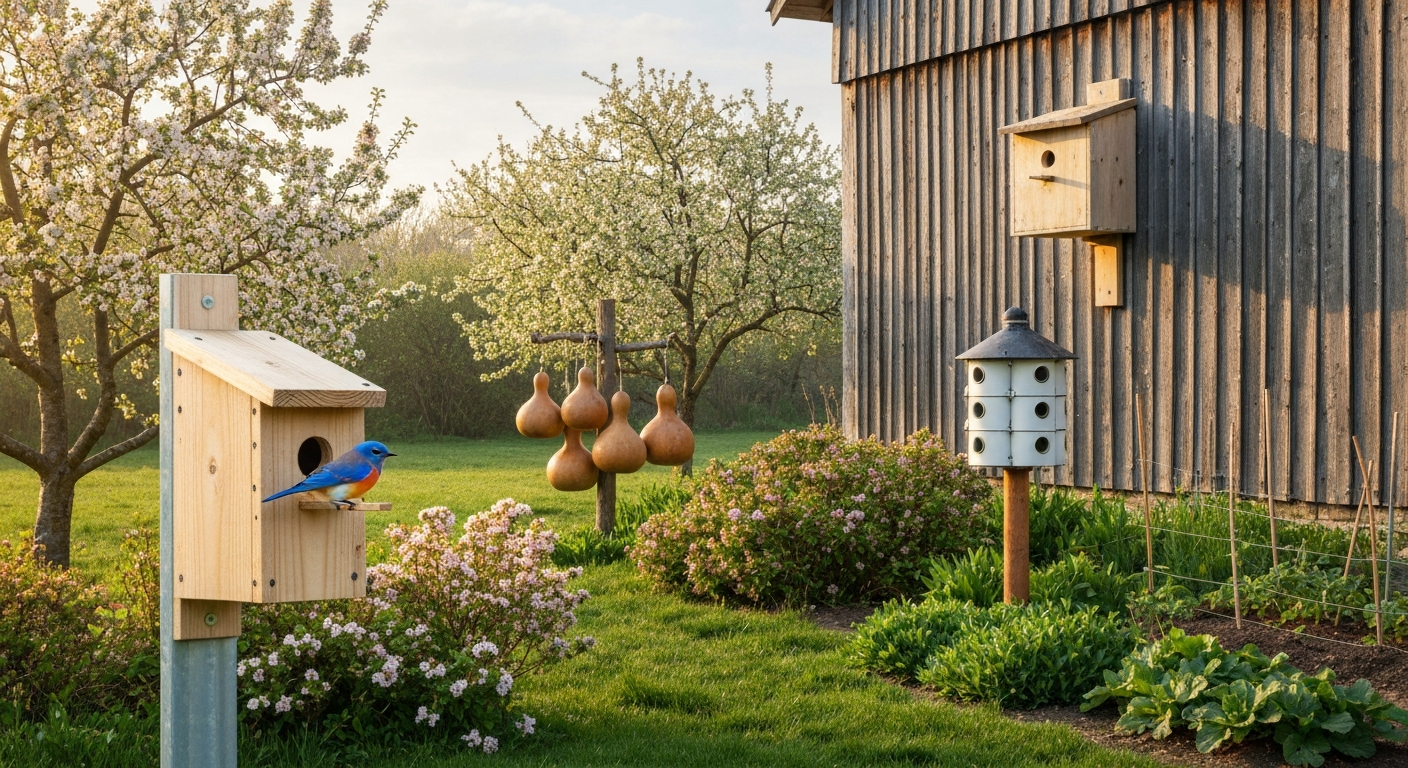
A bird house is an artificial cavity designed to mimic the hollow spaces that cavity-nesting birds use to raise young. In North America the term 'bird house' is the everyday name, but ornithologists, conservationists, and many extension services almost always call them 'nest boxes. If you’re wondering what is a bird house called, the more formal term used by researchers and conservation programs is “nest box.”. ' You will see both terms used interchangeably throughout the literature. The more formal 'nest box' is the term used in peer-reviewed ecology studies and in NestWatch's monitoring program, while 'bird house' dominates in garden retail and DIY contexts. Neither is wrong. Specialized versions get their own names: a box intended for Purple Martins in a multi-compartment tower is usually called a martin house, a box sized for owls is an owl box, and a box for raptors such as American Kestrels is a kestrel box or raptor box. If you need a quick answer to what a large bird house is called and how martin houses, owl boxes, and duck houses differ, read our short guide on larger nest structures titled 'what is a large bird house called'. Gourd-shaped alternatives hung in clusters for martins are simply called nesting gourds. Understanding these distinctions matters because each type has its own sizing, placement, and management requirements.
At their core, all bird houses serve the same purpose: they supply a safe, enclosed nesting space for obligate or facultative cavity-nesting species that cannot excavate their own holes. When old trees with natural cavities are removed, bird houses become a critical substitute. Woodpeckers excavate cavities that are then used by secondary cavity nesters (bluebirds, chickadees, swallows, wrens, nuthatches, kestrels, screech owls, and many others). Without either natural cavities or nest boxes, these secondary nesters simply cannot breed successfully in many modern landscapes.
Why bird houses matter: conservation and ecosystem services
The conservation case for nest boxes rests on solid ground. A synthesis of more than 600 nest-box studies published in the scientific literature documents repeated findings: nest boxes increase local bird occupancy, deliver measurable ecosystem services (primarily insectivory), and in some contexts affect plant productivity. The pest-control data is particularly compelling for gardeners. A 2021 study in the Journal of Applied Ecology (García et al.) found that nest boxes in apple orchards increased insectivory by birds and reduced arthropod pest abundance, with measurable effects on yield in some systems. An earlier California vineyard study (Kross et al. 2011) documented that boxes occupied by Western Bluebirds increased larval removal rates beneath the boxes by approximately 3.5 times compared to unoccupied control areas, providing a clear mechanism for crop protection.
Beyond pest control, nest boxes address a direct conservation bottleneck: cavity scarcity. Urban and suburban landscapes, intensively managed farmland, and young-growth forests simply lack the mature, dead, or dying trees that produce natural cavities at the density cavity nesters need. Targeted nest-box programs have contributed to documented population recoveries for Eastern Bluebirds (which declined sharply through the mid-20th century partly due to cavity competition with introduced House Sparrows and European Starlings) and for American Kestrels, whose populations continue to decline in parts of their range. Even in healthy woodlands, supplemental nest boxes increase breeding density and can buffer populations against local disturbance.
There is also a well-documented citizen-science value. Programs like Cornell Lab's NestWatch have enrolled hundreds of thousands of participants who monitor nest boxes, generating data on breeding phenology, productivity, and population trends that would be impossible to collect through professional surveys alone. Putting up and monitoring a nest box connects you directly to that scientific infrastructure.
Common types of bird houses and the species they serve
Not every nest box is the same. The type you build should be determined by which species live in your region and what habitat your yard provides. Here is a practical overview of the main categories.
Standard single-pair nest boxes (small songbirds)
These are the most common bird house designs: a simple enclosed box with a round entrance hole, made from 3/4-inch wood. Designed for one breeding pair at a time, they suit wrens, chickadees, titmice, nuthatches, tree swallows, and bluebirds. The entrance-hole diameter is the primary species-selection tool: smaller holes admit smaller birds and exclude larger competitors and predators. A 1.0- to 1.125-inch hole is right for House Wrens; 1.125 inches suits chickadees; 1.25 inches works for nuthatches; 1.5 inches is the standard for Tree Swallows and Eastern/Western Bluebirds. European Starlings can squeeze through a hole of approximately 1 9/16 inches (about 1.56 inches), so keeping holes at or below 1.5 inches helps exclude them from boxes targeted at bluebirds and swallows.
Purple Martin houses and nesting gourds
Purple Martins are colonial cavity nesters that need multi-compartment housing. Traditional martin houses are wooden or aluminum towers with 6 to 24 individual compartments, mounted on a telescoping or pulley-rigged pole 12 to 20 feet high in open areas near water. Crescent-shaped and natural gourd alternatives (hung in clusters of 8 to 24 or more) have become increasingly popular because gourds retain heat better and are easier to lower for weekly monitoring checks, which the Purple Martin Conservation Association (PMCA) considers essential for active colony management. Martin housing should not be treated as a set-and-forget project: weekly nest checks, active sparrow and starling management, and strict timing of pole raising (tied to martin arrival dates in your region) are all required for a successful colony.
Owl boxes
Barn Owl boxes and Screech-Owl boxes are the most commonly built owl boxes for backyard or farm settings. Screech-Owl boxes use a floor of roughly 8 by 8 inches, an interior depth of about 12 to 15 inches, and a 3-inch entrance hole. Barn Owl boxes are substantially larger (floor approximately 10 by 18 inches, depth 15 to 18 inches) and are often mounted inside barns, on large posts, or on the exterior of farm buildings. Barred Owl and Great Horned Owl boxes are larger still and often require input from a local raptor conservation group or state wildlife agency, particularly if they involve tree mounting on public land. Raptors and owls need much larger boxes and different mounts: American Kestrel boxes use ~9"×9" floor, entrance and perch geometry appropriate to kestrel; Barn Owl and Barred Owl boxes are larger still and often require professional guidance and permits, consult your state wildlife agency or a local raptor conservation group for species‑specific plans Raptors and owls need much larger boxes and different mounts: American Kestrel boxes use ~9"×9" floor, entrance and perch geometry appropriate to kestrel (follow species‑specific extension or raptor‑conservation plans); Barn Owl and Barred Owl boxes are larger still and often require professional guidance and permits (consult state wildlife agencies and raptor conservation groups).. Always check local regulations before installing owl boxes, especially for species that may be subject to state or federal protection.
Raptor boxes (kestrel boxes)
American Kestrel boxes use a floor of approximately 9 by 9 inches, an interior depth of 9 to 12 inches, and an entrance hole of 3 inches. They are mounted 10 to 30 feet high on poles or trees at the edge of open habitat (meadows, farm fields, road corridors). Because kestrel populations are declining in many parts of North America, well-managed kestrel box programs can make a real contribution to local conservation. Some state wildlife agencies run coordinated kestrel box networks and can provide regional plans and monitoring protocols.
Duck boxes and wood duck houses
Wood Ducks and Common Mergansers use large boxes mounted over or near water. Wood Duck boxes use a floor of about 10 by 10 inches, an interior depth of 24 inches, and an oval entrance hole of 3 by 4 inches. A predator baffle on the mounting pole is critical for these boxes because raccoon predation is the primary cause of nest failure. Wood Duck boxes are a proven conservation success story and are among the most rewarding large nest-box projects for backyard pond or wetland owners.
Decision checkpoints: choosing the right design
Before you cut a single board, work through these five questions. Getting them right before you build saves a lot of remounting and rebuilding later.
- Target species: Which cavity-nesting birds are actually present in your region and habitat? A wooded suburban yard may support chickadees, nuthatches, and wrens. An open field or meadow edge is bluebird and kestrel territory. A yard near water could attract Tree Swallows or Wood Ducks. Build the box for what lives there, not for what you wish lived there.
- Habitat match: Does your yard have the open space, tree cover, water proximity, or field edge that your target species requires? Purple Martins will not use a box surrounded by trees. Screech-Owls need mature trees nearby. Bluebirds need open areas with low perches. No amount of perfect construction compensates for a wrong habitat.
- Predation risk: What mammalian and snake predators are present locally? Raccoons, squirrels, rat snakes, and cats are the most common box predators in most of North America. If any of these are active in your yard, a predator baffle on the mounting pole is not optional; it is essential. Plan the baffle into your project from the start.
- Maintenance access: Can you open, clean, and monitor the box easily and safely from the ground or a stable step stool? A box mounted 15 feet up a smooth tree trunk is a box you will never clean. Build or buy a hinged side or front panel, and mount on a pole or post you can safely reach.
- Local rules: Are there neighborhood, HOA, municipal, or wildlife-agency rules about mounting structures, attracting certain species, or managing specific birds? In some jurisdictions, disturbing active nests (even of non-target species) can have legal consequences. Check before you install.
Materials and tools: what bird houses are made of
Recommended woods
The best material for a nest box is untreated, rot-resistant wood with walls at least 3/4 inch thick. Cedar is the top choice: it weathers well, resists rot and insects naturally, and is widely available in 1-by lumber (which is actually 3/4 inch thick). Cypress is equally durable and is preferred in the southeastern United States. Pine works well and is the most affordable option; it will need replacement sooner than cedar or cypress in wet climates but is perfectly serviceable for a beginner build. Exterior-grade plywood (at least 3/4 inch, BC grade or better) is a good choice for larger boxes like owl or duck boxes where larger flat panels are needed. For a focused overview of recommended materials and pros and cons, see what are bird houses made of.
Avoid any pressure-treated lumber for interior surfaces. The U.S. EPA and NestWatch recommend using untreated, rot‑resistant wood (cedar, cypress, or pine) for nest boxes and caution that older CCA-treated and some newer pressure‑treated lumber can leach toxic preservatives and should not be used inside or near cavities EPA and NestWatch recommend using untreated, rot‑resistant wood.. Older chromated copper arsenate (CCA) pressure-treated wood is a recognized health hazard and is now banned for residential use in the US and Canada, but newer alkaline copper quaternary (ACQ) and copper azole treatments also leach copper compounds and should not be used inside or near nest cavities. For exterior surfaces, a water-based exterior paint (light or natural colors to avoid heat buildup) applied only to the outside is safe once fully dried and cured. Never paint or stain the interior cavity or around the entrance hole.
Hardware and fasteners
- 1-5/8" or 2" exterior-grade screws (coated deck screws or stainless steel): use screws rather than nails so the box can be disassembled for cleaning
- Galvanized or stainless steel hinges (1.5" to 2") for the cleanout panel
- A hook-and-eye latch or small barrel bolt to secure the cleanout panel against raccoons
- Galvanized or stainless carriage bolts (3/8" x 3" or 4") with washers and nuts for mounting to a post or pole
- A 3" or 4" galvanized pipe flange if mounting on a metal conduit pole
Tool list
- Circular saw or miter saw (for crosscuts) and a table saw or jigsaw (for ripping panels to width) — a hand saw works for beginners at the cost of more time
- Drill/driver (corded or cordless) with a Phillips bit and a countersink bit
- Hole saw or spade bit in the appropriate diameter for your target species (1.0", 1.125", 1.25", 1.5", or 3" for owls/kestrels)
- Tape measure, combination square, and pencil
- Clamps (at least two bar or C-clamps) to hold panels while drilling and assembling
- Sandpaper (80-grit and 120-grit) or a rasp for roughening the interior below the entrance hole
- Safety glasses and hearing protection
- Dust mask (N95 or better) if working with MDF, plywood, or any treated or unknown-origin wood
Safe workshop practices
Wear safety glasses any time you are cutting, drilling, or driving screws. Clamp your workpiece rather than holding it with your hand near a drill bit or saw blade. When cutting hole-saw circles in thin wood, the piece can grab and spin; always clamp it to a sacrificial backer board. Use a sharp hole saw: dull bits require more force and are more likely to catch. If your wood source is unknown (salvaged lumber, old pallets), sand it and clean it thoroughly before use and wear a dust mask to avoid exposure to unknown preservatives or lead paint on older wood.
Cut lists and basic plans for three common builds
The three designs below cover the most commonly requested backyard nest boxes. All use 3/4-inch (nominal 1-by) untreated cedar or pine. Dimensions are interior measurements where noted; lumber is actual 3/4" thickness throughout. Follow the numbered steps for each build in sequence.
Build 1: General-purpose small-bird box (wrens, House Sparrow exclusion tip included)
This is the simplest box to build and a good first project. It suits House Wrens and Carolina Wrens with a 1.0-inch to 1.125-inch entrance hole. Note: an unmanaged wren box placed near other nest boxes can result in House Wrens puncturing eggs in nearby boxes, which is a natural but frustrating behavior; place wren boxes away from boxes targeting other species.
| Part | Dimensions (inches) | Quantity | Notes |
|---|---|---|---|
| Front panel | 4 wide × 8 tall | 1 | Drill 1.0"–1.125" entrance hole centered, 6" from bottom of panel |
| Back panel | 4 wide × 12 tall | 1 | Extra length for mounting bracket or direct screw-to-post attachment |
| Side panels | 4 wide × 8 tall | 2 | Cut top at 5° angle to match sloped roof; drill two 5/8" vent holes near top |
| Floor | 4 × 4 (actual interior) | 1 | Cut corners at 45° (3/8" notches) for drainage; recess 1/4" from bottom edges |
| Roof | 6 wide × 7 long | 1 | Provides 2" overhang front, ~1" overhang each side; attach with two screws to allow removal if needed |
- Cut all panels to dimension. Mark and cut the 5/8" ventilation holes on each side panel (two holes per side, near the top, roughly 1/2" from the top edge and 1" from each side edge).
- Cut the four 3/8" corner notches on the floor panel using a jigsaw or handsaw for drainage.
- Drill the entrance hole in the front panel using a 1.0" or 1.125" hole saw. Roughen the interior surface below the entrance hole with 80-grit sandpaper or a rasp so fledglings can grip the wood when exiting.
- Assemble the back panel flat on your work surface. Attach one side panel to the back using two 1-5/8" exterior screws per joint, pre-drilled and countersunk to prevent splitting.
- Drop the floor into the box (it should sit recessed about 1/4" from the bottom edge of the sides). Secure with two screws per side.
- Attach the front panel. One side of the front panel should be left on a hinge to serve as the cleanout panel. Use a 1.5" galvanized hinge at the bottom of the cleanout side and a hook-and-eye latch at the top to keep it closed.
- Attach the second side panel. Drive screws through the back and front into the side edges.
- Attach the roof with two screws into the top of the back panel. The roof should slope slightly forward (the angled side-panel tops create this pitch). Confirm a 2" front overhang.
- Sand any sharp edges on the exterior. Apply exterior wood stain or paint to outside surfaces only, in a neutral or light color. Let dry completely before mounting.
Build 2: Bluebird/Tree Swallow box
This is the workhorse of the nest-box world. The same basic box dimensions serve Eastern Bluebirds, Western Bluebirds, and Tree Swallows. The Audubon Society's widely referenced DIY plan calls for a 1.5-inch entrance hole for Eastern and Western Bluebirds (1 9/16 inch where ranges overlap, though staying at 1.5 inches helps exclude starlings). NestWatch bluebird guidance recommends a floor of approximately 5 to 5.5 inches square, an interior depth of 8 to 9 inches from floor to the bottom of the entrance hole, and mounting at 4 to 6 feet above ground, spaced at least 300 feet from other bluebird boxes.
| Part | Dimensions (inches) | Quantity | Notes |
|---|---|---|---|
| Front panel | 5.5 wide × 11 tall | 1 | 1.5" entrance hole centered, 7.5" from bottom of panel (gives ~9" from hole to floor) |
| Back panel | 5.5 wide × 15 tall | 1 | Extended for mounting; drill two 3/16" pilot holes for carriage bolts 1" from top and 10" from top |
| Side panels | 5.5 wide × 11 tall | 2 | Cut top at 5°–10° slope; two 5/8" vent holes per side near top |
| Floor | 5.5 × 5.5 | 1 | 3/8" corner notches for drainage; recess 1/4" |
| Roof | 8 wide × 8 long | 1 | 2"–3" front overhang; 1.25" side overhangs |
- Cut all panels. Mark ventilation holes (two 5/8" holes per side panel, near top) and drill them before assembly.
- Cut corner drainage notches on the floor panel.
- Drill the 1.5" entrance hole in the front panel using a hole saw. Roughen interior below the entrance hole with 80-grit sandpaper.
- Assemble back panel flat. Attach one side with two screws top and bottom.
- Set the floor in place, recessed 1/4". Screw through side into floor edge; screw through back into floor edge.
- Attach the front panel. Make one side of the front panel the hinged cleanout side: attach a 1.5" galvanized hinge at the bottom of the opening side and a barrel bolt or hook-and-eye latch at the top. Alternatively, use a side-opening design where one full side panel pivots on a nail through the top.
- Attach the second side panel.
- Attach the roof with screws into the back panel. Confirm front overhang of at least 2 inches.
- Finish exterior surfaces only with a light-colored exterior stain or paint. Do not paint interior. Mount on a smooth metal conduit or wooden post 4 to 6 feet above ground with a predator baffle (see predator-proofing section).
Build 3: Chickadee/Titmouse box
Chickadees (Black-capped, Carolina, Mountain) and Tufted Titmice prefer a slightly smaller, deeper box than bluebirds. The key dimension is the 1.125-inch entrance hole, which admits chickadees and titmice but excludes House Sparrows (mostly). Interior depth of 8 to 10 inches discourages larger birds from nesting even if they can fit through the hole. Mount 4 to 15 feet high, ideally on a tree or post at the edge of wooded cover.
| Part | Dimensions (inches) | Quantity | Notes |
|---|---|---|---|
| Front panel | 4 wide × 10 tall | 1 | 1.125" entrance hole centered, 7.5" from bottom of panel |
| Back panel | 4 wide × 14 tall | 1 | Extended for tree or post mounting |
| Side panels | 4 wide × 10 tall | 2 | 5° roof slope cut at top; two 5/8" vent holes per side |
| Floor | 4 × 4 | 1 | 3/8" corner notches; recess 1/4" |
| Roof | 6.5 wide × 6 long | 1 | 2" front overhang, ~1.25" side overhangs |
- Cut all panels and drill ventilation holes in both side panels before assembly.
- Notch floor corners for drainage.
- Drill the 1.125" entrance hole in the front panel. Roughen interior below the entrance hole.
- Assemble: back panel flat, attach one side, insert and secure the recessed floor, attach the front panel (with one edge hinged for cleanout access), close with the second side.
- Attach roof with screws into the back panel top. Confirm overhang.
- Finish exterior only. Fill any gaps on exterior joints with exterior wood filler or caulk. Do not caulk interior seams.
- Optionally add a small handful of wood shavings (not sawdust) to the interior floor: chickadees often appreciate a base layer for nesting, unlike some other species that bring their own material.
Scaling for other species: key dimensions to change
The three builds above are templates. To adapt them for other species, the critical variables are entrance-hole diameter, floor area, and interior depth. The table below gives standard guidance drawn from NestWatch and university extension sources. Always confirm current NestWatch species pages for your region, as some recommendations have been refined over time.
| Target species | Entrance hole diameter | Floor area (inches) | Interior depth (floor to hole) | Mounting height |
|---|---|---|---|---|
| House Wren | 1.0"–1.125" | 4 × 4 | 6"–8" | 5–10 ft |
| Chickadee / Titmouse | 1.125" | 4 × 4 | 8"–10" | 4–15 ft |
| White-breasted Nuthatch | 1.25" | 4 × 4 | 8"–10" | 5–15 ft |
| Tree Swallow | 1.5" | 5 × 5 | 6"–8" | 4–10 ft |
| Eastern/Western Bluebird | 1.5" | 5"–5.5" × 5"–5.5" | 8"–9" | 4–6 ft |
| Screech-Owl | 3" | 8 × 8 | 12"–15" | 8–30 ft |
| American Kestrel | 3" | 9 × 9 | 9"–12" | 10–30 ft |
| Wood Duck | 3" × 4" oval | 10 × 10 | 22"–24" | 4–6 ft over water or 10–20 ft on land |
Mounting and placement
A correctly built nest box in the wrong location will either sit empty or attract the wrong species. Placement decisions involve height, direction the entrance faces, substrate (pole, post, tree), distance from cover, and spacing between boxes.
For most small-bird boxes, a smooth metal conduit pole (1/2-inch or 3/4-inch EMT electrical conduit from any hardware store) is the best mounting option. It is inexpensive, durable, and naturally harder for raccoons and squirrels to climb than wood posts or trees. Drive the conduit 18 to 24 inches into the ground using a post-driver or by digging a pilot hole. Use a flange or a mounting block screwed to the back panel of the box to attach to the conduit. Bluebird boxes and swallow boxes mounted this way on smooth conduit with a cone or stovepipe baffle below the box are dramatically more successful than tree-mounted boxes in areas with mammalian predators.
Entrance-hole orientation matters. Facing the entrance hole away from prevailing wind and rain (typically north to northeast in most of North America, though southeast is sometimes recommended in northern cold-spring climates to catch morning sun) reduces wet nest problems and overheating. Avoid south-facing boxes in full sun in hot climates; internal temperatures can reach lethal levels for nestlings. Partial afternoon shade is preferable in USDA hardiness zones 7 and warmer.
Seasonal timing for installation
In most of North America, nest boxes should be in place by late winter or very early spring, before resident species begin prospecting for nest sites. For Eastern Bluebirds, this means boxes up by late February to early March in zones 5 to 7, and by mid-January in zones 8 to 9. Tree Swallows arrive on breeding grounds in early spring (March to April depending on latitude) and immediately begin exploring cavities. Chickadees and nuthatches may begin prospecting as early as February. If you miss the early-spring window, put boxes up anyway: many species have second broods, and boxes available from mid-season will be occupied the following year. For Purple Martins, the timing of raising the pole is critical: martins arriving to find no housing available quickly move on. PMCA provides region-specific first-arrival date maps that should govern your installation schedule.
Predator-proofing
This is not optional. In most backyards and rural areas, unguarded nest boxes suffer high predation rates from raccoons, squirrels, rat snakes, and cats. NestWatch data and multiple comparative studies confirm that predator guards significantly increase daily nest survival across cavity-nesting species. There are three main guard types to know.
| Guard type | How it works | Best for | Notes |
|---|---|---|---|
| Cone baffle | Sheet metal or plastic cone mounted on the pole below the box, pointing downward; prevents climbing | Raccoons, squirrels, cats on poles | Minimum 18" diameter; install at least 4 ft from ground; keep clear of trees and fences |
| Stovepipe (cylinder) baffle | Open-ended metal cylinder (12"+ diameter, 24"+ tall) around the pole; animals inside the cylinder cannot find purchase | Raccoons, squirrels, snakes on poles | Often cited as the most effective single-guard option; can be made from 8" or 10" stovepipe sections |
| Noel guard / entrance extender | Wire mesh or wooden tube extending 3"–4" outward from the entrance hole; prevents predators reaching in from outside | Raccoons and cats reaching into hole from outside | Combine with pole baffle for best results; does not help if predator can reach the box body |
Combining a pole-mounted stovepipe or cone baffle with a Noel guard on the entrance hole is the strongest combination recommended in the literature. Keep the box isolated: trim any branches within 10 to 12 feet that a squirrel or raccoon could use to jump onto or over the baffle. A box mounted on a smooth metal pole with a properly sized stovepipe baffle and a clear jump-distance perimeter can realistically achieve near-zero mammalian predation.
Managing invasive competitors: House Sparrows and European Starlings
Both House Sparrows (Passer domesticus) and European Starlings (Sturnus vulgaris) are introduced species in North America that aggressively compete with native cavity nesters for nest boxes. NestWatch explicitly documents that unmanaged boxes in many suburban and agricultural areas primarily benefit these invasive species rather than the native birds they are intended for. An entrance hole of 1.5 inches or smaller prevents starlings from entering most standard nest boxes. House Sparrows are more difficult to exclude by hole size alone because they can nest in boxes with holes as small as 1.0 to 1.125 inches (the chickadee/wren range). Active management strategies documented by NestWatch include: checking boxes weekly during the nesting season and removing House Sparrow nests before they contain eggs, installing sparrow-spooker devices (reflective flash tape attached above the entrance hole after a target species begins incubating), and using entrance-hole reducers when target species are not in residence.
In North America, House Sparrows and European Starlings are not protected under the Migratory Bird Treaty Act, which means their nests and eggs may legally be removed from nest boxes. This is an uncomfortable but important management reality: a nest box without active sparrow and starling management in an area with high populations of these species often does more harm than good for native birds.
Cleaning and maintenance schedule
A nest box that is never cleaned accumulates parasites (blow fly larvae, mites, lice) that can kill nestlings in subsequent broods. The NestWatch recommendation is to clean boxes after each brood fledges, or at a minimum once per season at the end of the breeding season (late summer to early fall). For species that have two or three broods per season (bluebirds commonly raise two to three broods), mid-season cleaning between broods gives the next clutch a clean start.
- Open the cleanout panel and remove all old nesting material. Wearing gloves is a good idea.
- Inspect the interior for signs of parasites (small white larvae, dark mites on the walls). If present, wipe the interior with a dilute bleach solution (1 part bleach to 9 parts water), rinse thoroughly, and allow to dry completely before closing.
- Check all screws and hardware. Tighten any loose fasteners. Check that the cleanout latch closes securely.
- Inspect the entrance hole for signs of enlargement by woodpeckers or squirrels. If the hole has been enlarged beyond the target diameter, attach an entrance-hole reducer or replace the front panel.
- Check the predator baffle: confirm it is still securely mounted and that no branches have grown within jump range.
- In late fall (after all birds have fledged), leave the box closed but not latched if you are in a region where chickadees or other species roost in boxes over winter. Some birders add a small handful of dry wood shavings as winter roost material.
- Inspect the wood for rot, particularly the floor and roof. Cedar and cypress resist rot well; pine floors in wet climates may need replacement after 5 to 7 years.
Regional and habitat variations worth knowing
Nest-box programs are not one-size-fits-all across North America. A few key regional considerations: In the Pacific Northwest, boxes intended for Western Bluebirds should be monitored carefully for Western Scrub-Jay intrusion and for Tree Swallow competition; separating boxes by 150 to 300 feet within bluebird trails has been shown to reduce swallow monopolization. In the Southeast, heat management is the top construction priority: larger vent holes, lighter exterior colors, and northeast-facing entrances reduce nestling mortality during heat spikes. In the Great Plains, wind is the primary structural concern; use longer carriage bolts and brace the mounting post against prevailing westerly winds. In northern boreal regions, Black-capped Chickadees and Common Goldeneyes use boxes where natural cavities in aspen are abundant but declining; boxes fill quickly and can supplement naturally declining cavity supply. In all regions, consult your state or provincial wildlife agency and local Audubon chapter for species-specific guidance and any current population concerns that should influence which species you target.
Putting it all together
The practical case for bird houses is strong: they address a real habitat bottleneck, deliver documented pest-control and biodiversity benefits, and are genuinely satisfying to build. For a concise summary of the conservation and practical reasons behind nest-box projects, see why are bird houses important (resource ID 45fb37b7-9d5b-4533-8da8-78740d3168dd). The keys to getting real results are matching the box design to a species that actually lives in your habitat, building to the correct dimensions with safe untreated wood, mounting with a predator baffle on a smooth pole, and committing to seasonal monitoring and cleaning. A well-built, well-placed, and actively managed nest box can last 20 or more years and host dozens of successful broods over its lifetime. That is a meaningful conservation contribution, and it starts with a few boards, a drill, and an afternoon in the workshop.
FAQ
What are bird houses (nest boxes) for and why are they important?
Bird houses, also called nest boxes or cavity boxes, provide artificial nesting sites for cavity‑nesting and semi‑cavity‑using birds when natural cavities are limited. They support breeding, increase local bird occupancy, and can deliver ecosystem services (pollination support indirectly, pest control via insectivorous species, seed dispersal) while offering educational and wildlife‑connection benefits for homeowners. Conservation‑minded use follows species‑appropriate design, placement, monitoring, and management to avoid aiding invasive species or causing harm (sources: Cornell Lab/NestWatch; ScienceDirect review; García et al. 2021).
What common names do bird houses go by and how do types differ by target species?
Common names: bird house, nest box, cavity box, martin house (multi‑compartment), gourd (for Purple Martins), owl box, raptor box, kestrel box. Types differ in size, entrance diameter, interior dimensions, compartment number, and mounting style: single‑pair songbird boxes for chickadees/bluebirds; multi‑compartment or gourds for Purple Martins; large platform or cavity boxes for owls/raptors. Choose the type by the target species' nesting ecology and local guidance (NestWatch; PMCA; extension plans).
What specific evidence shows bird houses benefit people and ecosystems?
Peer‑reviewed and field studies show nest boxes increase use by insectivorous birds and are linked to reduced arthropod pest abundance and plant damage in orchards/vineyards, sometimes improving yield (e.g., García et al. 2021; Kross et al. 2011). Systematic reviews of hundreds of nest‑box studies document changes in bird occupancy, microclimate effects, and downstream ecosystem effects while noting context‑dependent outcomes. Proper design and management are key to realizing benefits (ScienceDirect topic overview; Journal of Applied Ecology; PubMed study).
What materials should I use — what are bird houses made of?
Use untreated, rot‑resistant wood such as cedar, pine, or cypress, or exterior‑grade plywood for larger boxes. Avoid CCA or older pressure‑treated lumber because preservatives can be toxic. Fasten with galvanized or stainless steel screws/nails; use non‑toxic exterior sealant only on outside surfaces (do not seal or paint interiors). Provide ventilation and drainage per standards. This guidance is consistent with Cornell Lab/NestWatch and university extension recommendations.
What are authoritative, evidence‑based construction features (ventilation, drainage, wall thickness, roof, cleaning access)?
Recommended features: wall thickness ≈3/4" for insulation; at least four drain holes (3/8"–1/2") in the floor or cut‑out corners; ventilation — two 5/8" holes per side near the top (or equivalent slots) to prevent overheating; roof overhang 2–4" front, ~2" sides; recessed or raised floor edges to reduce rain entry; interior roughening below entrance for fledgling climbing; hinged or side‑open panel for cleaning; predator‑resistant mounting provisions. See NestWatch 'Features of a Good Birdhouse' and extension plans for specifics.
What entrance‑hole sizes and interior dimensions should I use for common species?
Match hole size and interior volume to target species. Typical examples (authoritative ranges): House Wren ~1.0–1.125"; Chickadees ~1.125"; Nuthatches ~1.25"; Tree Swallow ~1.5"; Eastern/Western Bluebird commonly ~1.5" (Audubon recommends 1½" but check local NestWatch pages); European Starling can fit ≈1.56" — use smaller holes to exclude starlings. Interior floor sizes and depths vary (bluebird ~5"×5" floor, 8–9" depth; chickadee smaller). Always consult species pages (NestWatch, extension) for exact cut lists. (Sources: NestWatch, Audubon, university extension).},{
Next Articles
Why Bird Houses Are Important: Benefits and How to Use Them
Learn why bird houses matter for biodiversity and nesting success, plus safe design, placement, and maintenance tips.
What Is a Bird House Called? Birdhouse vs Bird Box
Birdhouse vs bird box vs nesting box: what to call it and how to choose the right cavity nesting shelter.
What Are Bird Houses For and How They Help Backyard Birds
Learn what bird houses do and how to choose the right nest box size and placement for safer backyard nesting.