There are four main types of bird houses: enclosed cavity boxes (the classic wooden birdhouse with an entrance hole), open platform or tray feeders adapted for nesting, gourd houses, and multi-compartment colony houses. Each one supports a different nesting behavior, so picking the right style is less about looks and more about matching the house to the bird you want to attract. Here is how each type works, what it is built for, and how to choose the one that will actually get used in your yard.
What Types of Bird Houses Are There and How to Choose
Maya Thompson
22 Mar 2026
Bird house types, matched to how birds actually nest
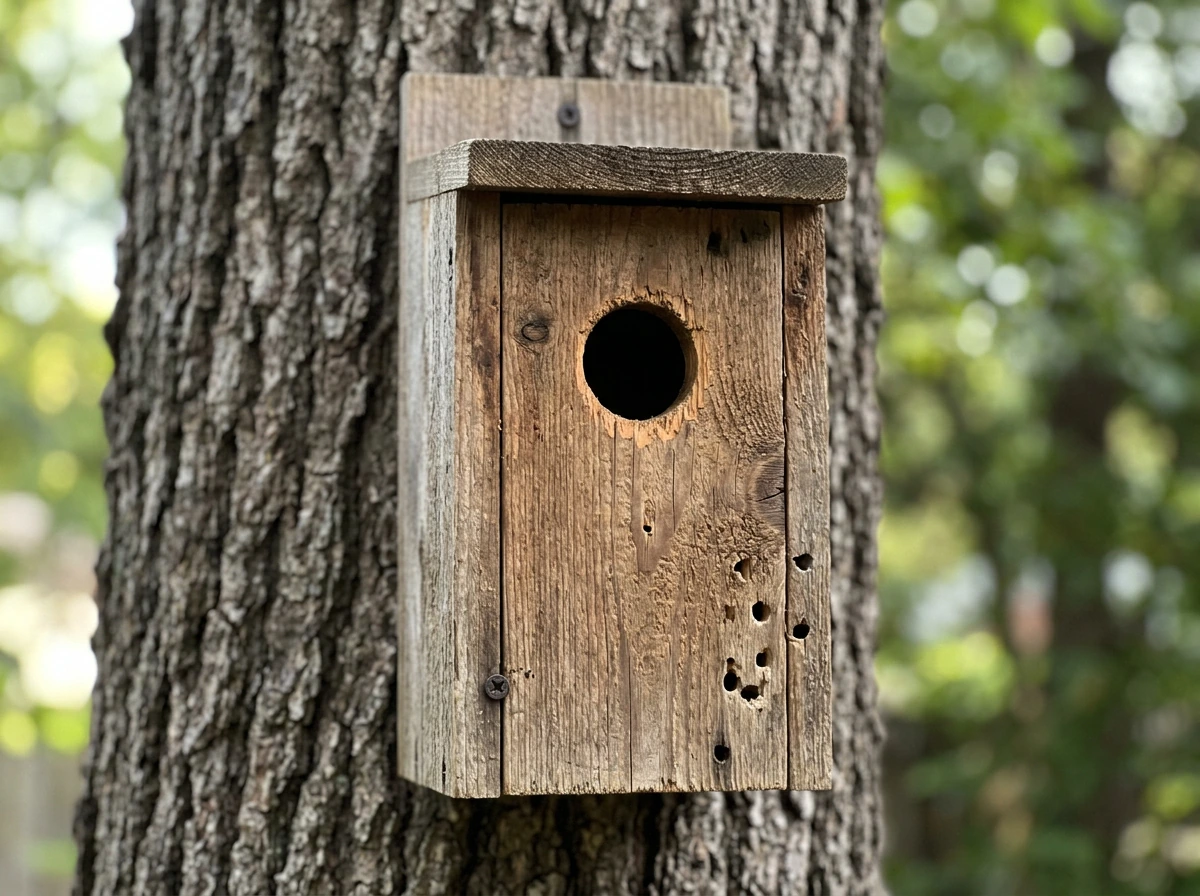
Before you look at any specific design, it helps to know that birds fall into two broad nesting camps: cavity nesters and open-cup nesters. Cavity nesters evolved to breed inside holes in trees, so they readily move into enclosed boxes. Open-cup nesters build open bowl-shaped nests on branches or ledges, and they prefer a flat platform over an enclosed box. A small number of species (most famously purple martins) nest in loose colonies and do best in multi-unit housing. Once you know which group your target bird belongs to, the right house style becomes obvious.
Cavity nesters: the classic enclosed birdhouse box
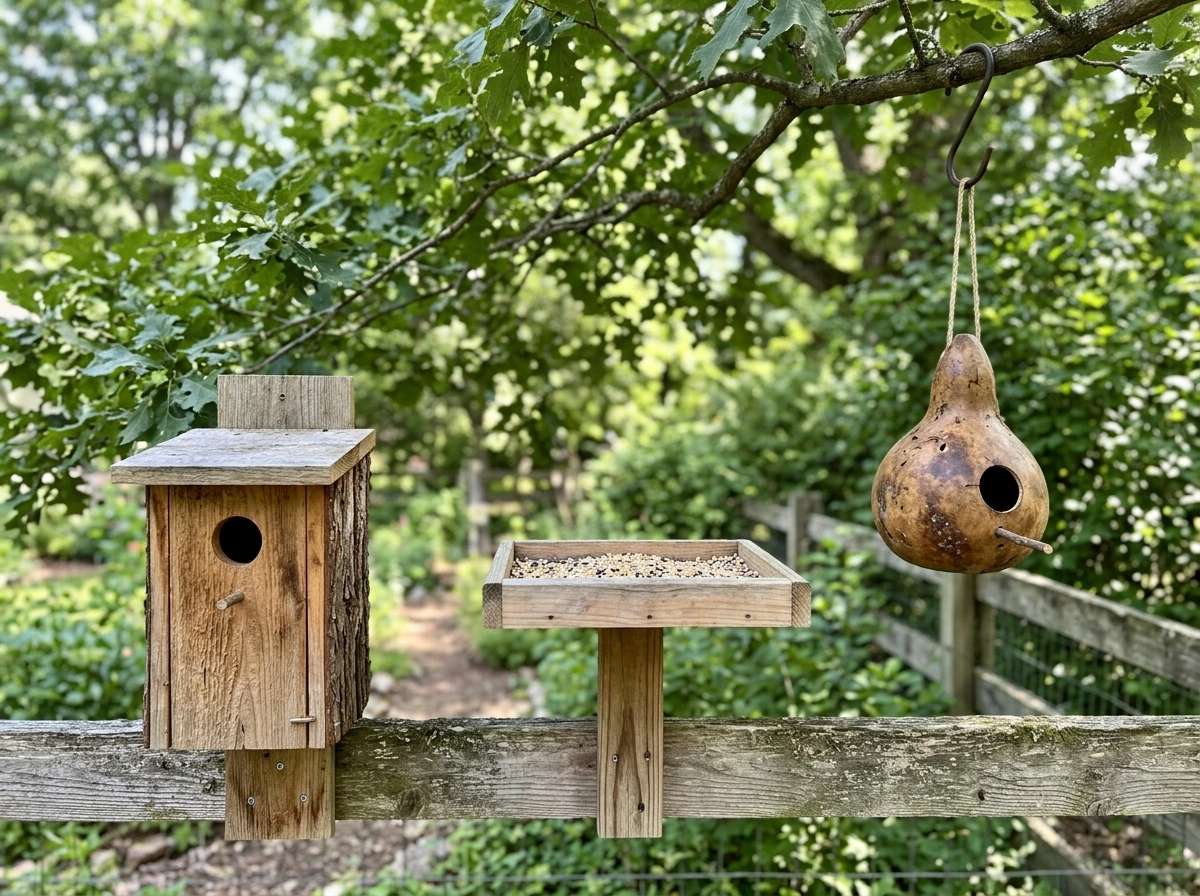
The enclosed wooden nest box is what most people picture when they think of a birdhouse, and it is by far the most useful style to start with. It mimics a natural tree cavity: four walls, a floor, a sloped roof for rain runoff, and a single circular entrance hole on the front face. Species like bluebirds, chickadees, wrens, nuthatches, tree swallows, flickers, screech owls, and kestrels all nest this way. These birds will not use an open platform, so if any of them are your target, an enclosed box is non-negotiable.
The entrance hole diameter is the single most important dimension on an enclosed box. A smaller hole targets smaller songbirds and physically blocks larger competitors from moving in. A house wren, for example, needs only a 1-inch entrance hole. A black-capped chickadee fits through a 1 1/8-inch hole. A bluebird needs about 1.5 inches. If you drill the hole too large, starlings and house sparrows will take over the box before your target species gets a chance. When in doubt, size the hole to the smallest bird you want to host, then go from there.
Cavity depth matters too. A house wren is comfortable in a box with a cavity depth of about 6 to 8 inches, while a black-capped chickadee does well in a cavity around 9 inches deep. The inside front face below the entrance hole should have a rough or grooved texture so fledglings can climb out on their own. The Washington Department of Fish and Wildlife specifically recommends rough interior surfaces for exactly this reason, and if you are buying a finished box, you can score the inside with a utility knife if the surface is too smooth.
Key dimensions for common cavity-nesting species
| Species | Floor Size (in) | Cavity Depth (in) | Entrance Diameter (in) | Mounting Height (ft) |
|---|---|---|---|---|
| House Wren | 4 x 4 | 6–8 | 1.0 | 5–10 |
| Black-capped Chickadee | 4 x 4 | 9 | 1 1/8 | 8–20 |
| Eastern Bluebird | 5 x 5 | 8 | 1.5 | 4–6 |
| Tree Swallow | 5 x 5 | 6–8 | 1.5 | 5–10 |
| Eastern Screech-Owl | 8 x 8 | 12–15 | 3.0 | 10–30 |
| American Kestrel | 8 x 8 | 12–15 | 3.0 | 10–30 |
Open-cup nesters: platform and tray designs
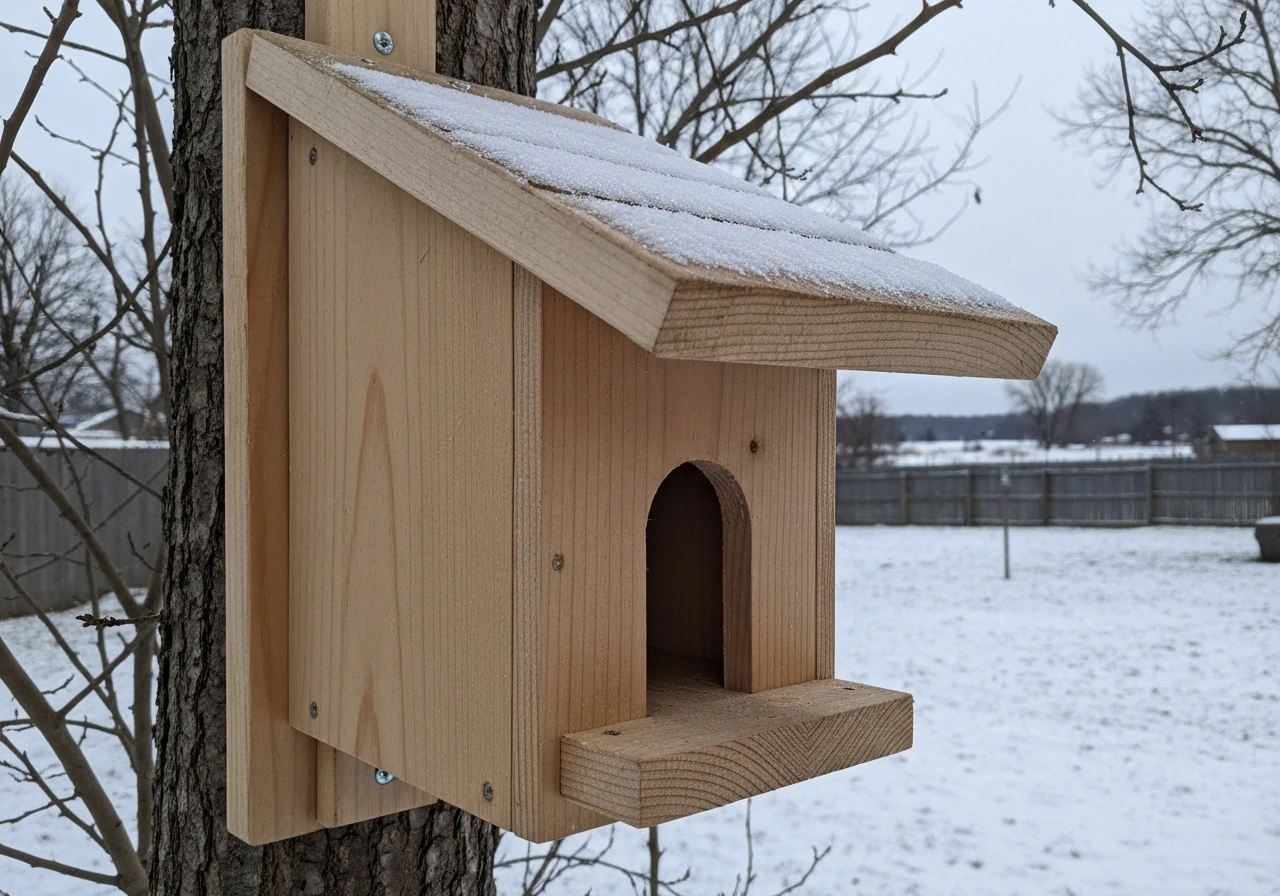
Robins, phoebes, barn swallows, and mourning doves do not nest in enclosed cavities. They build open cup or shelf nests on horizontal surfaces, and an enclosed box will sit empty if you are targeting these birds. A nesting platform (sometimes called a nesting shelf or tray) is basically a small open-sided wooden shelf, usually with a partial roof for rain cover and a low lip on the front to keep eggs from rolling out. Some designs have three sides and a roof; others are nearly completely open. Mount them under a porch eave, on a barn wall, or under a deck overhang to give the birds the overhead shelter they naturally look for.
These platforms are simple to build and inexpensive to buy. The key is placement: robins like platforms at about 5 to 15 feet off the ground in a somewhat sheltered spot with nearby vegetation, while barn swallows strongly prefer locations inside or under open structures. A platform sitting on a post in the middle of an open yard will not attract either species. Think about where you have already seen these birds loitering or nesting naturally and mount the shelf nearby.
Specialized options: gourds, log hollows, and colony houses
Gourd birdhouses
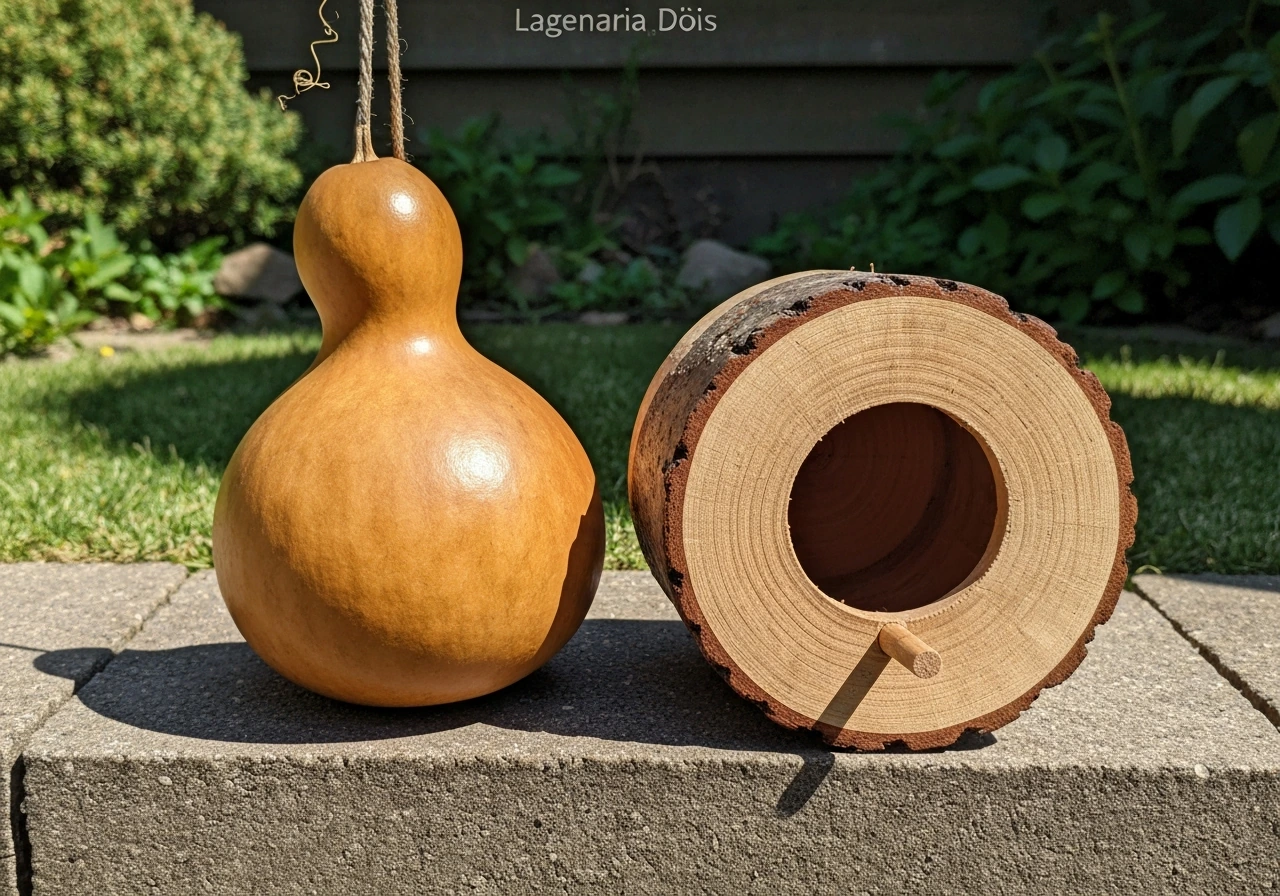
Dried natural gourds (specifically lagenaria gourds, the hard-shelled variety) have been used as birdhouses for centuries, and purple martins in particular seem to have a genuine preference for them. According to the National Wildlife Federation, a gourd used for a purple martin house should be at least 10 inches wide to give the birds enough interior space. You drill an entrance hole sized to 2 1/8 inches (the size recommended by the University of Maryland Extension for purple martins), hang them in a cluster on a rack or trolley pole system in an open area near water, and martins will prospect them during spring migration. Gourd houses also work for wrens and bluebirds if sized accordingly. They are natural insulators, they drain and ventilate well if drilled properly, and they are genuinely attractive in a garden setting.
Log and woodcut hollows
A log hollow or woodcut nest box is essentially a natural-looking alternative to a milled lumber box. You take a short section of log (often cedar or pine), hollow out the interior with a drill or chisel, and add a drilled entrance hole and a rough floor. These boxes are heavier and more time-consuming to make, but they are excellent at regulating temperature because of the wood mass, and they look completely at home in a naturalistic or wooded yard. The same dimensional rules apply as with any cavity box: match the interior floor size, cavity depth, and entrance hole diameter to your target species.
Multi-compartment colony houses
Multi-compartment houses are designed for species that nest in loose colonies, with purple martins being the prime example. A typical martin house has anywhere from 6 to 24 individual compartments arranged in a tower or apartment-style structure, all mounted on a single tall pole. Each compartment needs its own 2 1/8-inch entrance hole, adequate floor space, and ventilation. These are high-commitment setups: purple martins in the eastern U.S. are almost entirely dependent on human-provided housing, so once you attract a colony you are signing up for annual management. The Purple Martin Conservation Association is explicit that cleaning out old nesting material and replacing it with fresh is one of the most effective ways to reduce parasite loads between nesting seasons. If you are in a region where martins are common (more on regional factors if you are in a place like Minnesota or Southern California, where martin populations and available species differ), a colony house is worth the investment.
Sizing, entrance holes, and where to put the box
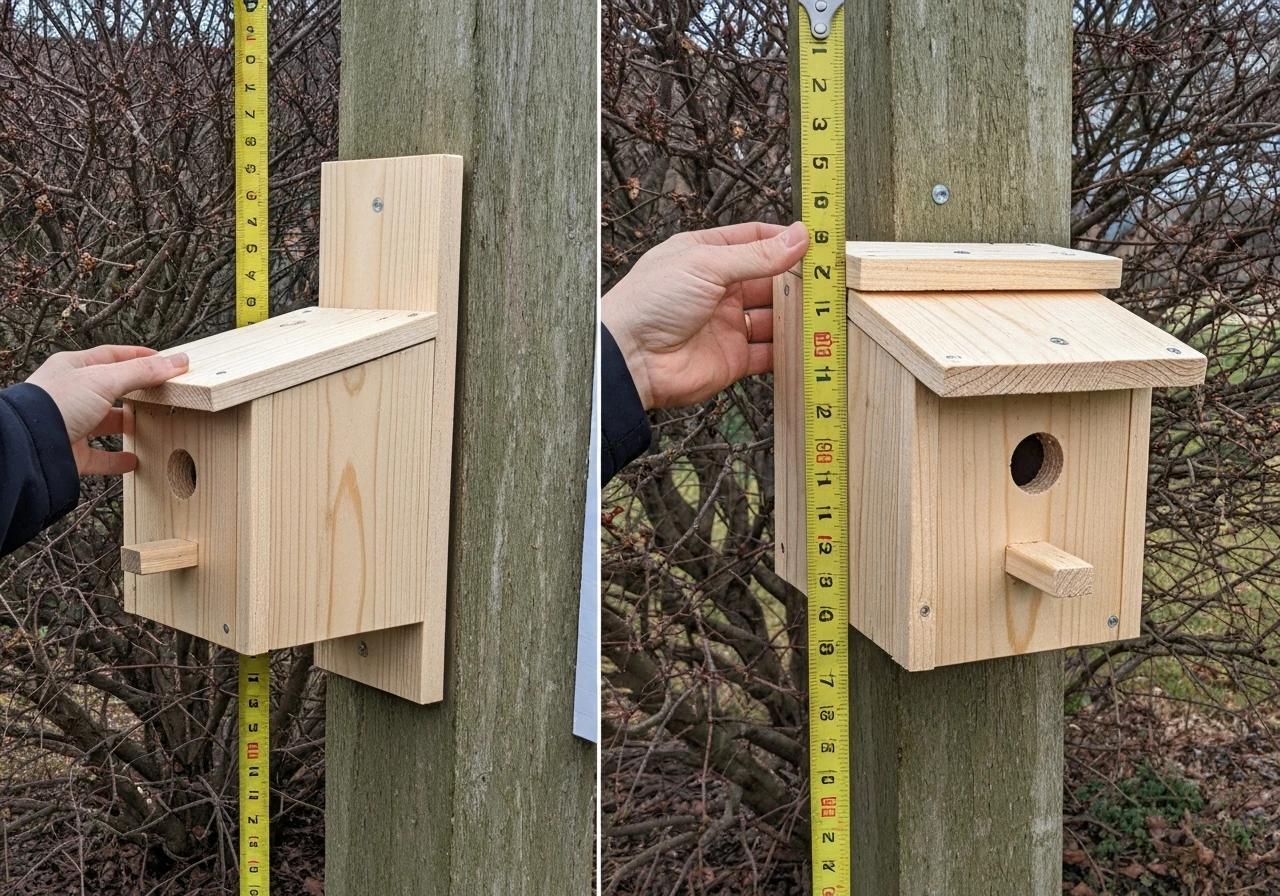
Getting the size right is not about being fussy. It is about whether the box gets used at all. A box that is too small will not attract the species you want. One with too large an entrance will be taken over by starlings or house sparrows. Use the table above as your baseline, then cross-reference with a nesting chart for your specific region and target species. NestWatch provides a detailed species-by-species placement table that is worth bookmarking.
Mounting height varies quite a bit by species. Chickadees are comfortable at 8 to 20 feet. Bluebirds prefer a lower mount, around 4 to 6 feet. Screech owls want 10 to 30 feet. Texas Parks and Wildlife recommends a minimum of 5 feet above ground when using a metal pole, partly for your access during monitoring and partly because it adds some predator separation. The direction the entrance faces matters less than people often think, but facing the hole away from prevailing weather (usually south or east in most of the U.S.) helps keep rain from driving in. Habitat type is more important: bluebirds need open grassland with scattered perches, while wrens prefer brushy edges or woodland margins.
Spacing between boxes is also worth thinking about if you plan to put up multiple houses. Most territorial songbirds (wrens, bluebirds, chickadees) will not tolerate another nest box of the same species within their territory, so putting two bluebird boxes right next to each other is counterproductive. A general rule is to space same-species boxes at least 100 yards apart, or pair them back-to-back at the same pole to allow two different species to each defend one direction.
Materials, durability, and keeping predators and weather out
Cedar and pine are the most commonly used woods for nest boxes, and both work well. Cedar is naturally rot-resistant and can last 10 to 15 years with minimal maintenance. Pine is cheaper and easier to work with, but it weathers faster and may need replacing in 5 to 7 years outdoors. Avoid pressure-treated lumber for any part of the interior or areas birds will contact directly, as the preservatives can be harmful. Exterior plywood is passable for budget builds but tends to delaminate at the edges after a few seasons of rain. Recycled plastic lumber (like that used in outdoor furniture) is extremely durable and easy to clean, though it is heavier and does not insulate as naturally as wood.
Ventilation and drainage are not optional. A box with no air movement gets dangerously hot in summer and stays damp in rain. The simplest approach is to drill four small holes (about 1/4 inch each) near the top of the side walls for ventilation, and either drill four drainage holes in the floor corners or bevel the corners off so water can escape. NestWatch specifically describes both approaches as acceptable and recommends choosing one or the other for every box you build or buy.
Predator guards are probably the single upgrade that most improves occupancy rates. A metal pole with a smooth conical baffle below the box stops raccoons, cats, and snakes from climbing up. The U.S. Fish and Wildlife Service emphasizes predator guards as a key design consideration, and NestWatch states directly that adding a baffle prevents most predator access. The Washington Department of Fish and Wildlife recommends wrapping a sheet-metal guard around any wooden post or tree used for mounting. If you are mounting on a wooden fence post, add the metal wrap. If you are mounting on a metal conduit pole, the smooth surface alone does most of the work, though a baffle adds insurance. A metal hole guard or metal plate around the entrance hole also stops squirrels from chewing the opening larger.
Picking the right type for your yard and birds
Start by identifying which birds already visit your yard or live in your neighborhood. If you are ready to compare options, these guidelines will help you narrow down the best places for bird houses for your specific backyard setup. If you are also trying to narrow things down by where you live, these best bird houses can complement your bird-specific setup. If you are also trying to narrow things down by where you live, these best bird houses can complement your bird-specific setup, and best bird houses for minnesota can be a helpful next step when your local species list is different. If you see bluebirds, tree swallows, or chickadees, an enclosed cavity box sized to the species is your best first move. If robins nest under your porch eave every year, a platform shelf in a similar sheltered spot will get used quickly. If you are in an open area near water and martins pass through your region each spring, a gourd rack or colony house is worth trying. Do not buy a multi-compartment martin house if purple martins do not breed in your part of the country, as it will sit empty and become a house sparrow hotel.
For most backyard birders starting out, the enclosed cavity box in bluebird or chickadee sizing is the safest bet. These two species are widespread across most of North America, they are active monitors of available cavities, and they are relatively tolerant of human activity near the nest once established. If you are choosing your first house, a 5x5-inch floor box with a 1.5-inch entrance hole covers both bluebirds and tree swallows and gives you the broadest chance of success. (For small-bird focused setups or region-specific guidance for places like Minnesota or Southern California, the <a data-article-id="6BC01730-80D0-4B64-A99D-3E953A175073">best bird houses for southern california</a> for those regions will vary based on local species, so it is worth looking into region-specific recommendations as well. If you are specifically targeting smaller songbirds, use these best bird houses for small birds as your baseline before you fine-tune the hole size and placement. )
Quick comparison of birdhouse types
| Type | Best For | Key Feature | Limitations |
|---|---|---|---|
| Enclosed cavity box | Bluebirds, chickadees, wrens, swallows, owls | Entrance hole size controls which species can enter | Wrong hole size = wrong bird (or no bird) |
| Open platform/tray | Robins, phoebes, barn swallows, doves | Open sides mimic natural ledge nesting sites | Needs sheltered placement; exposed to weather without eave/overhang |
| Gourd house | Purple martins, wrens, bluebirds | Natural insulation; traditional martin preference | Needs proper sizing; gourds degrade faster than wood if not cured well |
| Log/woodcut hollow | Same as cavity box species | Natural look; excellent temperature regulation | Heavy; labor-intensive to make; harder to open for cleaning |
| Multi-compartment colony house | Purple martins only | Houses entire colony in one structure | High maintenance; only useful where martins actively breed |
Cleaning and seasonal maintenance
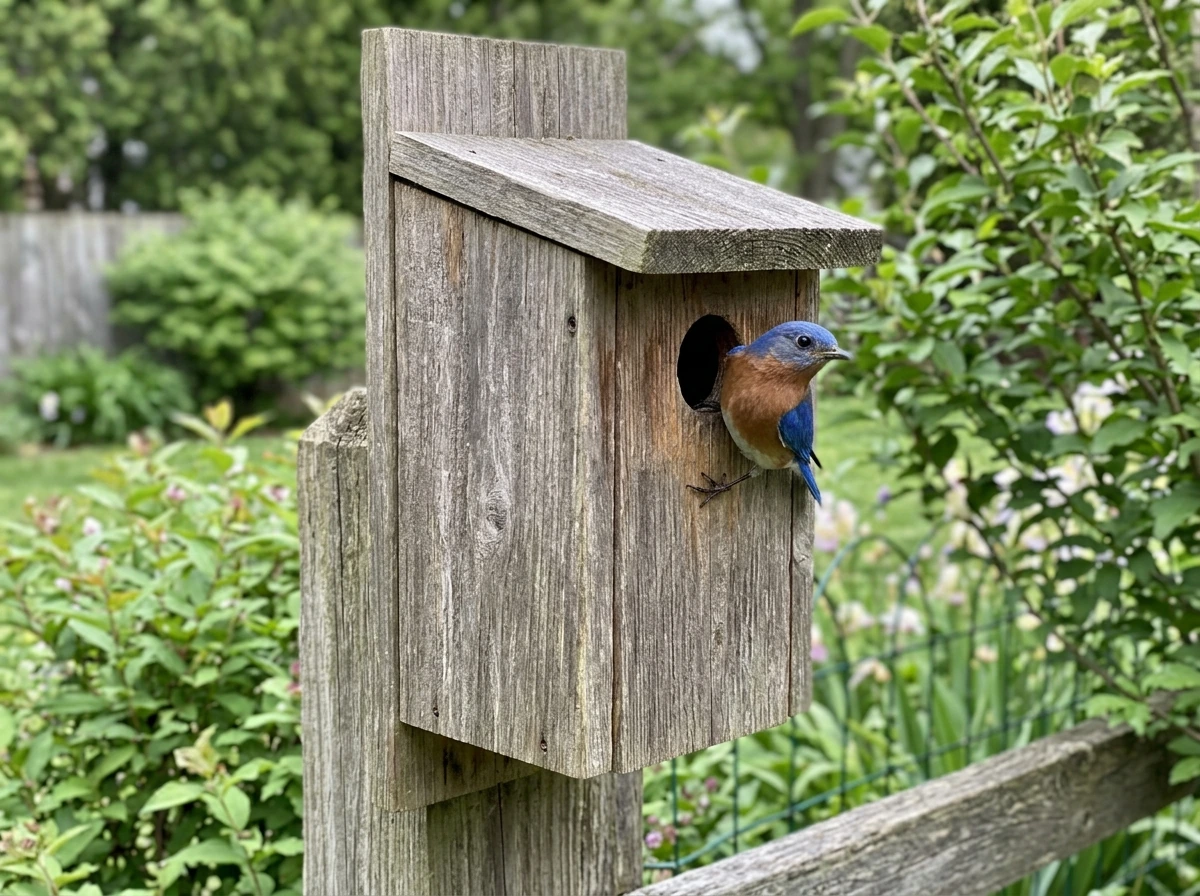
A birdhouse that never gets cleaned will eventually stop being used. Parasites, bacteria, and old nesting material accumulate over the season and can harm the next clutch. The good news is that maintaining a nest box does not take much time if you do it consistently.
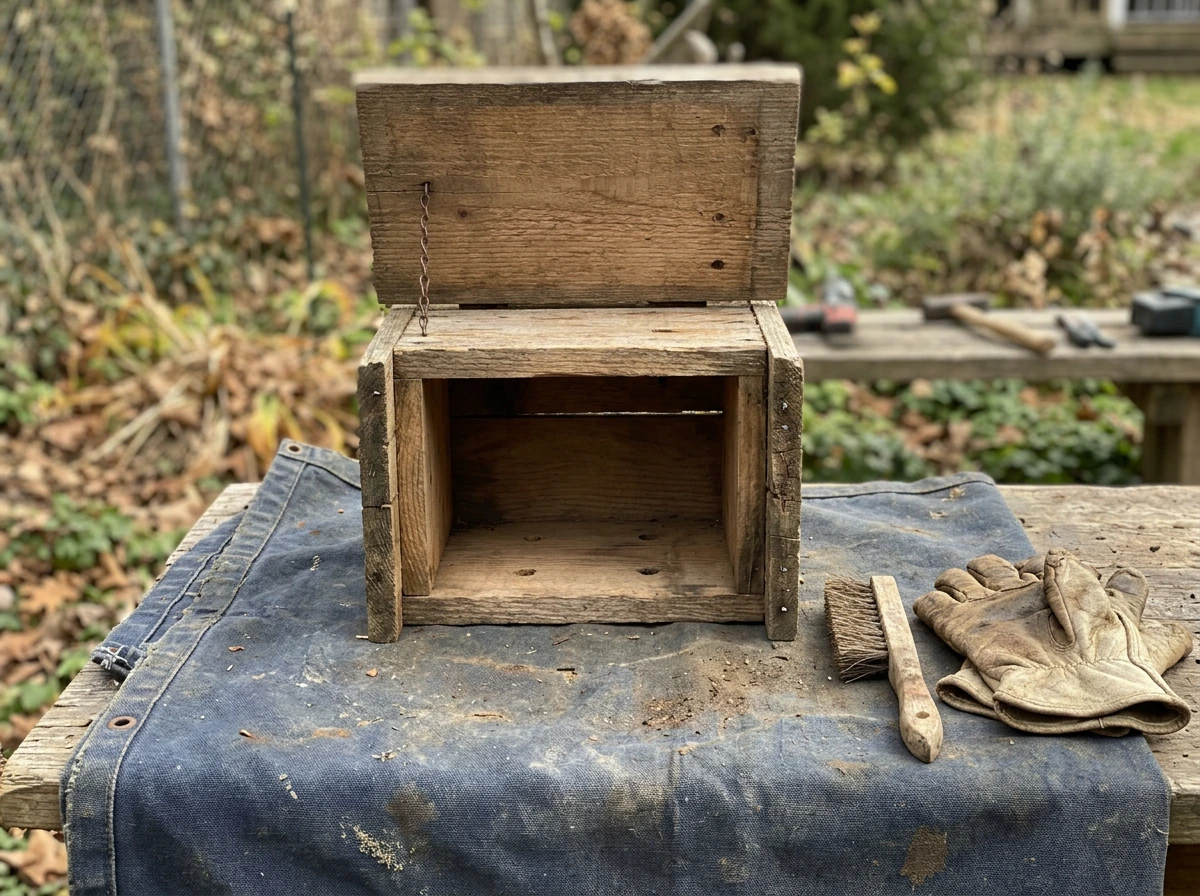
Clean nest boxes after each nesting attempt ends and the young have fledged, or at minimum once at the end of the breeding season (typically late summer in most of North America) and again in early spring before birds begin prospecting. Never clean a box that shows any signs of active nesting: eggs, young, or adults entering and exiting regularly. Wait until the box has been empty for at least a week.
- Open the box and remove all old nesting material completely. Carry it at least 15 feet away from the box before discarding it (this is the bluebird protocol from the San Juan Preservation Trust, and it prevents parasites from crawling back in).
- Brush out any debris, feathers, or insect matter from the interior walls and floor.
- Mix a cleaning solution of 1 part household bleach to 10 parts water (this is the ratio NestWatch recommends for boxes with fecal contamination or parasite concerns).
- Spray or wipe the interior surfaces with the solution. Let it sit for a few minutes.
- Allow the box to air-dry completely with the door open before closing it up again.
- Check that drainage holes are clear and ventilation holes are unobstructed. Confirm the entrance hole has not been chewed wider by squirrels.
- Inspect the predator baffle and mounting hardware. Tighten any loose screws and replace corroded hardware.
For multi-compartment martin houses and gourd racks, the Purple Martin Conservation Association recommends replacing old nesting material with fresh (some managers use a small amount of dried pine straw) as part of the annual cleanup, since this removes the bulk of blow fly larvae and mites that overwinter in the nest debris. Martin houses should be lowered on their telescoping poles for this process, which is one reason a good pole system with easy lowering is worth paying for upfront.
After cleaning, leave the box open or the entrance unblocked through fall and winter. If you are planning ahead for cold weather, use the best bird houses for winter to help birds roost and stay protected through the season. Many cavity-nesting birds roost in nest boxes on cold nights, and a clean, dry box is a genuine survival resource in winter. You can plug the entrance hole in late January in cold climates to discourage early house sparrow takeover, then open it back up a week or two before your target species is expected to arrive based on local migration timing.
Your decision path, from start to finish
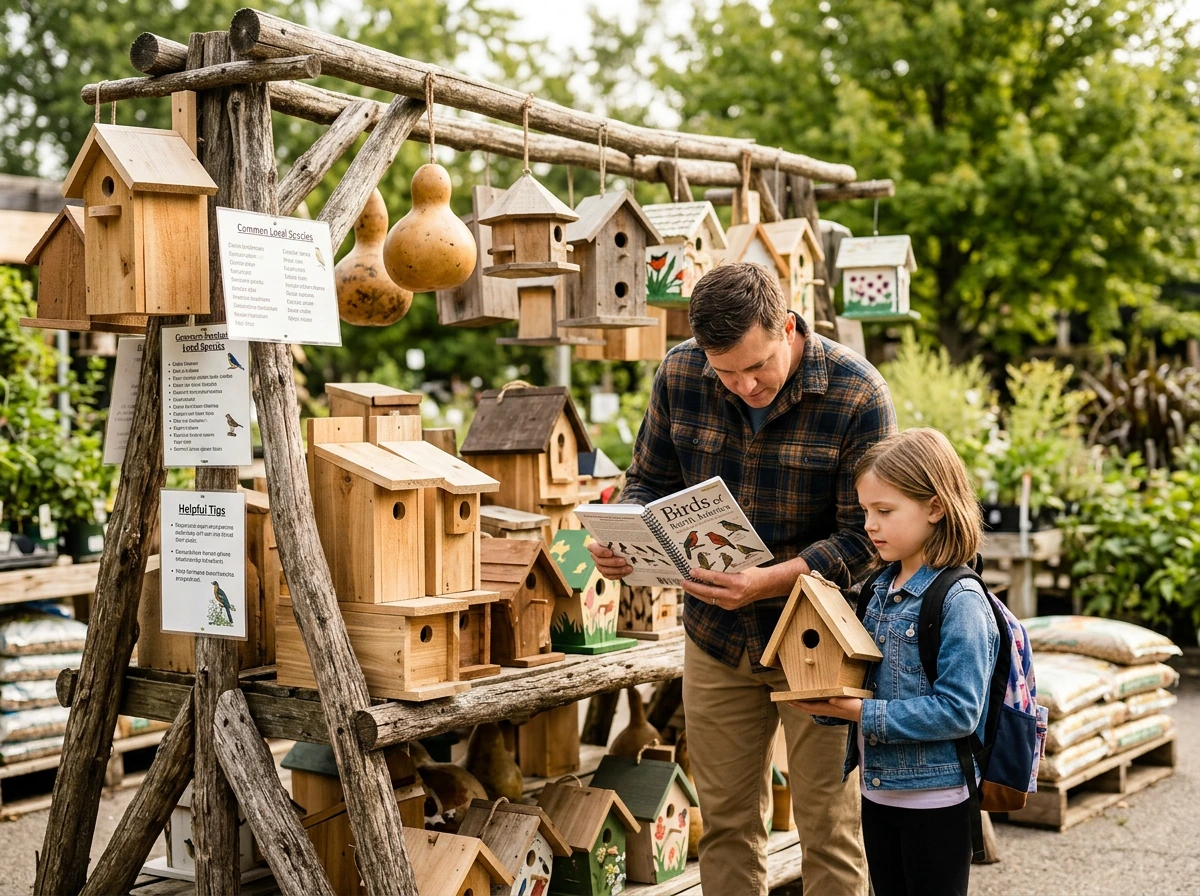
Here is the practical sequence to follow: First, identify which birds you want to attract and confirm they breed in your area. Second, match the nesting behavior to the house type (cavity box, open platform, gourd, or colony house). Third, use the size and entrance hole chart above to spec the box correctly for your target species. Fourth, choose a location based on habitat type and mounting height, and add a predator baffle to whatever you mount it on. Fifth, build or buy a box with ventilation holes and drainage built in. And sixth, commit to cleaning after each nesting season so the box stays healthy and continues to get used year after year. That is the whole loop, and every step is something you can act on today.
FAQ
Can I mix features from different birdhouse types (like adding an entrance hole to a platform)?
Yes, but only for species that actually accept that setup. If your target bird is a cavity nester (like wrens, bluebirds, chickadees), a fully enclosed box is what they look for. If your target is an open-cup builder (like robins or phoebes), an enclosed box will usually remain empty, even if the entrance hole size is correct.
What should I do if I’m getting the wrong species using my birdhouse?
Often, the entrance hole opening is the limiting factor for nest-box takeovers. If the hole is too large, starlings and house sparrows can enter, while a hole that is too small blocks your target species. For best results, size the opening to the smallest bird you want to host, and use proper cavity depth and ventilation so the target species stays comfortable.
Does the direction the entrance faces really matter for birdhouse success?
For enclosed cavity boxes, positioning the opening away from prevailing driving rain can help, but it is not as critical as hole size, mounting height, and ventilation. Focus first on habitat match (open grassland for bluebirds, brushy edges for wrens) and predator protection, then fine-tune the entrance direction if you live in a very stormy area.
When is the best time to clean a birdhouse, and can I clean it during nesting?
If the box is already occupied, do not clean immediately. Wait at least a week after the birds have stopped using it, and make sure there are no eggs or active adults entering and exiting. Cleaning too early can cause nest abandonment and can also expose birds to disturbance right before they need the safest possible site.
Will cleaning in late fall or winter stop cavity-nesters from roosting?
If you use a cleaning schedule, roosting is usually addressed by leaving the box available in cold months, not by keeping it dirty. In late winter, you can briefly plug the entrance in cold regions to discourage early house sparrow activity, then reopen a week or two before your target species typically arrives locally.
Can I put up a martin-style colony house even if purple martins are rare where I live?
Multi-compartment colony houses are only useful where purple martins actually breed. If martins do not nest in your region, those openings often become prime spots for house sparrows. The safer move is to choose a single-species cavity box or platform that matches what you already see locally.
Are plastic or composite birdhouses as good as wood?
Yes, but with important constraints. Wood is generally fine if it is not pressure-treated, and pine usually weathers faster than cedar. Whichever material you choose, the key requirements remain ventilation, drainage, correct entrance size, and a rough or grooved interior climbing surface below the entrance for fledglings.
What kind of predator guard actually improves occupancy rates?
Predator guards help most when they prevent climbing all the way to the box, not just when they block one approach path. For posts, wrap-around metal guards or smooth conical baffles are effective, and a baffle under the box is especially useful for raccoons. Also consider adding a metal plate or hole guard around the entrance to reduce squirrel chewing.
How far apart should multiple birdhouses be placed?
Spacing matters most within the same species. Territorial songbirds generally defend a nearby area, so two identical bluebird boxes too close together can interfere with nesting. A practical approach is to space same-species houses farther apart, and if you are using multiple units on one pole, consider back-to-back placement so each pair can defend one side.
How do I choose if I’m not sure which birds are going to use my yard?
Start by checking your yard’s existing nesting behavior, then match the house type accordingly. If you do not see cavity nesters but you see open-cup nesters using ledges, a cavity box will be wasted money. Use what you observe as the quickest diagnostic, then refine with local species charts for hole size and mounting height.
What is the most common reason a birdhouse sits empty?
Yes, and it is a common mistake. Several birds will not use enclosed cavities at all, so building or buying an enclosed box for robins, phoebes, or barn swallows typically leads to no nesting. For these species, use a shelf or tray mounted under a sheltered overhang near suitable perching sites.
Next Article
Best Bird Houses for Winter: How to Choose and Place Them
Choose and place the best winter bird houses with weatherproof design, ventilation, and safe roosting to attract cold bi