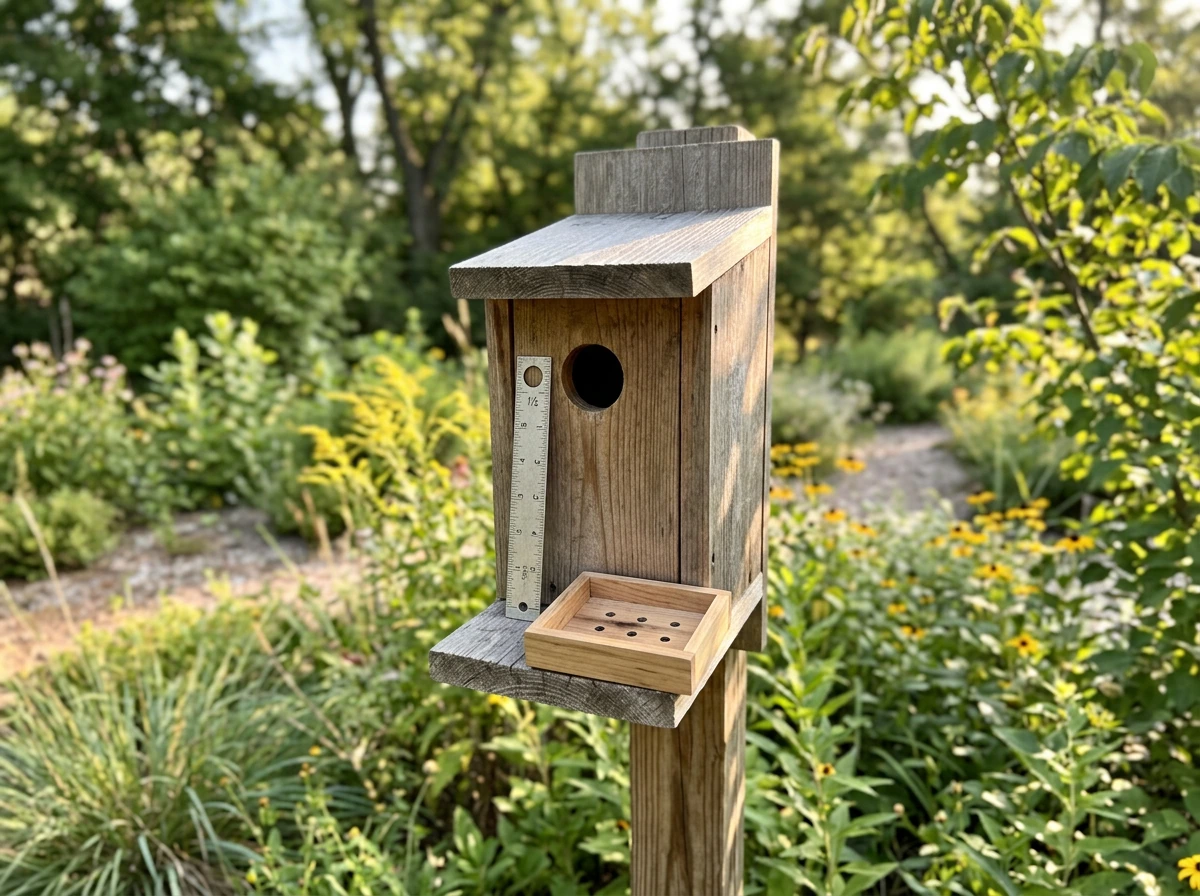
For Southern California backyards, the best birdhouse is one sized precisely for the species you're targeting, built or finished with heat-resistant materials, oriented to stay shaded through the hottest part of the afternoon, and fitted with a predator guard before it ever goes up. That combination matters more here than almost anywhere else in the country, because SoCal heat can cook eggs and nestlings inside a poorly ventilated box, and a loose cat or a Pacific gopher snake will empty a nest in minutes if you haven't planned for it.
Best Bird Houses for Southern California: Sizes, Specs
Maya Thompson
23 Jun 2026
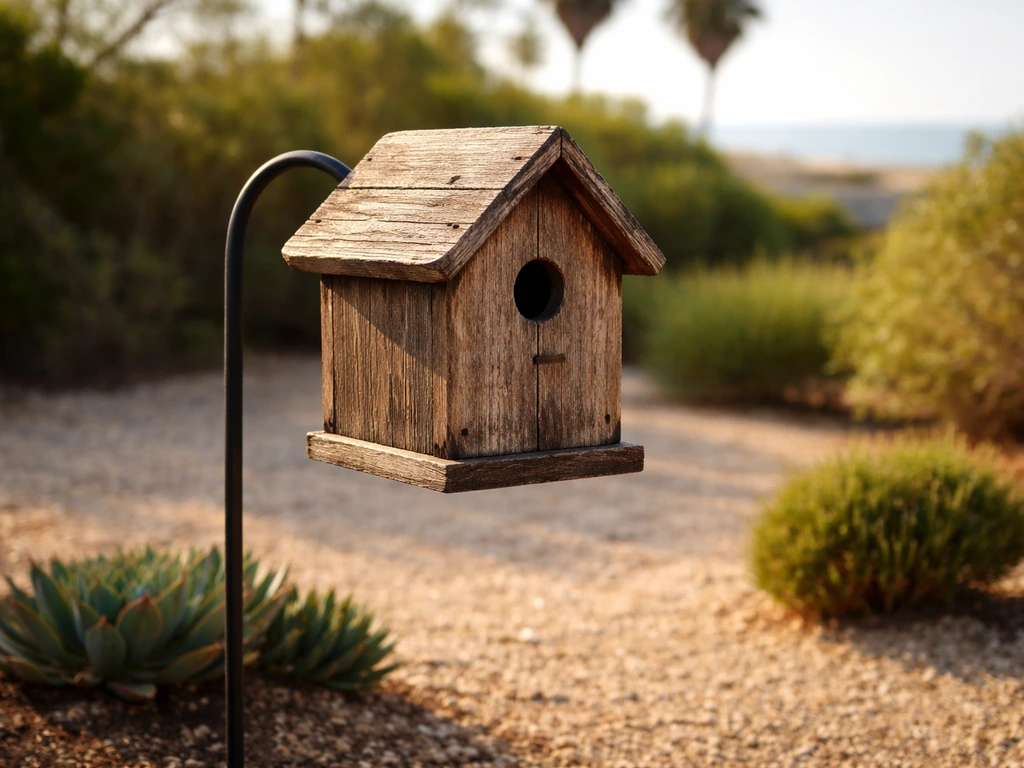
What 'best' really means for Southern California nesting birds
In a general birdhouse guide, 'best' often means attractive or easy to hang. In Southern California it means something much more specific: the right entrance hole so the target species can enter but House Sparrows or European Starlings can't take over, enough ventilation that interior temps don't spike above survivable limits on 100-degree inland days, a design you can open and clean in under five minutes, and hardware that keeps predators out. A beautiful cedar box with a 2-inch hole, no ventilation slots, and no baffle is not a good birdhouse here. It's a liability.
Southern California also has real microclimate differences that change what 'best' looks like. Coastal areas from San Diego to Malibu stay cooler, get marine layer in summer, and host different species than the hotter San Bernardino, Riverside, or Antelope Valley zones. Inland valleys and desert edges need more aggressive shading, deeper boxes, and more ventilation than coastal spots. Keep your own zip code in mind as you read through the recommendations below.
Pick the right birdhouse type for your target species
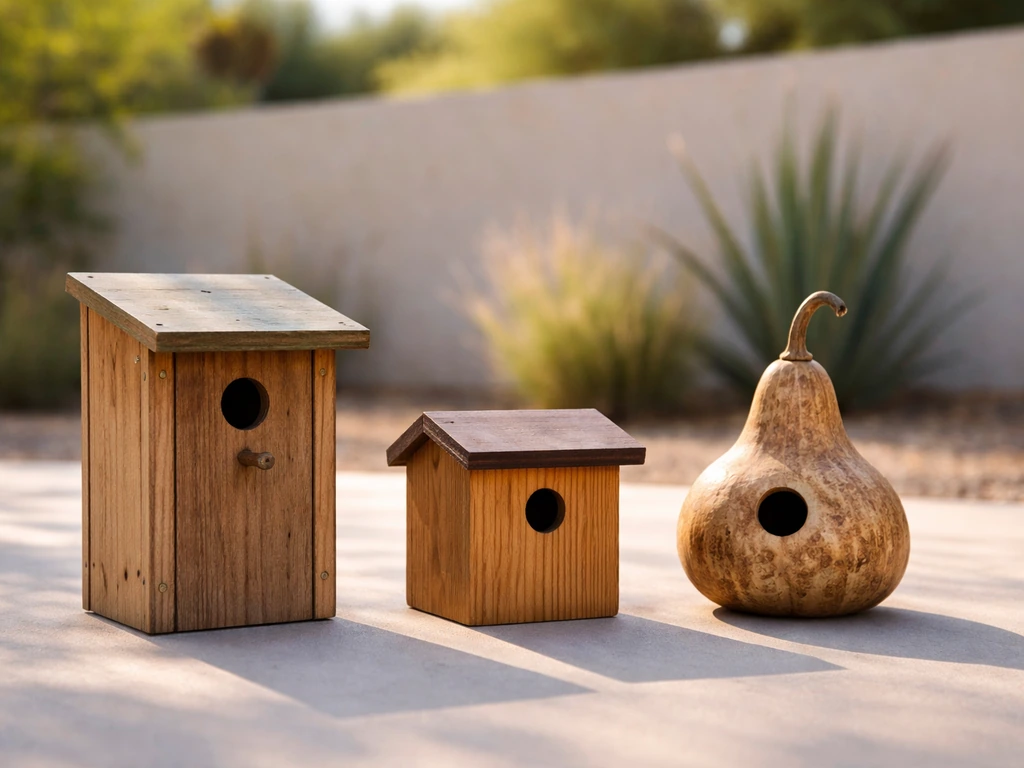
Southern California has a genuinely great lineup of cavity-nesting birds. Knowing which ones are realistic for your yard drives every decision that follows. Common options include bluebird boxes, swallow boxes, wren boxes, and woodpecker-style cavities, each shaped around a different species’ nesting behavior.
| Species | Birdhouse Style | Where They Nest in SoCal | Notes |
|---|---|---|---|
| Western Bluebird | Standard nest box (open face design) | Open grassland, oak woodland, foothill edges | Common in inland valleys; needs open perch area nearby |
| Oak Titmouse | Small enclosed nest box | Oak woodland, chaparral edges, suburban yards with oaks | Year-round resident; cavity loyal |
| Bewick's Wren | Small nest box or open-front box | Dense shrubby yards, canyons, coastal sage scrub | Very adaptable; will investigate multiple boxes |
| Tree Swallow | Standard swallow nest box | Near open water, meadows, coastal wetland edges | Needs open flight approach; does well on poles over water or grass |
| Violet-green Swallow | Standard swallow nest box | Mountains, canyon rims, suburban yards near open sky | Very similar needs to Tree Swallow |
| Ash-throated Flycatcher | Larger nest box or natural gourd | Desert edges, dry chaparral, Joshua tree habitat | Tolerates heat well; common in inland SoCal |
| House Wren | Small nest box | Brushy yards, foothill neighborhoods | Aggressive cavity competitor; space boxes well apart |
| Nuttall's Woodpecker | Deep woodpecker box | Oak woodland, riparian areas with large trees | Needs deeper box with coarse wood shavings on floor |
| Purple Martin | Multi-compartment gourd rack or martin house | Open areas near large water bodies in SoCal | Colony nester; requires serious predator management |
For most SoCal backyards, the most realistic and rewarding targets are Western Bluebird, Oak Titmouse, Bewick's Wren, and one of the swallow species. For small backyard birds, the right setup usually means matching the entrance size, ventilation, drainage, and predator protection to the species you want to attract western Bluebird, Oak Titmouse, Bewick's Wren. If your yard backs up to chaparral or desert scrub, the Ash-throated Flycatcher is a genuine possibility and easier to attract than people expect. Purple Martins are a bigger commitment and require very specific placement near large open water, so they're a project for experienced hosts rather than first-timers.
Correct measurements: hole size, box dimensions, and entry features
Getting the entrance hole right is the single most important dimension on any nest box. These measurements are the foundation of the best places for bird houses, so they help you choose the right spot and setup for your nesting birds. Too large and starlings move in. Too small and your target species can't enter. The measurements below are well-established and used by programs like NestWatch and the California Bluebird Recovery Program. Stick to them.
| Species | Entrance Hole Diameter | Interior Floor (W x D) | Interior Height | Entry Height Above Floor |
|---|---|---|---|---|
| Western Bluebird | 1.5 inches | 5 x 5 inches | 8–10 inches | 6–7 inches |
| Oak Titmouse | 1.25 inches | 4 x 4 inches | 8–10 inches | 6–8 inches |
| Bewick's Wren | 1.0–1.25 inches | 4 x 4 inches | 6–8 inches | 4–6 inches |
| Tree Swallow / Violet-green Swallow | 1.5 inches | 5 x 5 inches | 6–8 inches | 5–6 inches |
| Ash-throated Flycatcher | 1.5 inches | 6 x 6 inches | 8–10 inches | 6–8 inches |
| House Wren | 1.0–1.125 inches | 4 x 4 inches | 6–8 inches | 4–6 inches |
| Nuttall's Woodpecker | 1.5 inches | 4 x 4 inches | 12–15 inches | 9–12 inches |
| Purple Martin | 2.125 inches (crescent preferred) | 6 x 6 inches per compartment | 6 inches | 1–2 inches |
A few extra features matter as much as the raw numbers. Cut shallow horizontal grooves or staple a small square of hardware cloth on the interior wall below the entrance hole so nestlings can climb out when it's time to fledge. NestWatch specifically calls this a 'fledgling ladder' for Tree Swallows, but it benefits any species using a smooth-walled box. The entrance hole itself should be drilled cleanly with no splinters and have no external perch; perches help predators and nest competitors, not the nesting birds.
For bluebird boxes especially, the California Bluebird Recovery Program recommends an entrance extender: a short wooden tube glued or screwed around the outside of the entrance hole that extends it outward about 0.75 to 1 inch. This makes it much harder for a raccoon to reach in and grab eggs or young. It's a five-minute addition that genuinely improves outcomes.
Placement in SoCal: height, orientation, shade, and habitat spacing
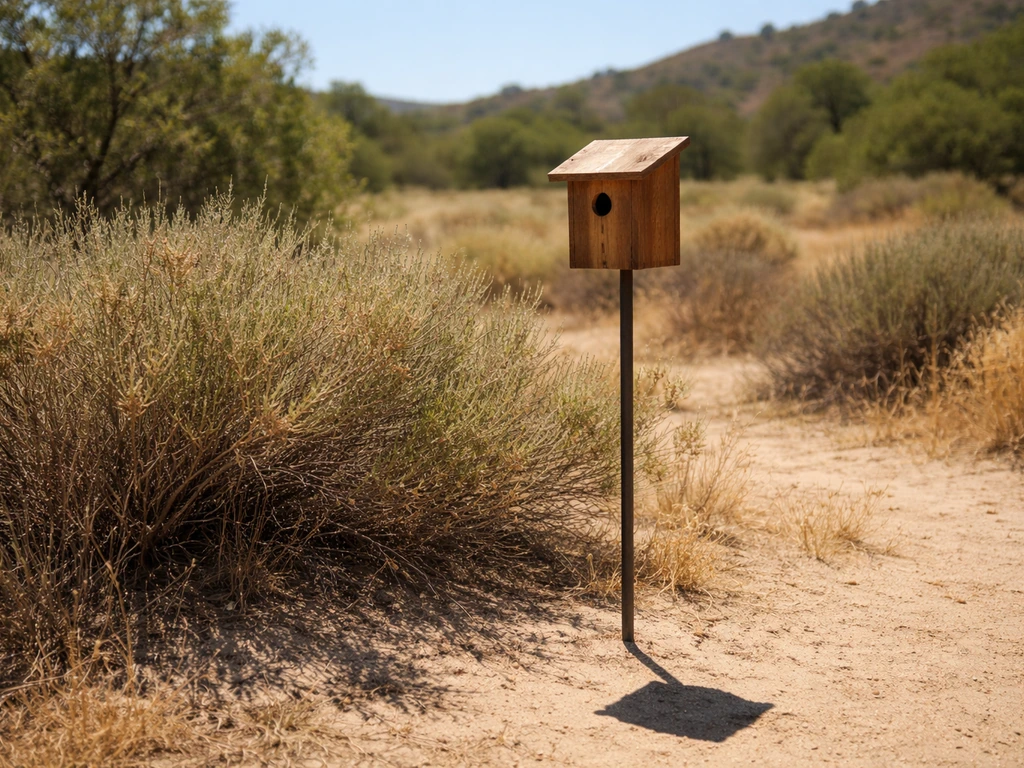
Height recommendations vary by species, but for most SoCal cavity nesters you're working in the 5- to 8-foot range above the ground when mounting on a pole. Tree Swallows do well at 5 to 6 feet on an open pole over grass or water. Bluebird boxes work at 4 to 6 feet. Ash-throated Flycatcher boxes can go higher, up to 10 feet, if you're mounting on a fence post or tree in drier habitat. Woodpecker boxes should go 10 to 20 feet up on a tree, mimicking a natural cavity.
Orientation is especially critical in Southern California. Face entrance holes east or northeast whenever possible. This gives the birds morning sun (which is gentle and helps warm the nest in cool coastal mornings) while keeping the box shaded during the brutal west and southwest afternoon sun that makes inland temps punishing from June through September. A west-facing box in Riverside or the San Gabriel Valley in July can hit interior temperatures that kill nestlings even if the adults are doing everything right.
For spacing: if you're putting up multiple boxes, keep the same species at least 100 feet apart, ideally 300 feet or more for bluebirds and swallows, which are territorial. Wrens can tolerate closer spacing in dense shrubby habitat. You can intentionally pair a bluebird box and a swallow box about 15 to 25 feet apart because those species tolerate each other as neighbors and the swallows will actually chase away House Sparrows, giving the bluebirds better odds.
Coastal yards have more flexibility on orientation because afternoon temps rarely get dangerous. Inland yards, desert-edge properties, and south-facing slopes in the foothills need to treat shade and ventilation as non-negotiable. If your only mounting option is a south or west face, add a shade baffle above the box or use a thicker-walled box (minimum 3/4-inch lumber) to slow heat transfer.
Predator-proofing and safety essentials
Predation is the number one cause of nest failure in managed birdhouses, and Southern California has a specific cast of predators to plan for. The Pacific gopher snake is explicitly flagged by the California Bluebird Recovery Program as a prevalent nest predator for bluebird boxes. It's nonvenomous but an excellent climber. Raccoons, opossums, and feral or free-roaming cats round out the threat list, and in some foothill and desert areas, rat snakes and even coyotes can disturb low-mounted boxes.
The most effective solution for pole-mounted boxes is a stovepipe baffle: a smooth metal cylinder (about 8 inches in diameter and 18 inches tall) centered on the mounting pole below the box. Snakes, raccoons, and cats cannot grip or climb past it. Pipe it so the bottom edge sits at least 18 inches above the ground and the top is tight to the pole. Stovepipe baffles are inexpensive, last for years, and outperform cone baffles for snake deterrence because snakes can work around a cone but can't navigate the inside of a cylinder.
For tree-mounted boxes, a cone baffle or wrap of sheet metal around the trunk below the box helps, though tree mounting is inherently harder to fully predator-proof than a freestanding pole. If you can choose, a smooth metal or PVC pole with a stovepipe baffle is always the safer option.
Cats are a special challenge in suburban SoCal. Even a well-fed outdoor cat will investigate a nest box. If neighborhood cats are a known issue, mount boxes higher (7 to 8 feet on a baffled pole) and avoid shrubby ground cover directly below the box that gives cats a launch or hiding point. Having a conversation with neighbors about keeping cats indoors during the April through July peak nesting season is genuinely worthwhile.
- Use a stovepipe baffle on all pole-mounted boxes: minimum 8-inch diameter, 18-inch height, centered on the pole
- Add an entrance hole extender (0.75–1 inch deep wooden collar) to bluebird and flycatcher boxes to prevent reach-in predation
- Mount on smooth metal or PVC conduit poles rather than wood posts whenever possible
- Avoid attaching boxes to fences or trees in areas with known raccoon or snake activity if you can mount on a freestanding pole instead
- Keep grass and ground cover trimmed below the box to reduce snake and cat ambush cover
- Never add an exterior perch: it helps nest competitors and predators, not your target species
Materials, ventilation, drainage, and weatherproofing that won't overheat birds
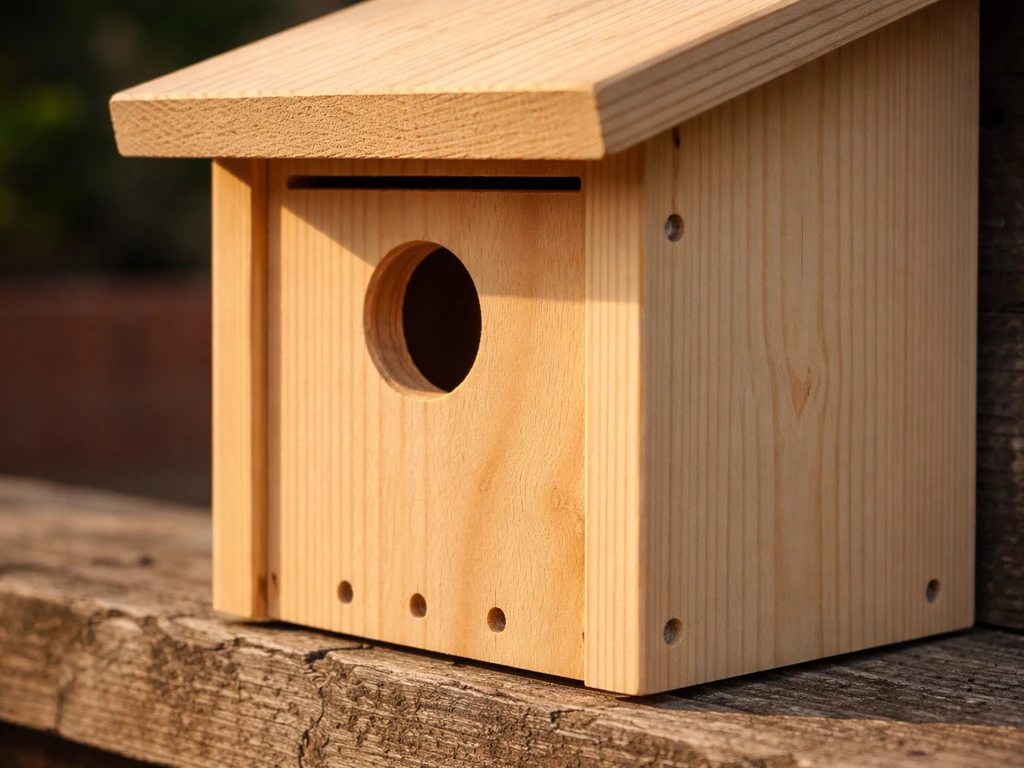
For Southern California, wood is the right material for nest boxes, and not all wood is equal. For winter specifically, the best bird houses are the ones that protect cavity-nesting birds from cold drafts and still provide safe ventilation best bird houses for winter. Cedar and redwood are the top choices because they insulate well, resist moisture, and don't require any finish.
Pine works fine if you use exterior-grade lumber at least 3/4 inch thick, and the extra thickness helps with heat insulation. Avoid plywood with exterior-grade glue for the main box body (fine for a roof baffle) because the thin layers conduct heat faster. Never use pressure-treated lumber inside a box or on surfaces birds contact. The chemicals are a real toxicity risk.
Finishes on the exterior are fine as long as you follow one rule: light colors only, or leave it unfinished. A dark-stained or dark-painted box in the Inland Empire in August will absorb enough radiant heat to become dangerous. If you want to finish the outside, use a light-toned exterior latex paint (tan, light gray, or white) or a light-toned exterior stain on the outside surfaces only. Never paint or stain the interior.
Ventilation is the feature most commercial birdhouses skip and most DIY builders forget. Drill four to six 1/4-inch ventilation holes near the top of each side wall, just below the roofline. This lets hot air escape instead of building up inside. On an inland SoCal box, also consider drilling two 1/4-inch holes in the upper front face (angled upward so rain doesn't get in) for cross-ventilation. The roof should overhang the front face by at least 2 to 4 inches to shade the entrance and block rain.
Drainage holes at the four corners of the floor (about 1/4 inch each) are essential. SoCal rain is rare but intense, and a flooded floor box will destroy a nest. Recessing or beveling the floor edges slightly so they don't sit flush against the walls also helps drainage. If you're buying a commercial box, check for drainage holes before you hang it. Many decorative boxes sold in garden centers have neither drainage nor ventilation.
Maintenance and cleaning schedule for healthy nests
A nest box you can't easily open is a nest box you won't maintain, and an unmaintained box quickly becomes a parasite and disease problem. Every box you put up should have a hinged side panel or a roof that swings open with a single screw or latch. No tools, no disassembly.
In Southern California, the main breeding season runs roughly February through July, with bluebirds sometimes getting two or three clutches in a good year. During the season, check boxes every one to two weeks. You're looking for signs of parasites (blowfly larvae visible in nest material), evidence of predator attempts (scratch marks, damaged entrance), and whether the nest has been taken over by House Sparrows (remove House Sparrow nests promptly and repeatedly: they are an invasive species and not protected). Keep disturbance brief and calm.
After fledglings leave each clutch, NestWatch recommends removing the old nest material so it doesn't accumulate parasites or block the floor for the next clutch. This is a common practice, not controversial, and bluebirds and wrens readily build a fresh nest in a cleaned-out box within days.
At the end of the breeding season, usually by August in most SoCal locations, do a full cleanout: remove all nest material, scrub the interior with a stiff brush and a dilute bleach solution (one part bleach to nine parts water), rinse thoroughly, and let it dry completely in the sun before closing it back up.
The California Bluebird Recovery Program notes that you don't need to disinfect after every single clutch, but a full disinfection at season's end is recommended.
- Check boxes every 1–2 weeks during the February–July nesting season
- Remove House Sparrow nests immediately and continue removing them on return visits
- After each clutch fledges, remove old nest material to reduce parasite load and prepare for the next clutch
- At season end (August or when nesting activity stops), do a full cleanout: brush, dilute bleach scrub, rinse, and sun dry
- Inspect hardware, baffles, and mounting pole for looseness or rust before the following February
- Leave the cleaned box in place through winter: some wrens and chickadees roost in boxes on cold nights
Quick-buy vs. DIY: how to choose for your yard
If you want the fastest path to a working setup, buy a plain, unfinished or lightly finished cedar or pine nest box from a wild bird specialty store or a conservation-focused vendor, then add a stovepipe baffle and an entrance hole extender yourself. This costs less than 30 dollars in materials for the baffle and extender, and takes about an hour. The box itself will cost anywhere from 20 to 60 dollars depending on species and size. Avoid any box with a painted interior, no drainage holes, no ventilation, or a plastic body.
If you're comfortable with a jigsaw and a drill, building your own box is straightforward and gives you full control over dimensions, wood thickness, and ventilation placement. For inland SoCal, I'd add an extra row of ventilation holes compared to standard plans and use 1-inch-thick cedar or pine rather than the thinner stock that gets specified in coastal-climate plans. The species-specific dimensions in the table above are all you need to build a functional box from scratch.
If you're deciding between species to target, start with what's already in your neighborhood. Spend a morning watching your yard or check eBird reports for your zip code before buying or building anything. A box optimized for Western Bluebird will sit empty if bluebirds don't pass through your area, but Bewick's Wrens or Oak Titmice are present in a much wider range of SoCal habitats and will investigate a box faster. Start with one box for the most realistic target species, get the placement and predator-proofing right, and add more boxes once you've seen what shows up.
Your pre-install checklist
Before you hang anything, run through this list. It covers the most common reasons a well-intentioned birdhouse fails in a Southern California yard. If you live in Minnesota, the same idea applies, but the best setup depends on local climate, predators, and which species are actually nesting where you are a well-intentioned birdhouse fails in a Southern California yard.
- Entrance hole is the correct diameter for your target species (see table above), drilled cleanly, with no external perch
- Interior has a fledgling ladder (horizontal grooves or hardware cloth patch) below the entrance hole
- Ventilation holes are present near the top of both side walls (minimum four holes at 1/4 inch)
- Drainage holes are present at the floor corners
- Roof overhangs the front face by at least 2 to 4 inches
- Box is made from untreated cedar, redwood, or pine at minimum 3/4-inch thickness
- Exterior finish (if any) is a light color; interior is completely unfinished
- Stovepipe baffle is installed on the mounting pole before the box goes up
- Entrance hole extender is attached for bluebird or flycatcher boxes
- Box is oriented east or northeast (especially critical for inland locations)
- Mounting height matches species recommendation and clears ground cover below
- Box has a side or roof panel that opens easily for monitoring and cleaning
- Spacing from other boxes of the same species is at least 100 feet (300 feet for bluebirds and swallows)
Once you've confirmed all of these, you're set up better than 90 percent of the birdhouses already hanging in Southern California backyards. Put it up by late January or early February to catch early-season scouts, and check it every week or two once activity starts. The first time you open the panel and find a nest with eggs in it, you'll understand why getting the details right was worth the effort.
FAQ
Can I paint or stain the inside of a birdhouse for the best bird houses for southern california?
Yes, but only if you keep the interior bird-safe. Use light-toned, exterior-rated finishes that you can fully cure before installation, and ensure the interior surfaces remain untouched (no paint, no stain, no sealant). For maximum safety, leave the box unfinished on the inside and use a sealed roof only if rain exposure is heavy.
What’s the safest time to move an installed birdhouse in Southern California?
If you must relocate, do it before nesting is active. In SoCal that usually means early winter (late January through early February) since breeding activity often begins by February. When moving during the season, avoid opening the box, and choose a nearby site with similar shade and predator protection so you are not abandoning a settled pair.
Are decorative birdhouses from garden centers ever a good choice in Southern California?
No, because they typically block airflow and often have no real drainage. Even if a decorative box looks nice, check for four corner drainage holes, roof overhang, and ventilation holes near the top. If any of those are missing, the box is more likely to overheat or flood, which is exactly what “best bird houses for southern california” are designed to prevent.
How much space should be clear in front of the entrance hole?
For most cavity nesters you should avoid placing boxes where the entrance is partially blocked by dense foliage within a few feet. While some wrens can tolerate clutter, many species struggle if the entrance is shaded or obstructed and predators have better hiding spots nearby. Leave a clear “approach zone” of open space in front of the entrance.
Should I clean and disinfect birdhouses during winter or only after nesting ends?
Winter feeding and birdhouse use don’t require the same timing. You can keep a house up year-round, but heavy cleaning and disinfecting should be done after the breeding season. In midwinter, just inspect quickly (without disturbing nests, if any), then reopen and service only if there are clear signs of pests or damage.
How often can I check my birdhouse without causing nest failure?
Not usually. Many species abandon nesting attempts if a box is opened too often or at the wrong times, especially during egg laying. Stick to the 1 to 2 week check schedule, and during checks look first, then minimize how long the door is open and how long you linger near the entrance.
What should I do if House Sparrows start using my birdhouse in Southern California?
If you find House Sparrow activity, remove it promptly and repeatedly, but do so carefully. Remove only sparrow nests or eggs you can safely access, keep disturbance brief, and clean the area inside the box after removal if you see sparrow material accumulation. Consider adding stronger access barriers (baffle, proper hole size, and no external perch) rather than enlarging the entrance.
How close can I place multiple birdhouses in one yard?
No, because extra boxes can increase competition if they are for the same target species or placed too close for territorial birds. For bluebirds and swallows, keep like-species boxes at least 100 feet apart (ideally 300 feet). For mixed targets, pairing a bluebird box and swallow box around 15 to 25 feet apart can work because of their neighbor tolerance.
Is mounting higher always better for birdhouses in cat-prone suburban areas?
It depends on species and on how well the box is predator-proofed, but a common mistake is choosing an attractive low placement that cats can reach. For SoCal, if neighborhood cats are an issue, mount higher (about 7 to 8 feet) on a baffled pole and avoid shrubs or cover directly below the box that could hide or launch cats.
If birds seem interested in the box, but no nesting happens, what should I double-check first?
Yes, and it’s an important edge case. Check both the entrance size and the entrance location relative to the box interior. If the entrance hole is too high or too low for a species, or if the interior wall shape blocks easy entry, you can get “interest” without successful nesting. Use species-specific dimensions and keep the entrance drilled cleanly with no splinters.
What are the most common “silent failures” that look fine from the outside?
If activity has stopped early, don’t automatically assume the box is bad. Look for predator signs (scratch marks, damaged entrance) and then verify the box can drain and vent properly. A box can look fine externally but still fail if drainage holes are blocked or ventilation holes were omitted.
Next Article
Best Bird Houses Guide: Buy or Build the Right Design
Choose the best bird house by matching your local species to design specs like entry size, ventilation, drainage, and mo