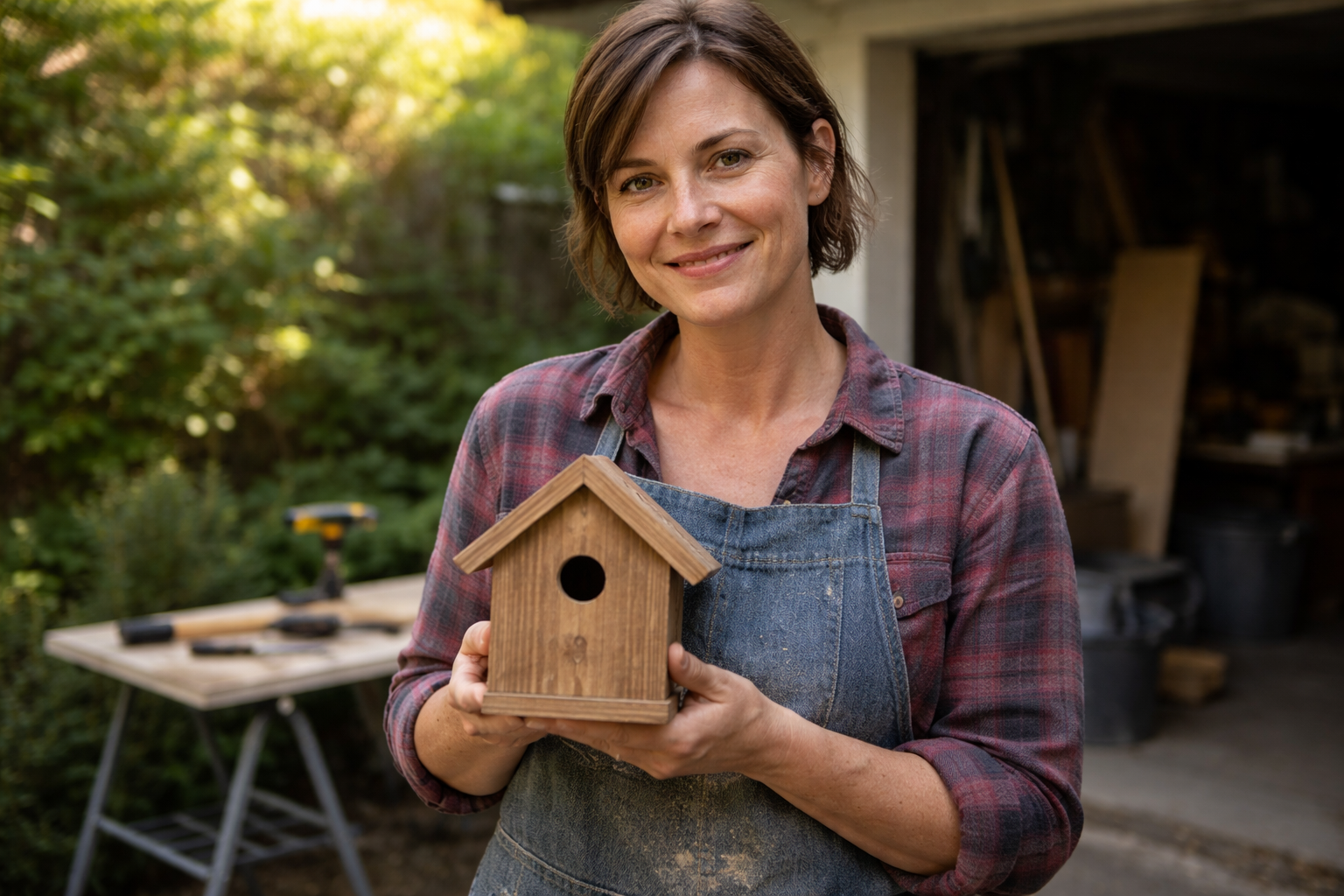
A bird house (also written birdhouse, or called a nest box or nesting box) is a man-made enclosed structure provided for birds to nest inside. It mimics a natural tree cavity, giving cavity-nesting species a safe, weather-protected space to raise young when hollow trees are scarce. The terms birdhouse and nest box are used interchangeably in practice, though conservationists tend to prefer 'nest box' to emphasize the functional, wildlife-benefit role over the decorative one. See our article on what a bird house is called for more on terminology and regional name variations.
Bird House Definition: DIY Guide, Sizes, Placement & Care
Maya Thompson
13 Jul 2026
What exactly is a bird house?
A bird house is a hollow box with an entrance hole sized to attract a target species, an enclosed interior where birds build a nest and incubate eggs, and enough structural integrity to survive a full breeding season outdoors. The Oxford Advanced Learner's Dictionary defines 'birdhouse' as a small box or structure put up for birds to nest in, and field guides treat 'nest box' as the direct functional synonym. You will also see the term 'nesting box' used on product labels and in extension publications. All three names describe the same thing.
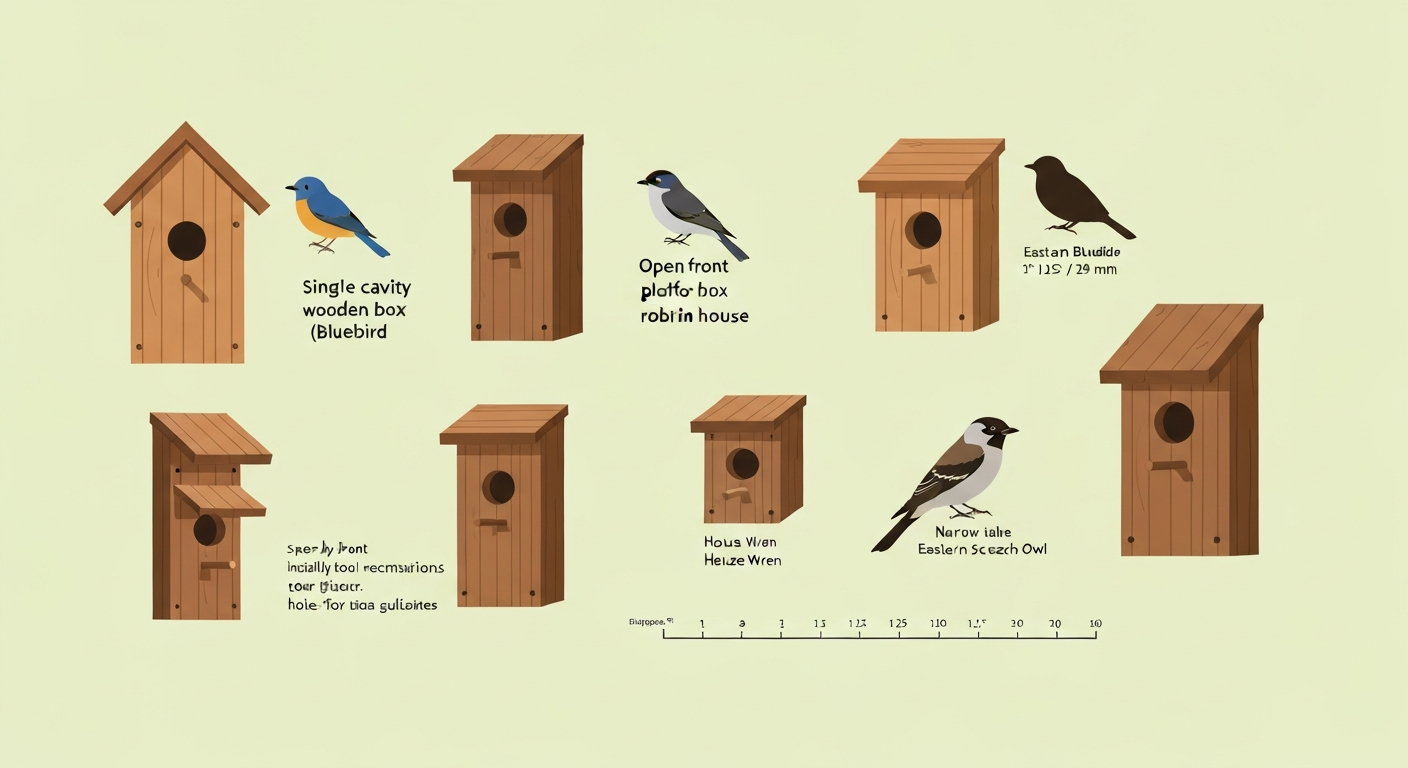
Common variants range widely in size and design. Single-cavity boxes are the most familiar, essentially a plain wooden chamber with one entrance hole, built for one species pair. Martin houses are multi-cavity structures, sometimes with dozens of compartments, designed specifically for Purple Martins, which are colonial nesters. Platform or open-fronted boxes work for species like American Robins or Eastern Phoebes that prefer a ledge rather than a fully enclosed cavity. Nest tubes, often made from PVC or clay, replicate narrow natural cavities for smaller species. Each variant still fits the core definition: a man-made structure that replaces a natural nesting cavity.
How a bird house differs from a feeder and a natural nest
A bird feeder provides food. A bird house provides a nesting site. These are fundamentally different needs, and birds treat them as such. A bird visiting a feeder is looking for a meal and will move on. A bird selecting a nest box commits to it for weeks, investing heavily in courtship, egg-laying, incubation, and brooding. That distinction matters for placement: feeders can go where people enjoy watching them, while nest boxes need quieter, more protected spots away from high-traffic areas.
A natural bird nest is different again. Most people think of nests as the cup-shaped structures robins build in shrubs, but cavity-nesting birds like bluebirds and woodpeckers naturally use hollow trees or old woodpecker holes. They do not build freestanding cup nests. When old-growth trees and dead snags are removed from backyards and farmland, these natural cavities disappear. A nest box directly replaces that missing habitat. The bird brings its own nesting material inside; the box is the cavity, not the nest itself.
Why put up a nest box? Conservation value and backyard species
Cavity-nesting birds have suffered significant population declines partly because dead trees are routinely cleared from lawns, parks, and farmland. A well-designed nest box directly addresses that shortage. The Eastern Bluebird is the best-documented success story: bluebird populations across North America rebounded substantially after the 1970s through coordinated nest-box trail programs, demonstrating that targeted box provision works at a meaningful scale.
Common backyard species that readily use nest boxes in North America include Eastern Bluebirds, Tree Swallows, Black-capped and Carolina Chickadees, Tufted Titmice, House Wrens, Carolina Wrens, White-breasted Nuthatches, Downy and Hairy Woodpeckers, Eastern Screech-Owls, and Barn Owls. In western states you can add Western Bluebirds, Mountain Bluebirds, Violet-green Swallows, and Ash-throated Flycatchers to that list. Each species has specific size and placement requirements, which is why a one-box-fits-all approach rarely works well.
There is also a legal dimension worth knowing from the start. Nearly all native migratory birds and their active nests, eggs, and young are protected under the U.S. Migratory Bird Treaty Act (MBTA). That means once a native bird is actively nesting in a box, you cannot legally disturb, move, or destroy that nest without a permit from the U.S. Fish and Wildlife Service or your state wildlife agency. This is a strong reason to get the location and box right before nesting season, not after.
Choosing the right bird house for your yard
The single most important variable is entrance-hole diameter. Hole size acts as a filter: it lets your target species in while physically excluding larger competitors. Cornell Lab's NestWatch (Features of a Good Birdhouse, NestWatch (Cornell Lab)) notes European starlings can enter holes ≥1 9/16 in (≈40 mm) and house sparrows ≥1 1/4 in (≈32 mm) Features of a Good Birdhouse — NestWatch (Cornell Lab). European Starlings, an invasive species that aggressively evicts native cavity nesters, can enter any hole 1 9/16 inches (about 40 mm) or larger. House Sparrows, another invasive competitor, can squeeze through holes as small as 1 1/4 inches (about 32 mm). Keeping hole sizes at or below the minimum needed for your target species is your first and cheapest line of defense.
Habitat and region shape which species are realistic targets. Open fields and meadows suit bluebirds and Tree Swallows. Forest edges and wooded yards attract chickadees, titmice, and nuthatches. A box on a rural property near open grassland has a genuine shot at a Barn Owl or American Kestrel. Urban and suburban yards with mature trees can support screech-owls. Think about what birds you already hear or see in your area before building or buying; that tells you what cavities are actually in demand.
Seasonal timing matters too. In most of the continental U.S., boxes for early breeders like Eastern Bluebirds should be up and ready by late February to early March. Tree Swallows arrive at breeding sites from March onward in the South and April in the northern states. Screech-owls and chickadees may begin investigating cavities in late winter. Getting boxes cleaned and mounted before these windows close dramatically improves your odds of occupancy. In the Southwest and Southeast, some species attempt second or even third broods, so a box left up and clean through summer can see multiple families in a single year.
Species dimensions and entrance-hole sizes at a glance
The table below summarizes verified nest-box interior dimensions and entrance-hole diameters for common backyard species, cross-checked against Cornell Lab NestWatch standards and North Carolina State Extension guidance. Floor dimensions are interior measurements. 'Depth' is the interior measurement from floor to the bottom of the entrance hole. Mounting height is measured from ground to box floor.
| Species | Floor (interior) | Depth to hole | Entrance hole diameter | Mounting height |
|---|---|---|---|---|
| Eastern Bluebird | 5" × 5" | 6–10" | 1.5" | 4–6 ft |
| Western / Mountain Bluebird | 5" × 5" | 6–10" | 1.5" | 4–6 ft |
| Tree Swallow | 5" × 5" | 6–8" | 1.5" | 10–15 ft |
| Black-capped / Carolina Chickadee | 4" × 4" | 6–8" | 1 1/8" (~29 mm) | 5–15 ft |
| Tufted / Oak Titmouse | 4" × 4" | 6–8" | 1 1/4" | 5–15 ft |
| House Wren | 4–6" × 4–6" | 4–6" | 1" (~25 mm) | 6–10 ft |
| Carolina Wren | 4" × 4" | 6–8" | 1.5" | 5–10 ft |
| White-breasted Nuthatch | 4" × 4" | 8–10" | 1 3/8" | 10–20 ft |
| Downy Woodpecker | 4" × 4" | 8–10" | 1.25" | 5–20 ft |
| Hairy Woodpecker | 6" × 6" | 12–15" | 1.5" | 10–20 ft |
| Eastern Screech-Owl | 8" × 8" | 12–15" | 3" (or 3" × 4" oval) | 10–30 ft |
| American Kestrel | 8" × 8" | 9–12" | 3" | 10–30 ft |
| Barn Owl (US) | 10" × 18" or larger | 15–18" | 6" × 7" oval | 10–20 ft on pole or building |
A tolerance of plus or minus 1/8 inch on entrance holes is generally acceptable. Going larger than the listed diameter defeats the exclusion benefit, so err on the slightly smaller side if you are unsure. For screech-owls and kestrels, a 3-inch round hole is the standard; an oval entrance (3 by 4 inches) is sometimes used for screech-owls because it more closely mimics a natural woodpecker excavation.
Materials and tools for building a bird house
Untreated wood is the recommended material for almost every nest box application. Cedar, pine, and cypress are the three most commonly used species, and each has genuine advantages. Cedar is naturally rot-resistant, stable through wet-dry cycles, and has a long service life outdoors without any finish; it is the top choice when budget allows. Pine (particularly 1-inch nominal, which is actually about 3/4 inch thick) is affordable and widely available at any lumber yard; it performs well if given a coat of exterior paint or stain on outside surfaces only. Cypress shares cedar's natural durability and is a good regional option in the South and Gulf Coast where it is readily available.
Wall thickness of at least 3/4 inch is not optional. Thicker walls buffer interior temperature swings, which matters because peer-reviewed research (Sudyka et al., 2023; Callan et al., 2023) confirms that nest boxes run significantly warmer than natural cavities, sometimes several degrees Celsius above ambient peak temperatures. Double-walled construction, where an inner timber lining is set inside the outer shell with an air gap, has been shown to reduce peak interior temperatures by up to 6 to 7 degrees Celsius compared with single-walled or thin plastic designs. See Influence of nest box design on internal microclimate: Comparisons of plastic prototypes, Callan et al., Austral Ecology (2023) for experimental data showing double-walled boxes with internal timber lining reduced peak internal temperatures by about 6–7°C compared with single-walled/plastic designs Influence of nest box design on internal microclimate: Comparisons of plastic prototypes — Callan et al., Austral Ecology (2023). In hot climates (Texas, Arizona, the Deep South), double-walled boxes or boxes positioned with morning sun and afternoon shade are worth the extra effort.
One material to firmly avoid is pressure-treated lumber, especially older boards. The U.S. EPA phased out residential uses of CCA (chromated copper arsenate) treated lumber at the end of 2003, but older stock still circulates in salvage yards and lumber reuse streams. CCA contains arsenic, and research reviewed by the National Pesticide Information Center at Oregon State University documents documented health risks from contact exposure. Never use potentially CCA-treated wood for any interior surface of a nest box.
For most beginner builds, the tool list is short. A circular saw or hand saw cuts the boards. A drill with a spade bit or a hole saw cuts the entrance. A jigsaw is helpful for oval entrances. You need a tape measure, a square, sandpaper (80 and 120 grit), exterior wood screws (1.5 to 2.5 inch, coarse thread), and a countersink bit. A drill press makes cleaner entrance holes but is not required. If you do not own a saw, many hardware stores will cut boards to length for a small fee, reducing the tool requirement to just a drill.
- Lumber: 1× (3/4" thick) cedar, pine, or cypress; exterior-grade plywood (for larger owl boxes)
- Entrance hole tools: 1.5" spade bit for bluebird/swallow, 1 1/8" spade bit for chickadee, 3" hole saw for screech-owl/kestrel
- Fasteners: exterior-grade coarse-thread wood screws (avoid nails for panels that need to open for cleaning)
- Drill bits: countersink bit, 1/4" bit for ventilation and drainage holes
- Finish: exterior latex paint or stain for outside surfaces only (light or natural colors to reduce heat absorption)
- Hardware: stainless or galvanized hinge or pivot screw for the cleanout panel; predator guard if pole-mounting
Basic construction checklist every box needs
Cornell Lab's NestWatch program provides an authoritative checklist of features every functional nest box should include. Before you declare a build finished, run through this list.
- Walls at least 3/4" thick (thicker in hot regions)
- Drainage holes in the floor corners (four 1/4" holes minimum) to let rainwater out
- Ventilation gaps or holes near the top of the side walls (two ~5/8" holes per side, or a 1/4" gap at the top of each side panel)
- Recessed floor (set the floor up 1/4" from the bottom of the side walls so water cannot wick in)
- Sloped, overhanging roof (at least a 2" overhang over the entrance to shed rain)
- Rough or grooved interior wall below the entrance hole (lets fledglings grip when climbing out; never sand the interior smooth)
- No exterior perch (perches give predators and House Sparrows a staging post; leave them off)
- Hinged side or roof panel for annual cleaning access
- Predator guard on the mounting pole (cone baffle or stovepipe baffle)
Nontraditional materials: license-plate boxes, transparent designs, and what to watch for
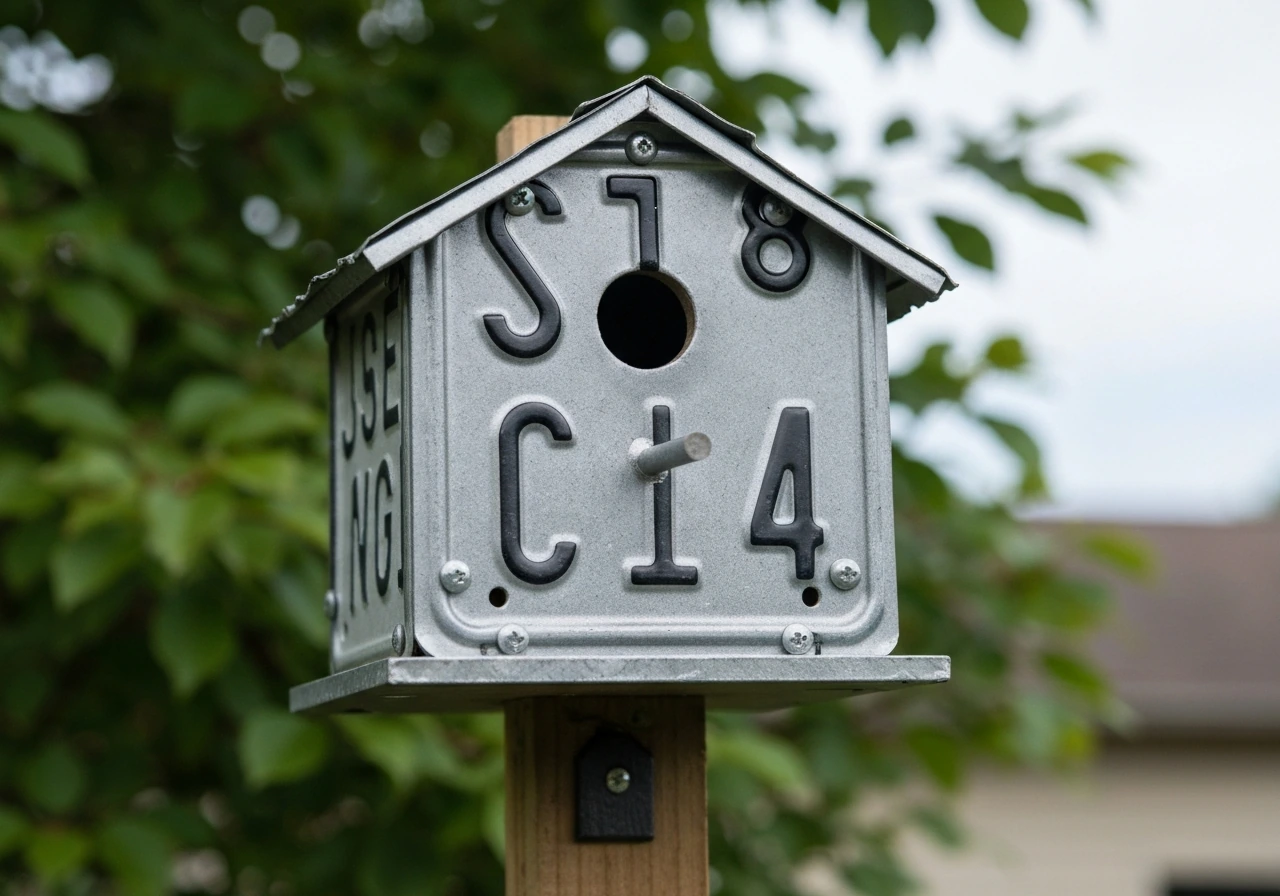
Not every bird house is built from plain lumber, and some of the most creative designs use reclaimed or unexpected materials. License-plate bird houses, where a folded metal plate forms the roof and sometimes side panels over a wooden frame, have a genuine upcycling appeal and the metal roof does an excellent job shedding rain. The flat painted surface of a license plate also makes an attractive decorative exterior. If you are drawn to that style, the critical rule is that the interior must still be wood, with adequate wall thickness. A bare metal interior overheats rapidly in sun, and thin metal provides almost no insulation. The license plate works best as a decorative exterior roof element over a standard cedar or pine box.
Transparent or observation boxes use a clear acrylic or methacrylate panel on one wall so you can watch the nest without opening the box. Research projects and educators have used these successfully. NestWatch guidance emphasizes that any observation window should be covered with an opaque hinged cover when not actively in use, for two reasons: clear panels let in extra light and heat, and birds incubating or brooding are sensitive to disturbance. Best practice is to install a light-blocking cover over the clear panel, peek briefly only when the adult is away foraging, and keep the panel small. For designs that let you observe nesting without opening the box, see bird houses you can see into for guidance on safe observation-window materials, shading, and how to cover the panel when not in use. Published field data comparing nesting success in observation boxes versus standard boxes are limited, so treat these as a useful educational tool with added responsibility, not a standard design.
Cornell NestWatch explicitly advises against thin plastic or metal sheeting as the primary wall material for nest boxes, citing poor thermal regulation. If you want to experiment with unusual materials, always pair them with a thick wooden inner lining, maximize ventilation, and position the box where it receives shade during the hottest part of the day. The species-specific dimension and hole-size requirements in the table above still apply regardless of what the exterior looks like.
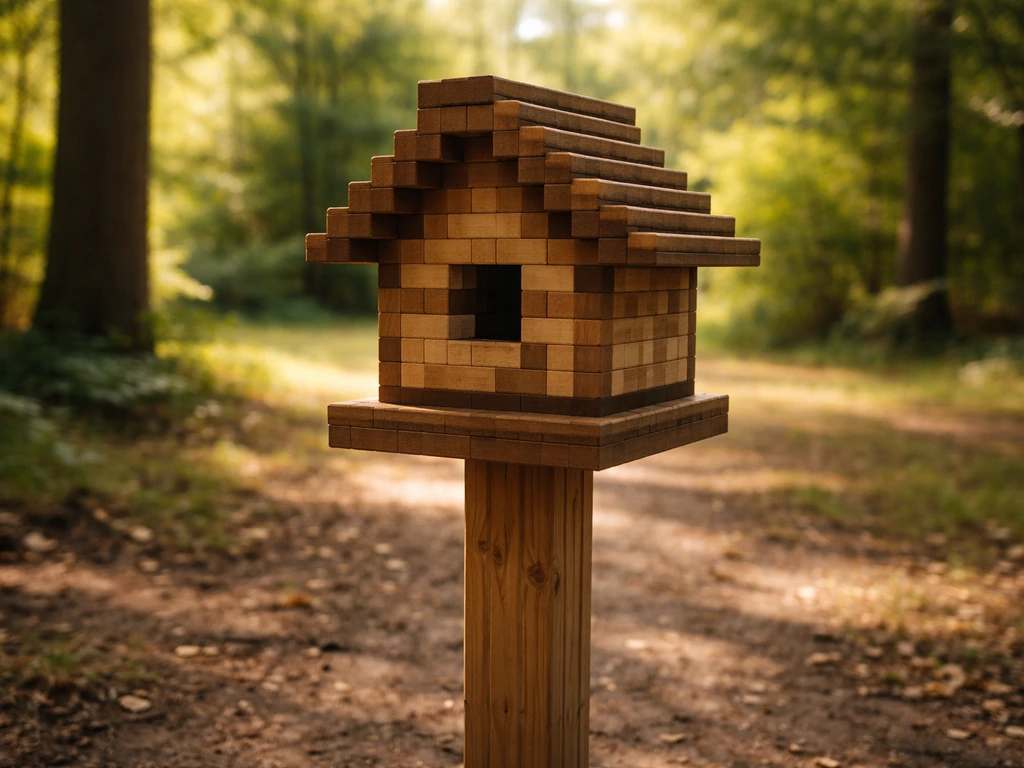
A quick note on virtual designs: building a Minecraft bird house is a popular introduction to the concept of nest box proportions for young learners, and the spatial thinking it encourages is genuinely useful. But a Minecraft build does not transfer directly to a real nest box. Real boxes demand precise entrance-hole diameters measured to within 1/8 inch, specific interior floor areas, real drainage, and real ventilation. Think of the virtual version as a sketch, not a plan.
Safety, durability, and environmental considerations
Material safety for the birds overlaps with durability for you. Untreated natural woods like cedar and cypress weather gracefully and do not leach chemicals near nestlings. If you paint the exterior of a pine box, use a light color (tan, light gray, or a bark-like brown) to reduce solar heat gain, and confirm the paint is fully dry and off-gassing before the box goes up. Never paint or varnish the interior. Exterior sealants, if used, should go on the outside only, and latex-based products are safer than solvent-based ones near wildlife.
Drainage and ventilation are functional safety features, not optional niceties. A flooded nest floor kills eggs and nestlings. Overheating is a documented cause of nestling mortality, particularly in dark-colored boxes in full sun. The research on nest-box microclimates confirms that single-walled plastic or metal designs in exposed locations regularly exceed temperatures that exceed safe ranges for developing embryos and nestlings. Drilling your drainage and ventilation holes correctly takes two minutes and prevents real harm.
Predator-proofing is the other major safety system. Mounting on a smooth metal pole with a cone or stovepipe baffle is the most effective method against raccoons, squirrels, and snakes. A Noel guard (a wire cage extending out from the entrance hole) physically prevents a predator from reaching in and pulling out eggs or nestlings. Entrance-hole extenders, which are a 1.5 to 2 inch deep wooden block with a matching hole drilled through it, add depth that makes it harder for a predator's arm to reach the nest floor. Avoid mounting boxes on tree trunks or fence posts, which give climbing predators easy access.
Cleaning protocol and end-of-season sanitation
Never disturb an active nest. Once a box is empty after a brood fledges (or after the nesting season ends), open the cleanout panel and remove all nesting material. Scrub the interior with mild dish soap and water, rinse thoroughly, and let it dry completely before closing it up. If the interior is heavily soiled with feces, use a 1:10 bleach-to-water solution to disinfect, then rinse with plain water and allow to dry fully. Some nest box monitors clean between broods within the same season, which is fine as long as the box is confirmed empty and inactive before you open it. Leaving old nesting material in place over winter harbors mites, blowfly larvae, and pathogens that can affect the next brood.
Once the box is clean and dry, inspect for any damage: check that screws are tight, the roof overhang is intact, drainage holes are clear, and the hinged cleanout panel closes securely. Make any repairs before the next season begins, because a box that needs attention in mid-February, when bluebirds are already scouting, is a box you will probably not get to in time.
Mounting and placement: a quick regional guide
For bluebird boxes in the East and Midwest, a smooth metal conduit pole 4 to 6 feet above the ground, placed in an open grassy area with a clear flight path, is the standard setup. Pair it with a second box 50 to 100 yards away to allow Tree Swallows to occupy one box, reducing competition pressure on the bluebirds. In the Pacific Northwest and Mountain West, Western and Mountain Bluebirds use identical box dimensions but prefer slightly more open, drier habitat. In hot-climate states, orient the entrance hole to face north or east to minimize direct afternoon sun on the opening.
For screech-owls and kestrels, boxes mounted 10 to 30 feet up on a pole or the side of a barn or large tree are appropriate. Owls often begin investigating boxes in January and February, well before most songbird activity, so these boxes should be up before the New Year in the southern half of the country. Barn Owl boxes are sometimes installed inside barns or on building exteriors; U.S. designs call for a substantially larger interior than UK specifications from the Barn Owl Trust, so confirm you are using a U.S.-specific plan.
For observation or camera-equipped boxes, install the camera or transparent panel before the season begins and minimize all visits once eggs are laid. Changing batteries or adjusting cameras during active incubation causes unnecessary stress and may, in certain circumstances, constitute a disturbance under the MBTA. Plan ahead, use long-life batteries, and if possible connect to a power source before nesting begins so you do not need to return mid-season.
FAQ
What is a clear, searchable definition of a "bird house" (birdhouse, nest box, nesting box)?
A bird house (also called a birdhouse, nest box or nesting box) is a man‑made, enclosed cavity provided to birds as a place to roost or build a nest. In conservation and field‑guide usage a nest box is a functional cavity replacement designed to mimic natural holes in trees or cliffs. Decorative bird houses intended only for ornament or feeding are not the same as functional nest boxes: functional boxes prioritize correct interior volume, drainage, ventilation, predator protection and species‑appropriate entrance sizes so birds can safely raise young.
How does a bird house differ from a feeder and from natural nests/cavities?
Differences: - Bird house / nest box: enclosed, species‑specific internal dimensions and entrance hole to support nesting and young; designed for microclimate control, drainage, ventilation, predator defenses and access for monitoring/cleaning. - Feeder: provides food openly or in covered ports; not built to shelter nestlings and often attracts many species (not selective). - Natural nest/cavity: formed in tree cavities, snags or cliff holes; typically better insulated and thermally buffered than most boxes. Nest boxes replace or supplement scarce natural cavities but require specific design to approximate natural microclimate and reduce risks (temperature extremes, predators, competitors).
What are evidence‑based interior dimensions and entrance‑hole sizes for common backyard species? (Give a quick reference table)
Common species reference (typical recommended values; regional variations exist—use local extension guidance when available): - Chickadee / Small tit: floor 4"×4" (10×10 cm); internal height 8–10" (20–25 cm); entrance 1 1/8" (29 mm); mounting height 5–15 ft. - House Wren: floor 4–6" square (10–15 cm); height 6–10" (15–25 cm); entrance 1" (25 mm); mounting height 6–10 ft. - Eastern Bluebird / Tree Swallow: floor 5"×5" (13×13 cm); internal height 8–12" (20–30 cm); entrance 1.5" (38 mm); bluebird height 4–6 ft, swallow often 10–15 ft. - House Sparrow exclusion note: use entrance ≤1 1/2" to deter starlings and ≤1 1/4" to reduce house sparrow access where desired. - Screech Owl (small owl): floor 8"×8" (20×20 cm); internal height 17–18" (43–46 cm); entrance ~3" (76 mm) or oval; mount 10–20 ft. - Barn Owl and large raptors: require much larger custom boxes—follow specialist guidance (Barn Owl Trust/raptor rehabilitation resources). Use these as starting points; alter dimensions slightly for local subspecies and consult local bird-conservation groups for adjustments.
What materials and tools are recommended for safe, long‑lasting nest boxes? What about nontraditional/upcycled materials (license plates, plastics, metal)?
Recommended materials: - Wood: untreated, exterior‑grade woods (cedar, pine, cypress or exterior plywood) are preferred—safe, breathable and thermally suitable. Use wall thickness ≥3/4" (18–20 mm) for structural stability and some insulation. - Fasteners: stainless or galvanized screws/nails to resist rust. - Finish: do not paint or treat interior surfaces. If exterior finish is desired, apply exterior paint or stain only to outside surfaces. Avoid pressure‑treated/CCA‑treated lumber for materials contacting nestlings. Tools: saw, drill with hole saw sizes matching entrance, screwdriver, measuring tape, square, sandpaper, clamps, safety glasses, gloves. Nontraditional/upcycled materials: - Thin plastics, metal sheets, and license plates: generally discouraged alone because they transfer heat rapidly, lack insulation, and can create hazardous edges. If used, mitigate by providing heavy insulating wood backing, double walls, ample ventilation, and always avoid direct contact between metal/plastic and nestlings. - Transparent/observation panels or acrylic windows: can be used for education/research if designed carefully—prefer hinged covers or removable opaque shutters so the box is normally opaque; avoid exposing nestlings to direct sunlight through clear panels and minimize light/heat intrusion. - Upcycling salvage wood that could be old CCA-treated lumber: avoid or verify non‑CCA history. When in doubt, do not use unknown treated wood inside boxes.
Give a complete, step‑by‑step DIY plan for a general-purpose small cavity box (e.g., chickadees/titmouse/house wren) including measurements and safety notes.
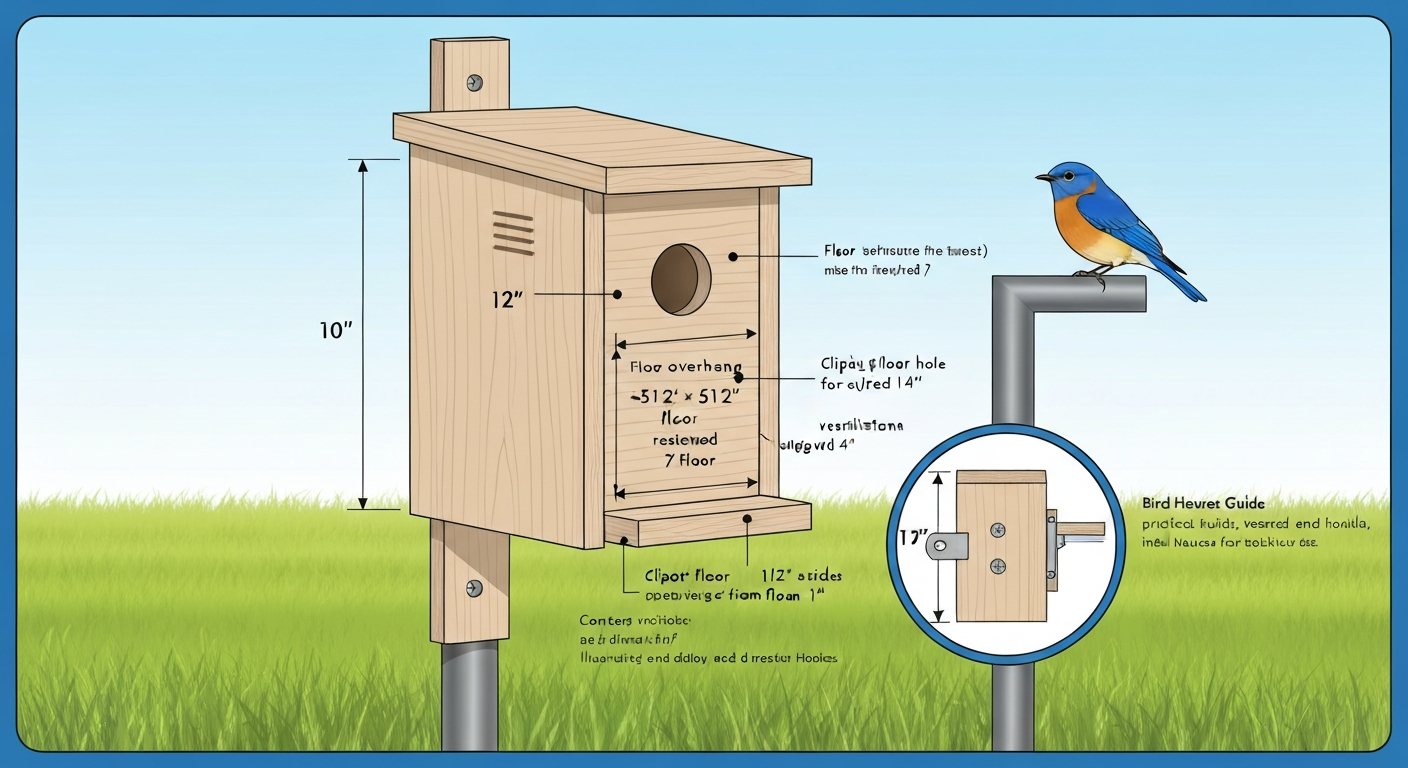
DIY plan (small cavity box for chickadee/titmouse/house wren): Materials: one 6 ft length of 3/4" exterior‑grade cedar or pine board; stainless or galvanized screws; exterior wood glue (optional); 1 1/8" hole saw (29 mm); drill; saw. Measurements and cuts (examples in inches; convert to metric if needed): - Back panel: 10" × 7" - Front panel: 10" × 7" with 1 1/8" entrance hole centered 2" down from top - Sides (2): 8" × 5" with a slight slope cut on top edge so roof sheds water - Floor: 4" × 4" with 1/4" drainage holes drilled near front - Roof: 6" × 7" (overhang 1/2–1") Steps: 1) Cut panels to size. 2) Drill entrance hole in front panel; sand edges. 3) Drill two small ventilation holes near top of sides or back (≈5/16" to 5/8"). 4) Drill 2–4 drainage holes in floor (1/4"–3/8"). 5) Assemble sides to back using screws from outside into inside (or glue + screws). 6) Insert floor into notches or screw from below into floor to allow removal for cleaning — or use a hinged side for access. 7) Attach front panel; make front or side that can hinge or be unscrewed for seasonal cleaning. 8) Mount roof with overlap and seal edges; allow small gap for ventilation but no large openings predators can use. Safety notes: - Use untreated wood and avoid toxic finishes inside. - Round or sand all sharp edges. - Do not install perches outside entrance. - Incorporate predator‑proof features (see predator FAQ). - Ensure box cleans easily (hinged side or removable panel). - Pre‑drill screw holes to prevent splitting. Diagrams to include: exploded view showing panels and fasteners, front elevation with hole placement, side section showing ventilation/drainage—label dimensions. Follow local species dimension table above to modify sizes.
How should nest boxes be mounted and placed for different habitats and regions? (Include height, orientation, and habitat tips)
Placement guidelines (general): - Orientation: face entrance away from prevailing winds and harsh midday sun—typically east to northeast in hot climates to reduce afternoon sun; in cooler climates south or southeast may warm the box. - Height: species‑specific (see species table): small passerines 5–15 ft (1.5–4.5 m); swallows often higher (10–15 ft); screech owls 10–20 ft. - Substrate: prefer mounting on smooth metal poles with a predator baffle or on buildings/posts rather than on tree trunks to discourage climbing predators. If mounting on trees, use straps or lag screws placed carefully to avoid damaging tree health and monitor annually. - Habitat: place bluebird boxes at edges with open perching lawn areas; wrens prefer shrubs or brushy edges; swallows near open water or open fields. - Spacing: follow species guidance—some birds defend territories and need spaced boxes (e.g., bluebirds ~100–200 yards apart) while others tolerate higher densities. - Regional adjustments: in hot regions add added insulation, deeper eaves, and more shading; in cold regions ensure tighter seams and slightly smaller vents to retain heat while still providing ventilation. Diagrams to include: plan showing pole mount with baffle, tree mount strap method (avoid girdling), recommended orientation arrow, and height scale for common species.