The birds most likely to nest in your backyard bird house are Eastern Bluebirds, Carolina or Black-capped Chickadees, House Wrens, Tree Swallows, and White-breasted Nuthatches. Which one actually moves in depends almost entirely on three things: the entrance hole diameter, the interior dimensions, and where you mount the box. Get those three right for a specific species, and you dramatically improve your odds.
What Birds Nest in Bird Houses: Match Species to Your Box
Maya Thompson
13 May 2026
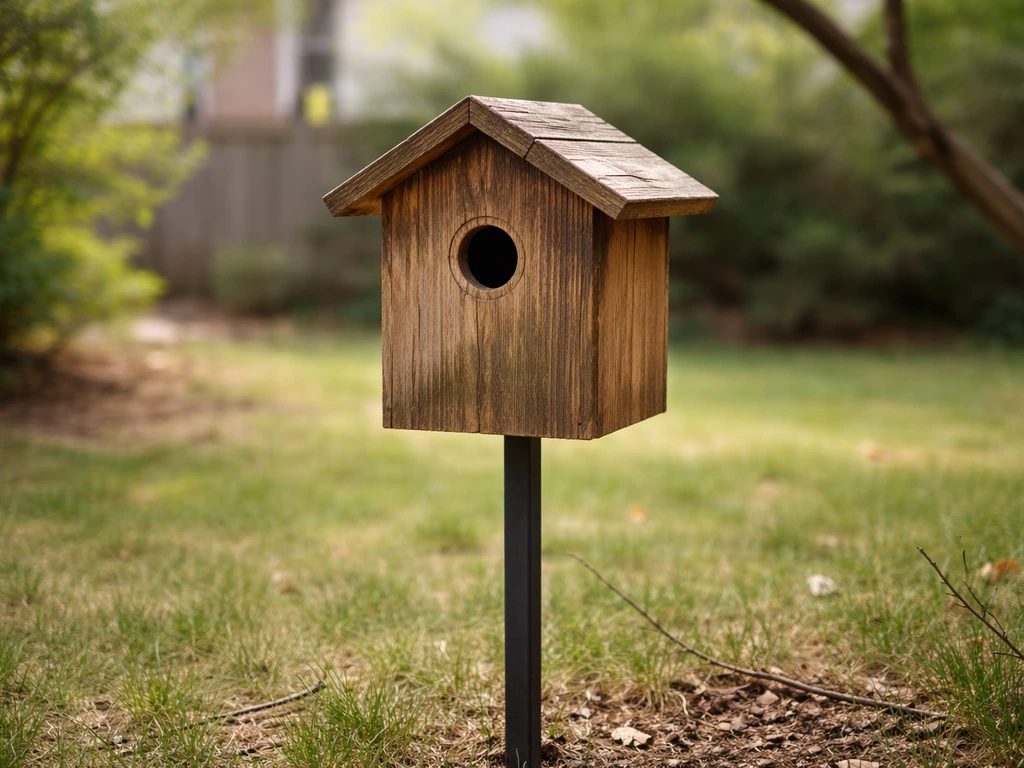
If you are wondering what birds use bird houses, the key is that only certain cavity-nesting species will accept an enclosed box made by people. Get them wrong, and you'll either attract nothing or end up hosting House Sparrows and European Starlings instead. Understanding how do bird houses work, including entrance size, interior setup, and placement, helps you choose the right design for the species you want.
Which birds actually use bird houses
Only cavity-nesting birds use bird houses, and even within that group, only "secondary" cavity nesters will accept a box built by humans. These are birds that need a pre-existing hole but can't excavate one themselves. Primary cavity nesters like woodpeckers make their own holes in dead wood and almost never use a standard nest box (with a few exceptions like the smaller Downy Woodpecker). Here are the species you're most realistically targeting in a typical North American backyard:
- Eastern Bluebird (and Western or Mountain Bluebird in their respective ranges): one of the most reliable box users and a conservation success story directly tied to nest box programs.
- Carolina Chickadee and Black-capped Chickadee: common across most of the continent, adaptable, and willing to use compact boxes in wooded or suburban yards.
- House Wren: small, bold, and prolific. They'll fill a box fast, but they can also be a problem for neighboring cavity nesters.
- Tree Swallow: a backyard insect-eater that loves open areas near water; will compete with bluebirds for boxes.
- White-breasted Nuthatch: less commonly attracted to boxes than the others, but will use a correctly sized box placed in mature woodland or near large trees.
- Tufted Titmouse: a box user across much of the eastern U.S., especially in yards with mature oaks.
- Screech Owls (Eastern or Western): will use larger boxes mounted high in trees, especially in suburban yards with mature canopy.
- Wood Duck (near water): requires a much larger box with a 3x4" oval entrance, usually mounted over or adjacent to a pond or stream.
Robins, cardinals, and most sparrows are open-cup nesters. They build on ledges, in shrubs, or in trees but rarely inside enclosed boxes. If you're hoping for robins specifically, a three-sided open nesting shelf is a better fit than a standard bird house. If you're wondering whether robins will use a standard bird house, the answer is usually no since they prefer open nesting sites robins use bird houses. The question of whether robins use bird houses is a common one, and the short answer is: not typical enclosed boxes. Do crows use bird houses is another common question, but the same rule applies since most enclosed boxes only work for cavity-nesting secondary species.
Match the bird house design to the right species
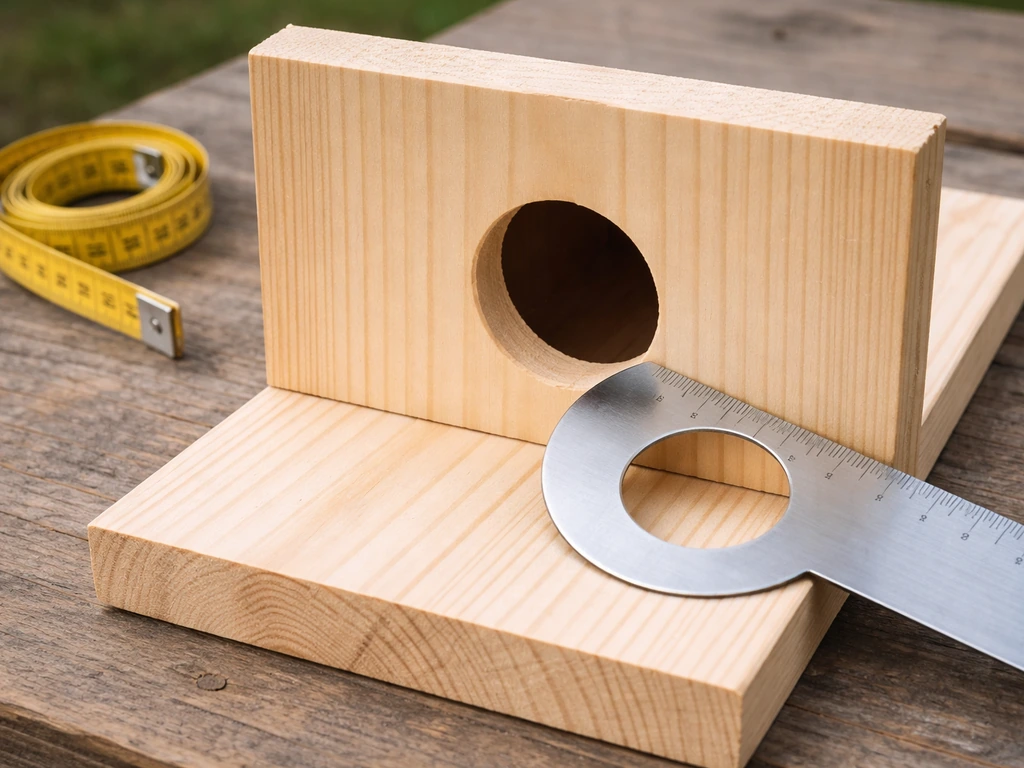
The entrance hole is the single most powerful tool you have. It acts as a filter: the right size lets your target species in while physically excluding larger birds you don't want. A 1-1/8" hole is sized for chickadees and Boreal Chickadees. Bump it up to 1-1/2" and you open the door to bluebirds while still excluding European Starlings. Go larger than that with a bluebird box and starlings, which can devastate a nest, will start investigating.
| Species | Entrance Hole Diameter | Floor Size | Interior Depth (floor to bottom of hole) | Notes |
|---|---|---|---|---|
| Chickadee (Carolina / Black-capped) | 1 1/8" | 4" x 4" | 6–8" | Prefers boxes in wooded or edge habitat |
| Eastern Bluebird | 1 1/2" | 4" x 4" to 5.5" x 5.5" | 4.5–6" (hole to floor) | Keep hole exactly 1 1/2" to exclude starlings |
| House Wren | 1 1/8" to 1 1/4" | 4" x 4" | 6–8" | Place at least 100' from other species' boxes |
| Tree Swallow | 1 1/2" | 5" x 5" | 6" | Prefers open areas; competes with bluebirds |
| White-breasted Nuthatch | 1 1/4" to 1 3/8" | 4" x 4" | 8–10" | Mount near large deciduous trees |
| Tufted Titmouse | 1 1/4" | 4" x 4" | 8" | Does well in suburban wooded yards |
| Eastern Screech Owl | 3" | 8" x 8" | 12–15" | Mount 10–30' high in mature trees |
| Wood Duck | 3" x 4" oval | 10" x 10" to 12" x 12" | 10–24" | Mount near water; add wood shavings inside |
Interior depth matters just as much as hole size. A bluebird box should have the bottom of the entrance hole sitting 4.5 to 6 inches above the floor. That distance gives the nestlings enough room to develop while keeping them below the reach of a raccoon or cat pawing through the hole. For chickadees, you want a slightly deeper box at 6 to 8 inches of interior depth. Beyond the hole and depth, make sure your box has drainage holes in the floor (four small holes in the corners work fine), ventilation gaps near the top of the side walls, and a rough or grooved interior below the entrance hole so fledglings can grip and climb out on their own.
When birds nest: what to expect month by month
Nesting season timing shifts by latitude, but here's a practical general timeline for temperate North America. Having your boxes up and ready by late February or early March puts you ahead of the rush.
| Month | What's Happening |
|---|---|
| Late February – March | Bluebirds and Tree Swallows begin scouting boxes; clean and mount boxes now if you haven't already |
| April | Bluebirds often start their first clutch; chickadees and titmice begin nest building |
| May | House Wrens arrive from migration and aggressively claim boxes; egg-laying begins for most species |
| June | First bluebird clutch fledges; wrens may be on their first or second brood; swallows fledge |
| July | Bluebirds start second brood; wrens can lay into July (in Tennessee, egg-laying extends from early May through July with two broods typical) |
| August | Most nesting wraps up; late second broods may still be in boxes |
| September – February | Nesting season over; clean boxes, do annual inspection, and re-mount before late winter scouts arrive |
A typical bluebird incubation period runs 12 to 15 days, after which nestlings spend about 17 to 21 days in the box before fledging. House Wren incubation is about 13 days, and chicks fledge in 15 to 16 days. Knowing these timelines helps you plan monitoring visits and anticipate when a box will be free again for cleaning between broods.
Where to put the bird house: height, orientation, and spacing
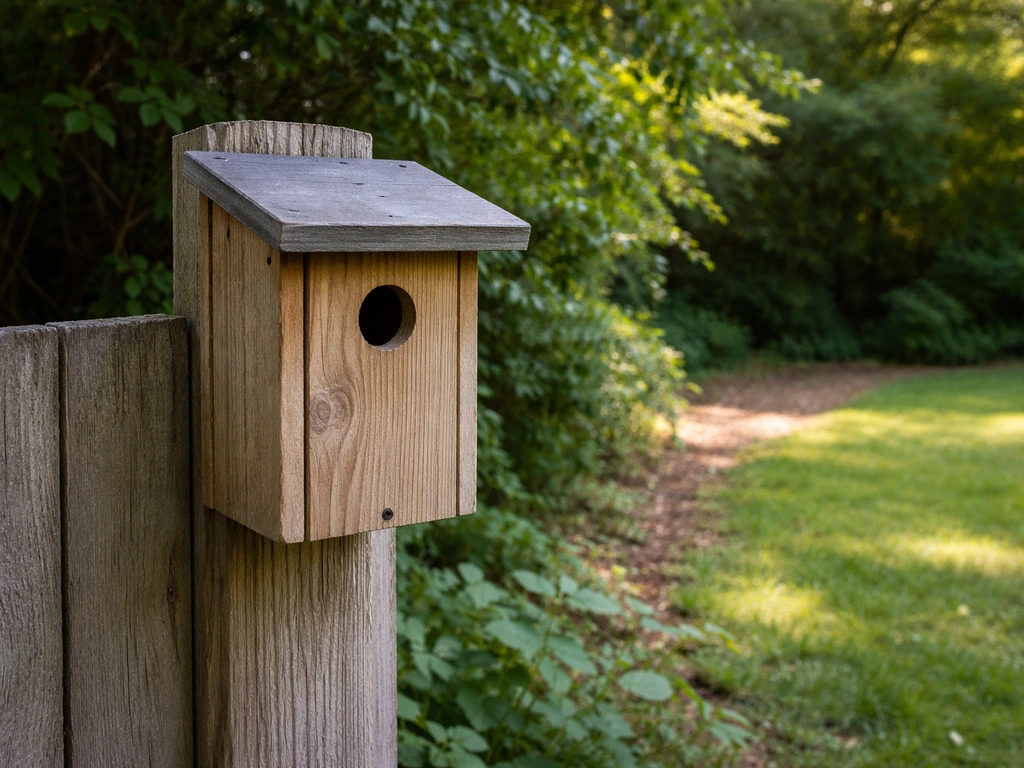
Placement is where most beginners go wrong. A perfectly built bluebird box mounted on a fence post in a shaded, shrubby corner of a yard is almost useless. Each species has specific habitat preferences, and you need to match the box location to what that bird naturally seeks out.
Height and orientation
- Eastern Bluebird: 4 to 6 feet above the ground on a smooth metal pole. Face the entrance toward an open area with low grass or ground cover where birds can hunt insects. A slight downward tilt of the box (5 degrees or so) keeps rain out.
- Tree Swallow: 5 to 8 feet on a pole in an open field or lawn, ideally within a few hundred feet of water.
- Chickadee and Titmouse: 4 to 15 feet, mounted on a tree or post at the edge of a wooded area. They prefer a natural tree setting over open fields.
- House Wren: 5 to 10 feet on a post, fence, or small tree in or near shrubby habitat. They don't need open areas.
- White-breasted Nuthatch: 12 to 20 feet on a tree trunk in mature woodland.
- Screech Owl: 10 to 30 feet in a mature tree, away from heavy human foot traffic.
Spacing between boxes
Don't crowd your boxes. Bluebirds are territorial and will defend a large area around their nest. For bluebirds and Tree Swallows, the "pairing" method works well: place two boxes about 15 to 25 feet apart so a swallow and a bluebird can each claim one, then space the next pair at least 300 feet away. For House Wrens specifically, NestWatch recommends placing any boxes intended for other species at least 100 feet away from a wren box, since wrens actively destroy the eggs and nestlings of nearby cavity nesters. This is one of the most practical pieces of spacing advice you'll find, and ignoring it leads to real losses.
Getting the dimensions right: a practical checklist
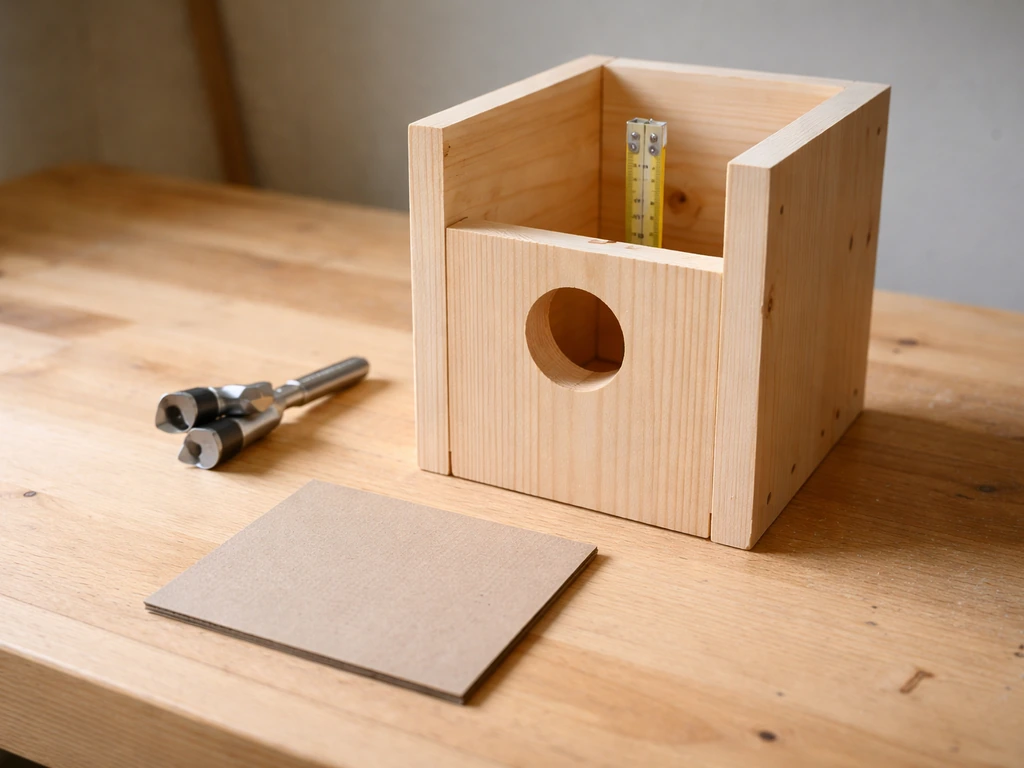
Before you mount any box, run through these five checks. They cover the most common reasons boxes go unused or attract the wrong birds.
- Entrance hole diameter: measured with a drill bit or hole gauge. Even a 1/8" difference can mean the wrong species gets in. Use the species table above as your reference.
- Interior floor size: at minimum 4"x4" for small songbirds. Larger species like Wood Ducks need proportionally larger floors.
- Depth from the bottom of the entrance hole to the floor: 4.5–6" for bluebirds, 6–8" for chickadees and wrens, deeper for owls and larger birds.
- Ventilation: at least two small gaps or holes (3/8" to 1/2") near the top of each side wall, below the roof line. This prevents heat buildup, which can kill eggs and nestlings.
- Drainage: four small holes in the corners of the floor, or a floor cut slightly small to leave corner gaps. Water pooling in a box is a real nest failure cause.
Entrance height above the floor (the distance from the floor to the bottom of the hole) is a spec that often appears in TPWD construction guides and is worth measuring precisely. It's not the same as total interior depth. For bluebirds, the entrance bottom should sit 6 to 8 inches above the floor. The North American Bluebird Society (NABS) nest box recommendations include typical ideal floor sizes from 4x4 inches to 5.5x5.5 inches and a recommended depth from the bottom of the entry hole to the floor of 4.5 to 6 inches. For wrens, 4 to 6 inches is acceptable given their smaller overall box size.
How to monitor nests without causing problems
Checking your nest box once a week during the nesting season is ideal. It gives you useful data, lets you catch problems early (predator damage, invasive species takeover, dead nestlings), and doesn't disturb active nests if done quickly. Approach the box calmly, open it, take a 3 to 5 second look, note what you see, and close it gently. The parent birds will flush and return quickly. Do not linger or repeatedly open the box during incubation or in the final days before fledging, when nestlings can panic and jump out prematurely.
What to do if the wrong birds show up
European Starlings and House Sparrows are non-native species with no legal protection in the U. S. and Canada, and both are destructive cavity nesters that outcompete and kill native birds. If starlings are investigating your bluebird box, double-check the entrance hole size: it must be no larger than 1-1/2" for bluebirds.
Starlings cannot fit through that opening. If House Sparrows claim a box intended for bluebirds or chickadees, it's legal and humane to remove their nest material and eggs repeatedly until they give up, then monitor closely for your target species. Many experienced monitors do this routinely. For House Wrens taking over a box you intended for bluebirds, the most effective solution is moving the boxes farther apart, not fighting the wren at its chosen box.
If a box simply isn't being used after several weeks in the right season, consider: Is the habitat right? Is the box in shade or in a location with no clear flight path to the entrance? Is the entrance hole the correct size? Sometimes simply moving a box 20 to 30 feet into a more open position makes the difference. Birds that use bird houses are also more attracted to boxes that have been weathered slightly (raw, rough-cut cedar or pine) than to shiny new painted surfaces.
Cleaning the box: between broods and at the end of the season
Cleaning is one of the most important things you can do to keep birds safe and encourage multiple broods per season. Accumulated nest material harbors mites, blowfly larvae, and other parasites that can weaken or kill nestlings. The rule is simple: only clean when you are absolutely certain there is no active breeding activity. If there's any doubt, wait.
- Confirm all chicks have fledged and the adults have stopped returning to the box with food. Give it 2 to 3 extra days to be sure.
- Remove all old nesting material. Drop it in a trash bag, not on the ground near the box.
- Scrub the interior surfaces with a stiff brush, mild dish soap, and water.
- If there is visible fecal matter or signs of heavy parasite infestation, use a 1: 10 bleach-to-water solution to wipe down the interior. Rinse thoroughly and let the box air dry completely before closing it.
- Check for damage: cracks, loose roof, damaged entrance hole edges. Repair now so the box is ready for the next brood.
- Re-open the box and monitor for the next nesting attempt.
At the end of the full nesting season (typically September or October), do a thorough year-end cleaning using the same process. Some people leave boxes open (or remove the front panel) over winter to discourage rodent nesting inside, then close and reinstall them by late February. In winter, some birds may use bird houses as roosting shelters, but activity inside depends on species and conditions leave boxes open. Others leave them closed and accept that a chickadee or wren might roost in the box on cold nights, which is a perfectly fine outcome. The key is that the box is clean, dry, and structurally sound before the next spring season begins.
Keeping birds safe: predators, competition, and guards
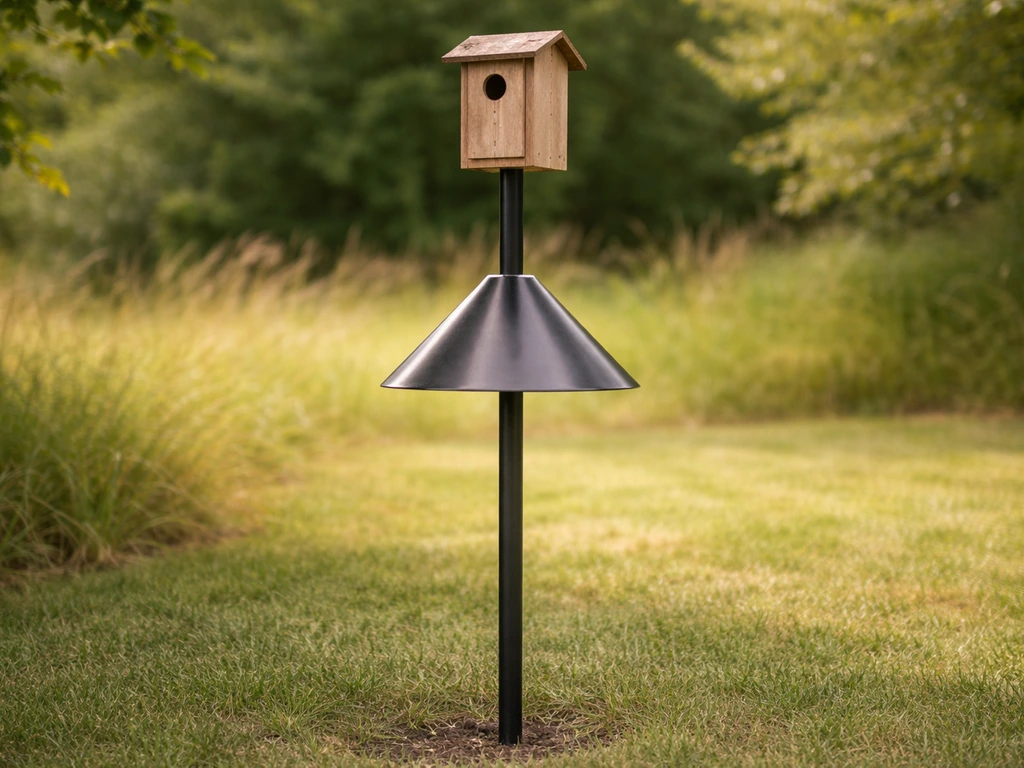
Predator control is where a lot of otherwise well-designed nest box programs fail. Raccoons, snakes, cats, and squirrels can all reach nest boxes and kill eggs, nestlings, or even incubating adults. No single guard is 100% effective, but combining two approaches makes a real difference.
Pole-mounted baffles
A smooth metal pole with a stovepipe or cone baffle installed below the box is your first line of defense against ground-based predators: raccoons, cats, opossums, and snakes. The baffle must be installed on the pole before the box goes up (you can't thread most baffles onto a pole after the fact). Position the baffle so its top is at least 4 feet off the ground, and make sure the box is mounted so that a raccoon on the baffle still can't reach the entrance hole. Smooth metal poles without rough surfaces are better than wooden posts, because snakes can climb textured surfaces more easily.
Entrance hole guards
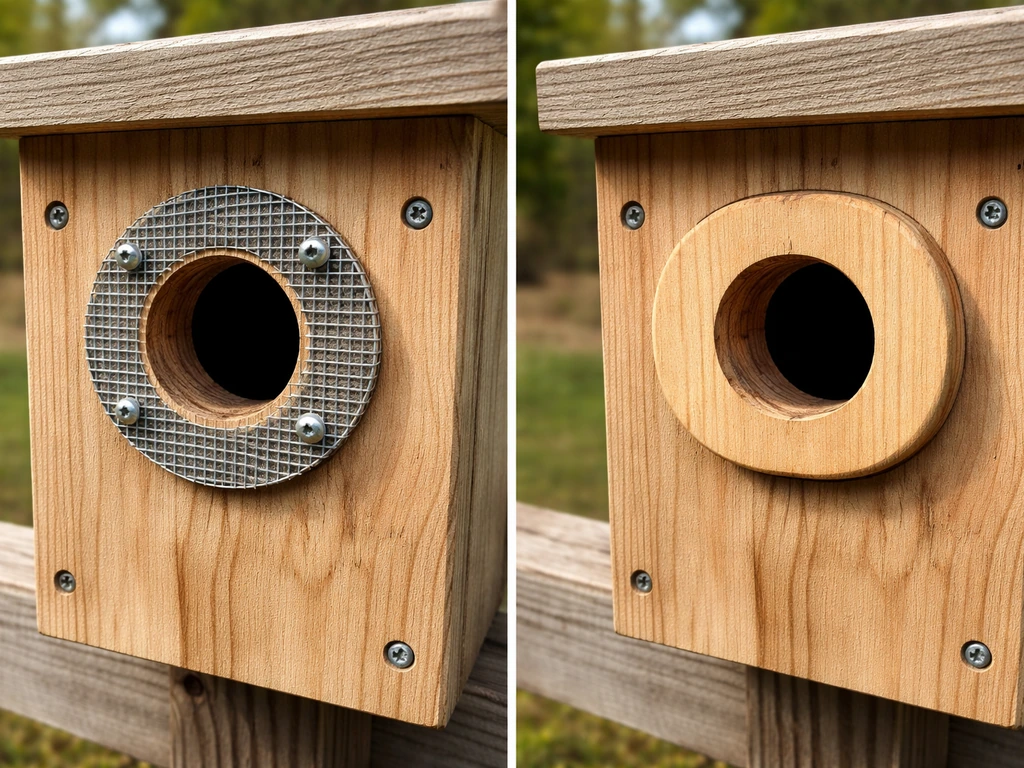
A heavy wire mesh or solid wood predator guard mounted around the entrance hole makes it much harder for a raccoon to reach inside and scoop out eggs or nestlings. The Virginia Bluebird Society describes a hardware cloth "cat/raccoon guard" that extends the entrance hole outward by 1.5 to 3 inches, making it essentially a tunnel that a predator paw can't navigate. These are inexpensive to make from scrap wood or hardware cloth and add meaningful protection to any box.
Location as a defense
Mounting boxes on free-standing metal poles in open areas (rather than on wooden fence posts or trees) automatically reduces access for most mammal predators. Bluebird boxes on smooth metal poles with baffles in open fields are far safer than the same box nailed to a fence post next to a hedgerow where a snake or cat has easy cover. Keep boxes away from overhanging branches that squirrels or raccoons can use as launching points.
Competition between species is another safety concern. Bluebirds and Tree Swallows are frequently monitored together because they will compete aggressively for the same boxes. Using the pairing method described in the placement section handles most of this naturally. House Sparrows are the most persistent threat at close range: active monitoring and nest removal is the most effective deterrent, since House Sparrow deterrent devices (like entrance hole reducers) often exclude your target birds too. There's no fully passive solution for House Sparrows; the sites with the best outcomes are actively monitored at least once a week.
FAQ
What birds nest in bird houses versus those that won’t, even if the box looks perfect?
Bird houses mainly work for cavity-nesting secondary species (birds that need an existing hole but cannot excavate). Open-cup nesters like robins and cardinals generally won’t use an enclosed box, so if you want them, use a shelf or ledge setup instead of a nest box.
Can I hang a bird house like a porch light, from a tree branch, or does placement have to be exact?
You’ll get better results on mounting locations that match the target species’ flight approach. For many species, boxes mounted on open, visible poles with a clear line of sight work far better than boxes tucked behind dense shrubs or on branches where squirrels can launch toward the entrance.
How do I know the entrance height is correct if the article talks about interior depth and entrance hole measurements separately?
Measure entrance height as the distance from the floor to the bottom of the entrance hole, not the overall box depth. Confusing these is one of the most common mistakes, and it can block your target species even when the box looks like it has the right hole size.
Do weathered or painted bird houses really matter for which birds nest in them?
Yes, especially early in the season. Slightly rough, weathered wood often attracts cavity nesters more than very smooth, freshly painted surfaces, because the interior texture feels more natural for grip and landing near the entrance.
If my box is attracting the wrong species, should I change the box or keep it and adjust my strategy?
Start by verifying the entrance hole size and, if relevant, the entrance bottom height. For House Sparrows, the article’s recommended approach is repeated removal of nest material and eggs with frequent monitoring, because passive reducers often eliminate your target birds along with the invaders.
How often should I check a box without causing problems for the birds?
Aim for about once per week during active nesting, with very fast openings (a short look then a gentle close). Avoid frequent visits late in incubation or right before fledging, because stressed nestlings can jump out prematurely.
What should I do if a bluebird box has activity but no eggs are laid after several visits?
Re-check habitat fit and flight access first, then confirm the opening is no larger than the target species needs. If the entrance is oversized, invasives may remove opportunities while still “investigating,” leaving you with repeated adult presence but no successful nest.
Can I use the same bird house for different bird species by just changing the entrance reducer?
Often you cannot reliably “swap” species using only entrance reducers, because interior dimensions and placement preferences also matter. For example, bluebirds and chickadees have different depth needs and different entrance height requirements, so a box tuned for one species may underperform for another.
Is it okay to leave bird houses open in winter?
It depends on your goals and your risk from rodents. Leaving a box open may reduce winter rodent nesting, but some cavity-nesting birds can also use boxes as roosting shelters, so decide whether you prefer discouraging rodents or allowing winter use by small birds.
What is the safest way to protect the nest box from predators without making it impossible for birds to access?
Use multiple compatible defenses. A smooth metal pole with a baffle blocks climbing predators, and a hardware-cloth guard around the entrance can add a tunnel-like barrier, but ensure the guard does not alter the entrance size or block the airflow for the target species.
Next Article
Do Birds Use Bird Houses in Winter? Winter Guide
Find out which birds may use bird houses in winter, how to prep and place boxes for safe roosting, or use better alterna
