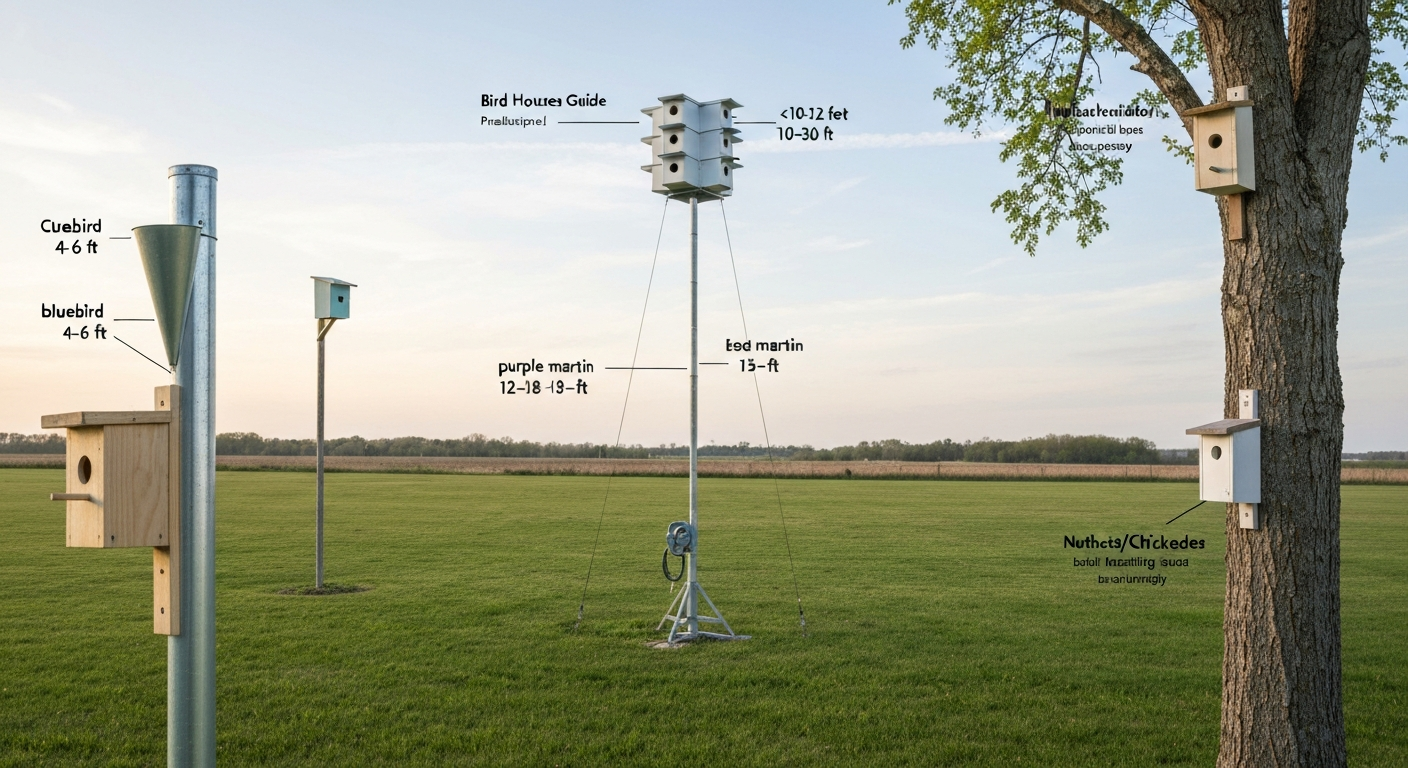
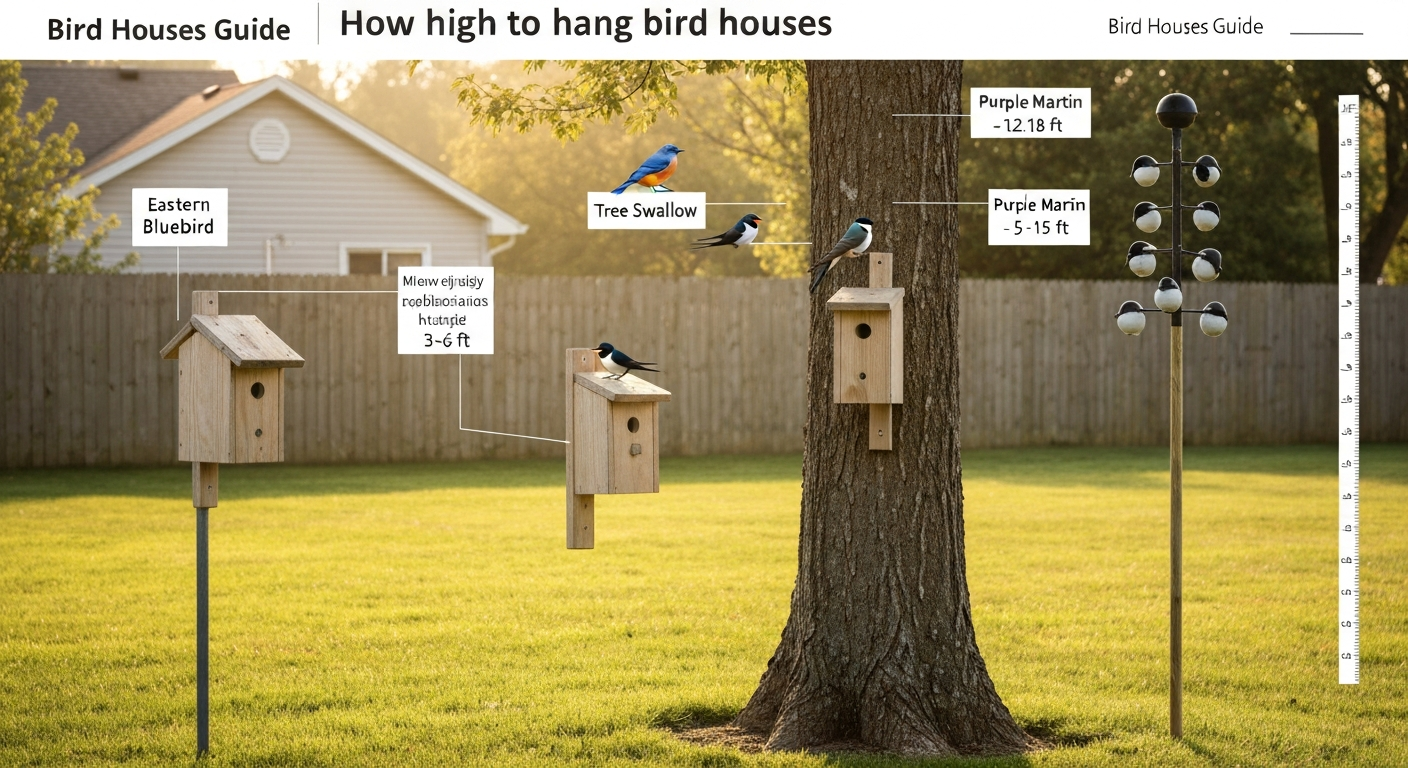
Most backyard nest boxes should be mounted between 5 and 10 feet off the ground, but the right height depends entirely on the species you are targeting. For specific height recommendations by species, see bird houses how high off the ground. For more detailed, species-specific mounting recommendations, see our guide on how high should a bird house be. Eastern bluebirds do best at 3 to 6 feet, tree swallows at 5 to 6 feet, chickadees and wrens anywhere from 5 to 15 feet, and purple martins need their housing up at 12 to 18 feet. Get the height wrong and the box sits empty, or worse, it becomes easy pickings for predators. Get it right, and you will have tenants within a season or two. For species-specific recommendations, consult our detailed guide to the best height for bird house placements.
How High to Hang Bird Houses: Heights, Holes & Mounting
Why mounting height actually matters
Height is not an arbitrary preference. Every cavity-nesting bird evolved to select nest sites at a specific elevation that balances predator avoidance, microclimate, and proximity to food. A box hung too low puts the nest within easy reach of raccoons, cats, and rat snakes. A box hung too high can overheat in midsummer sun, be inaccessible for monitoring, or simply be ignored by species that prefer to nest close to the ground. Regional and habitat factors layer on top of all of this: a bluebird box in a mowed rural meadow faces different predator pressure than one mounted on a suburban fence post where neighborhood cats prowl.
Timing compounds the height question. Cornell Lab's NestWatch program recommends installing boxes well before the breeding season, ideally in late winter or very early spring, so birds prospecting territories can find them. A box you hang in May is likely to sit empty until the following year. If you are reading this in summer, put the box up now anyway and let it weather in so it looks natural by next February.
At-a-glance height and hole-size cheat sheet
Print this table, laminate it, and tack it to your garage wall. These are the evidence-based targets from NestWatch construction plans and Purple Martin Conservation Association (PMCA) technical standards. Floor dimensions and depth are the interior measurements of the nest box itself.
| Species | Mounting Height | Entrance Hole | Interior Floor | Interior Depth |
|---|---|---|---|---|
| Eastern Bluebird | 3–6 ft | 1.5" round or 2.25"×1.375" oval | 5.5" × 5.5" | ~9" |
| Tree Swallow | 5–6 ft | 1 3/8" round | 5" × 5" | ~8" |
| Black-capped / Carolina Chickadee | 5–15 ft | 1 1/8" round | 4" × 4" | ~8" |
| House Wren | 5–10 ft | 1.0" round | 4" × 4" | ~6–8" |
| Tufted Titmouse | 5–15 ft | 1 1/4" round | 5.5" × 5.5" | ~8" |
| White-breasted Nuthatch | 5–20 ft | 1 1/4" round | 4" × 4" | ~8" |
| American Kestrel | 10–30 ft | 3" round | 8" × 8" | ~12" |
| Purple Martin (house compartment) | 12–18 ft | 1 3/4"–2 1/8" round | 6" × 6" min, 7" × 12" preferred | ~6" |
| Purple Martin (gourd) | 12–18 ft | 1 3/4"–2 1/8" round | 10–12" internal diameter | ~6" floor-to-hole |
A quick note on house sparrows: they will attempt to occupy almost any box in the 1" to 2" entrance range. House sparrows are an introduced, invasive species and are not protected under the Migratory Bird Treaty Act in the United States. If sparrows take over a box, you are legally permitted to remove their nests and eggs. Using the smallest entrance hole the target species will accept is the single most effective passive deterrent.
Species-by-species recommendations
Eastern bluebird
Mount bluebird boxes 3 to 6 feet above ground on a smooth metal pole in an open field, meadow, or mowed area with low or sparse ground cover. Bluebirds hunt by dropping from a perch to catch insects, so they need clear sight lines in front of the box. Use a 1.5-inch round hole or the NestWatch-recommended oval (2.25 inches high by 1.375 inches wide), which physically excludes European starlings. Space bluebird boxes at least 300 feet apart from each other to respect territorial requirements. If tree swallows are present in your area, pair boxes 15 to 25 feet apart, one for each species, to reduce competitive exclusion between the two.
Tree swallow
Tree swallows prefer the same open habitats as bluebirds but want their box a little higher: 5 to 6 feet works well. Keep the entrance hole at 1 3/8 inches. Tree Swallow, NestWatch (Cornell Lab of Ornithology) recommends mounting nest boxes 5–6 feet above ground in open habitat and using an entrance hole of about 1 3/8 inches Tree Swallow — NestWatch (Cornell Lab of Ornithology). They are aerial insect hunters and benefit from a completely clear flight path in front of the entrance. Pairing with a bluebird box (see above) reduces aggression between the species, since tree swallows will aggressively defend a bluebird box if it is the only one in the territory.
Black-capped and Carolina chickadee
Chickadees are flexible nesters and will use boxes from 5 all the way up to 15 feet, but 6 to 10 feet is a sweet spot for predator avoidance while still being easy to monitor. The interior is compact: a 4-inch by 4-inch floor with about 8 inches of depth. The 1 1/8-inch entrance hole matters a lot here because it excludes most competitors while fitting chickadees comfortably. Mount in woodland edge habitat or a yard with mature trees and shrubs nearby.
House wren
House wrens are one of the easiest birds to attract to a nest box. Mount boxes 5 to 10 feet high within roughly 100 feet of brushy or wooded cover, but make sure there is a clear flight path to the entrance. The 1-inch entrance hole is the key dimension here: it is large enough for a wren but excludes house sparrows and most other competitors. Wrens are not territorial in the way bluebirds are, so you can hang multiple boxes across a small yard without conflict.
Tufted titmouse
Titmice prefer boxes mounted 5 to 15 feet high in or near mature deciduous woodland. The NestWatch plan specifies a 5.5-inch by 5.5-inch floor with about 8 inches of depth and a 1.25-inch entrance hole. Titmice often use natural tree cavities in older forests, so placing the box on or near a mature tree is fine, though a smooth metal pole with a baffle is still safer from a predator standpoint.
White-breasted nuthatch
Nuthatches share very similar box dimensions to chickadees and titmice (4-inch by 4-inch floor, 8-inch depth) but the white-breasted nuthatch uses a slightly larger 1.25-inch hole. Mount 5 to 20 feet high in mature woodland with large-diameter trees. Nuthatches are less predictable nesters in artificial boxes than bluebirds or wrens, so patience is needed. Position the box on a tree trunk or wooden post at the woodland edge.
American kestrel
Kestrels are the smallest North American falcon and take readily to nest boxes in open agricultural and rural landscapes. Mount boxes 10 to 30 feet high, ideally on a utility pole, wooden post, or the side of a barn facing an open field. The 3-inch entrance hole and large 8-inch by 8-inch floor with 12-inch depth are non-negotiable: smaller boxes will be ignored. Face the entrance away from prevailing weather.
House sparrow: manage, do not accommodate
House sparrows are not a target species for nest boxes, but they are worth addressing directly because they can dominate every box in a yard and destroy the eggs and nestlings of native birds. Using the smallest acceptable entrance hole for your target species, monitoring boxes weekly during the breeding season, and removing house sparrow nests promptly are the most effective non-lethal management steps. Avoid mounting boxes on buildings in dense urban settings where house sparrow populations are highest.
Purple martin special guidance
Purple martins are colony nesters and arguably the most management-intensive backyard bird to host. They will not nest in a single small box. They need a dedicated multi-compartment house or a cluster of gourds on a dedicated pole system, installed at the right height, in the right location, and actively managed throughout the season. For recommended models, sizing, and setup tips, see our guide to the best martin bird houses for colonies and gourd systems. Getting martins established takes commitment, but once a colony forms it tends to return year after year.
Pole height and location
The PMCA recommends mounting martin housing at 12 to 18 feet above the ground. This is not a casual guideline: martins actively avoid housing that is too close to trees or structures that could conceal predators or obstruct their aerial approach. The housing must be in a completely open area, at least 40 feet (and ideally 60 feet or more) from trees, buildings, or any tall vegetation in all directions. Set the pole in concrete with at least 18 to 25 inches of pole buried belowground for stability at that height. In open water habitats like lake shores or farm ponds, martins will sometimes accept slightly lower poles, but 12 to 15 feet is still the target range.
Gourd vs. multi-compartment house
Both work, and many landlords use a combination. The PMCA recommends a minimum of 4 cavities to start attracting martins, with 6 to 12 cavities considered better for establishing a stable colony. Multi-compartment aluminum or plastic houses are easy to find and install, but the individual compartments in many commercial models are undersized. The PMCA considers 6-inch by 6-inch compartments a bare minimum and strongly recommends larger compartments (7-inch by 12-inch is the current PMCA preferred standard) to reduce nestling heat stress. White exterior color is required to reflect radiant heat in warm climates.
Natural and artificial gourds are preferred by experienced martin landlords because their rounded shape provides better internal microclimate regulation, and martins show a measurable preference for gourds over wooden or metal house compartments in some colony studies. A 10 to 12-inch internal diameter is the target for gourd cavities. Space individual gourds at least 18 inches apart when hanging them from a horizontal rack on the pole system.
Raise-and-lower pole systems
This is the single most important piece of equipment for martin landlords. Weekly nest checks are essential for successful martin management: monitoring for house sparrow and European starling takeovers, checking nestling health, and removing infested nests. You cannot safely do this at 15 feet without a system that brings the housing to you. The PMCA specifically recommends telescoping poles, rope-and-pulley systems, or winch/cable systems (often called Troyer-style winch poles after a widely used design). A brake winch with stainless cable is the most reliable option for heavy multi-gourd racks. Whatever system you use, make sure you can raise and lower the housing smoothly by yourself.
Mounting options: pros, cons, and when to use each
There are four main ways to mount a nest box: on a freestanding pole, on a tree, on a wall or building eave, and as a hanging or suspended gourd. Each has trade-offs for predator protection, species suitability, and ease of monitoring.
| Mounting Method | Best For | Predator Risk | Monitoring Access | Notes |
|---|---|---|---|---|
| Freestanding metal pole | Bluebirds, swallows, martins, kestrels | Lowest with baffle | Excellent | Best all-around option; use smooth EMT or galvanized pipe with stovepipe baffle |
| Tree mounting | Chickadees, titmice, nuthatches, wrens | Moderate to high | Good with ladder | Hard to baffle effectively; use only in low-predator areas or for species that prefer woodland |
| Wall or eave mounting | Wrens, nuthatches, kestrels (barn) | Moderate | Good | Predator guards difficult to attach; cats can reach from nearby structures |
| Hanging / gourd suspension | Purple martins primarily | Moderate (pole baffle helps) | Good with raise/lower system | Must have a raise-and-lower rack system for safe access; hang at least 18 inches apart |
I always default to a smooth metal pole with a predator baffle for any open-country species like bluebirds and swallows. Research published in the Wildlife Society Bulletin (Bailey and Bonter, 2017) analyzed over 24,000 NestWatch nest records and found that boxes equipped with predator guards had meaningfully higher nesting success, with the combination of a stovepipe baffle and a hole extender or Noel wire guard providing the greatest benefit. That data is hard to argue with.
Hardware, anchors, and fasteners
The right hardware makes the difference between a box that is still standing in ten years and one that tilts or falls after the first winter. Here is what I use and recommend.
- Poles: 3/4-inch or 1-inch EMT electrical conduit (galvanized steel) is inexpensive, smooth, and easy to cut to length. For heavier boxes or martin housing, use 1.5-inch or 2-inch galvanized steel pipe.
- Burial depth and concrete: For any pole taller than 6 feet, bury at least 24 inches in concrete. For martin poles (12–18 ft), bury 18 to 25 inches as the PMCA recommends. Use a post-hole digger or auger to get a clean hole.
- Stovepipe baffles: A 24-inch length of 8-inch diameter galvanized stovepipe centered at 4 to 5 feet above ground blocks raccoons and most climbing predators. Cap the top of the baffle cone with a cone-shaped sheet metal cap so the stovepipe hangs loosely and spins when climbed.
- Anti-rotation brackets: When mounting a box on a wooden post or tree, use a simple L-bracket or a through-bolt with a washer plate on the back to prevent the box from spinning in wind. Metal conduit strap clips work well for attaching boxes to pipe poles.
- Hole extenders: A 3/4-inch to 1-inch wooden or metal tunnel around the entrance hole raises the effective depth a predator's paw must reach. The NestWatch Noel guard (a cylinder of 1/2-inch hardware cloth attached over the entrance) is an effective alternative.
- Stainless steel screws and exterior-grade fasteners: Use 1.5-inch or 2-inch stainless steel screws for all box assembly. Galvanized screws are acceptable but will corrode faster. Never use staples for structural joints.
- Snake guards: A separate smooth metal cone or commercial snake-guard device mounted below the baffle adds an additional layer of protection, particularly relevant in the southeastern United States where rat snakes are common. A 2024 Wildlife Society Bulletin study on wood duck boxes confirmed that guard height and design significantly influence snake access probability, reinforcing the value of this addition.
Step-by-step installation checklist
Follow these steps in order. The whole job takes about two hours for a standard single-box pole installation once you have your materials gathered.
- Choose and clear the site: Identify the target species, then select a site that matches their habitat needs (open field for bluebirds, woodland edge for chickadees, completely open with water nearby for martins). Remove any ground-level vegetation that would allow predators to approach undetected.
- Mark and dig the post hole: Use a post-hole digger or auger to dig a hole at least 24 inches deep (or 18–25 inches for martin poles). The hole diameter should be about twice the pole diameter for a solid concrete fill.
- Cut the pole to length: Add your desired mounting height to your burial depth plus 2 inches. For a bluebird box at 5 feet, with 24 inches buried, cut the pole to 86 inches (7 feet 2 inches). Deburr any cut ends with a file.
- Attach the predator baffle to the pole before setting it: Slide the stovepipe baffle components onto the pole, then thread any cable or hardware needed for the raise-and-lower system (for martin poles) before the pole goes in the ground.
- Set the pole in concrete and check level: Set the pole in the hole, pack concrete around the base, and check plumb in two directions with a level. Brace the pole with scrap lumber until the concrete sets (minimum 24 hours, 48 hours preferred in cold weather).
- Attach the nest box or housing to the pole: Use conduit strap clips for round poles, or a mounting bracket for wooden posts. Tighten all fasteners so the box does not wobble. For martin housing, attach the raise-and-lower system hardware at this stage.
- Position the baffle: Slide the stovepipe baffle up to 4 to 5 feet above ground level and secure it with set screws or hose clamps through pre-drilled holes. The baffle should hang loosely enough to spin if a predator grabs it.
- Check the entrance hole orientation: Face the entrance hole away from prevailing weather (generally south to southeast in North America) and verify there are no branches, wires, or structures within 10 feet of the entrance that could serve as a predator's launch point.
- Record the installation: Note the date, species target, GPS coordinates or a rough sketch of the location, and mounting height. This is invaluable for monitoring records and for locating the box when vegetation grows in.
- Safety check and first inspection: Confirm the pole is plumb and immovable when pushed firmly. Verify all hardware is tight. Check inside the box: no debris, no gaps in construction, drainage holes at the floor corners are open.
Placement details: direction, clearance, and habitat
Compass orientation
Face the entrance hole between south and southeast as a general rule in North America. This orientation gives the box morning sun (which warms nestlings early in the day) while avoiding the hot afternoon sun, which can be lethal in unventilated boxes in summer. In very hot southern climates, a north-facing or northeast-facing entrance can help reduce internal temperatures. For purple martin housing, orientation matters less because the colony's height and the reflective white exterior do more work thermally, but still avoid due west to protect against afternoon heat.
Clearance from branches and obstacles
Keep at least 10 feet of clear space between the entrance hole and any nearby branch, wire, roofline, or structure in the forward arc of the box. Predators use branches and fence tops as staging areas before approaching a box. For open-country species like bluebirds and tree swallows, 50 feet of clearance in front of the box is better than 10. For woodland species like chickadees and nuthatches, nearby tree canopy is expected and acceptable, but the entrance itself should face into a small gap or clearing.
Distance from feeders and water
Keep nest boxes at least 20 to 30 feet away from active bird feeders. Feeders concentrate bird activity and attract house sparrows, which are the most aggressive nest-box competitors for native species. Water sources (birdbaths, small ponds) can be closer: 15 to 30 feet is fine and can actually attract cavity nesters, though the same logic about house sparrow congregation applies if the water source is heavily used.
Habitat-specific placement tips
- Urban yards: House wrens and chickadees are the most realistic targets. Mount boxes on the quieter side of the yard, away from high foot-traffic areas. Use the smallest practical entrance hole to exclude house sparrows. Monitor weekly during April through July.
- Suburban yards with lawn and trees: Bluebirds and tree swallows are possible if you have at least a quarter-acre of mowed or sparse-grass area. Mount boxes in the most open corner of the yard on a freestanding pole with a stovepipe baffle. Pair boxes (one for bluebirds, one for swallows) 20 feet apart.
- Rural properties, fields, and meadows: Bluebird trail setup (multiple boxes spaced 300 feet apart along a field edge or fenceline) is the gold standard. Kestrel boxes work well on utility or fence posts at field edges. Consider martin housing if you have at least half an acre of open space clear of tall trees.
- Woodland edge and forest: Chickadees, titmice, nuthatches, and wrens are the primary targets. Boxes can be mounted on trees here without major predator-guard complications, though a smooth-pole installation is still safer. Keep boxes under 15 feet for easy ladder access.
Predator-proofing in practice
The research is unambiguous: predator guards substantially improve nest success. The 2017 Bailey and Bonter study in the Wildlife Society Bulletin drew on more than 24,000 nest records and found that the combination of a stovepipe baffle plus either a Noel wire guard or a hole extender outperformed any single guard type alone. An MDPI global review of nest-box predator-proofing reinforces this, noting that the most effective solutions are species- and context-specific, and that design trade-offs such as microclimate effects of a guard versus its exclusion value must be considered. The practical takeaway: use a stovepipe baffle on any freestanding pole, add a hole extender or Noel guard at the entrance, and add a dedicated snake guard in regions where rat snakes are active. Check all guards at the start of each season to make sure they have not been dislodged or corroded.
Cleaning and sanitation schedule
A dirty box is a health hazard for nesting birds and a deterrent for future occupants. At a minimum, clean out every nest box once each breeding season is fully complete, usually in late summer or early fall. For boxes that had multiple clutches (wrens and bluebirds regularly raise two or three broods), check and remove old nesting material between each clutch once you are confident the current brood has fledged. Use a stiff brush and a dilute bleach solution (one part bleach to nine parts water) to scrub the interior, then allow the box to dry completely before closing it up. Leave boxes in place over winter: bluebirds and wrens sometimes use them for roosting, and having a weathered, established-looking box in place improves occupancy rates the following spring.
Height, species biology, predator protection, and habitat placement all connect. Once you have a box at the right elevation with a good baffle under it and the entrance facing the right direction, your main job becomes consistent monitoring and sanitation. That combination, more than any single factor, is what separates a box that sits empty for years from one that produces fledglings season after season.
FAQ
What is the quick-reference guide for how high to hang or mount bird houses for common backyard species?
Quick reference mounting heights (typical ranges): Eastern/Western Bluebird 3–6 ft; Tree Swallow 5–6 ft; House Wren 5–10 ft; Chickadees 5–15 ft; Tufted Titmouse 5–15 ft; Nuthatches 5–20 ft (species-dependent); Purple Martin colony housing 12–18 ft (pole‑mounted, often 12–20 ft in open areas). These are general ranges—choose within the range based on habitat, predator risk, and local guidance.
What species-specific entrance-hole sizes and internal dimensions should I use (including purple martins)?
Species quick specs (typical): Eastern Bluebird: hole 1.5" round or 2.25"×1.375" oval; interior ~5.5"×5.5" floor, ~9" depth. Tree Swallow: hole ≈1 3/8"; similar floor ~5–6" square, depth ~8–10". House Wren: hole ≈1.0"; floor ~4–5" square, depth ~6–8". Chickadees: hole ≈1 1/8"; floor ~4"×4", depth ~7–9". Titmice: hole ≈1.25"; floor ~5.5"×5.5", depth ~8". Nuthatches: hole ≈1.25" (white‑breasted ~1.25"); floor ~4–5" square, depth ~8–10". Purple Martins (colony): compartments ideally 6"×6" minimum; PMCA prefers larger compartments (examples: 7"×12" compartments or gourds 10–12" diameter); entrance openings commonly 1.75"–2.25" (many use ~2.125"). Follow species‑specific construction plans for precise interior heights/porch recommendations.
How should I mount bird houses — pole, tree, or wall — and what hardware is recommended?
Mounting options: Pole (preferred in many situations): use smooth metal or PVC pole with stovepipe baffle for predator deterrence; secure with a concrete footer and use brackets or winch systems for martin poles. Tree mounting: use a wide-band tree strap or lag screws with a spacer to avoid girdling; avoid nailing directly if possible. Wall/structure mounting: attach using corrosion‑resistant screws and a mount plate; add predator guards and ensure the box is firmly fixed. Hardware: galvanized or stainless screws, lag bolts for poles, pole brackets, stovepipe or cone baffles, Noel guards or hole extenders, winch/pulley systems for martin poles. For purple martins use raise/lower systems (telescoping pole, rope & pulley, or winch) and anchor pole in concrete with 18–25" below ground.
How far above the ground should bird houses be to stay safe from predators like cats, raccoons, and snakes?
Safe distances off the ground: generally mount small‑songbird boxes 5–15 ft where practical to reduce mammal access. For bluebirds lower heights (3–6 ft) are effective but pair with pole baffles to deter predators. For snakes and climbing mammals place predator guards high enough that rodents/snakes cannot bridge from nearby structures or vegetation—stovepipe baffles typically extend 24–36" or more below the box and should be positioned so there is at least 4–6 ft of clear smooth pole beneath the box. Purple martins at 12–18 ft are high enough to reduce many ground predators but still need secure poles and baffles.
How should boxes be oriented and placed in the landscape (habitat placement tips)?
Orientation and placement: face entrance away from prevailing winds and blistering sun—typically east to northeast or north‑east in hot climates to reduce afternoon sun; avoid facing directly into strong prevailing winds. Place boxes with a clear flight path to the entrance (no obstructing branches <3 ft in front). Match habitat: bluebirds prefer open grassy areas with short perches nearby; tree swallows like open habitat near water/fields; wrens want woody cover within ~100 ft; cavity nesters (chickadees, titmice, nuthatches) favor wooded edges. Space multiple boxes to reduce competition—bluebird boxes often 100–300 ft apart, tree swallows/bluebirds 15–25 ft if coexisting.
What predator-deterrent measures work best for nest boxes?
Effective predator deterrents: stovepipe (cylindrical) metal baffles on smooth poles; cone baffles on poles; Noel (wire) guards around the hole to stop raccoons and some snakes; hole extenders to increase flyway distance from predators; snake guards that prevent climbing predators from reaching the box; remove nearby low branches and brush that provide a bridge; mount boxes on smooth poles rather than rough wood. Studies and NestWatch recommend combining guard types (baffle plus hole guard) for highest nesting success. Ensure guards do not create entrapment hazards and preserve ventilation/drainage.
Bird Houses: How High Off the Ground, Heights & Placement Tips
Birdhouse heights & hole sizes for bluebirds, chickadees, wrens, swallows, nuthatches, martins & kestrels; mounting.