Window bird houses do work, but with important caveats. Birds will nest in a box mounted on or very close to a window just as readily as one on a pole, provided the box is sized correctly for the target species, the glass is treated to prevent collisions, the mount is secure enough to hold the box through a full nesting season, and the location avoids overheating. The close-up viewing they offer is genuinely spectacular. The risks, chiefly glass collisions, suction-cup mount failure, heat buildup against glass, and disturbance from indoor activity, are real but manageable with the right design and installation. Go in with clear expectations, follow the welfare steps below, and a window nest box can be one of the most rewarding setups a backyard birder can try.
Do Window Bird Houses Work? Evidence-Based Guide & How-To

The evidence-based verdict: what we know and where the gaps are
There is no peer-reviewed study that directly compares occupancy rates or reproductive success between window-mounted and pole-mounted nest boxes. Cornell Lab's NestWatch program, the Audubon Society, and the American Bird Conservancy, which between them publish the most authoritative North American nest-box guidance, base their recommendations on box design, predator guards, placement height, and microclimate. None of those bodies have published a controlled window-versus-pole trial. What the science does give us is solid evidence on the factors that determine whether any nest box works: entrance-hole diameter matched to species, interior floor area and depth, internal temperature, ventilation, predator exclusion, and low disturbance during active nesting. A window-mounted box lives or dies by exactly those same variables. For a broader look at whether bird houses are effective across different mounting methods, see our related article on do bird houses work.
The honest conclusion is that window placement is a mounting method, not a fundamentally different product. Commercial window nest boxes with suction-cup backs or clear Plexiglas panels do exist and are used by backyard birders, but their vendor pages carry no peer-reviewed occupancy data. I treat them the same way I treat any nest box: get the dimensions right, manage the microclimate, guard against predators, and let the birds decide. When those conditions are met, window boxes attract and fledge birds. When they are not, the birds investigate and leave, the same outcome you get from a poorly designed pole box.
Who should consider a window bird house
If you have a yard and a fence post, a traditional pole-mounted box is almost always the easier, lower-risk option. But window mounting solves real problems for specific situations. Apartment dwellers with a balcony or a large single-pane window are often unable to sink a post into ground, and a window box may be the only cavity-nesting option available. Urban homeowners with small lots and no suitable trees or posts sometimes find a shaded north- or east-facing window is the only spot that stays cool enough. Educators and parents who want children to watch a full nesting cycle from inside without going outdoors get enormous value from the clear-back window box format. And dedicated birders who already run a yard box program sometimes add a window unit specifically to get nest-camera-quality views without drilling into a wooden box.
DIYers are particularly well suited to window boxes because the most common commercial weakness, an undersized suction-cup mount that fails after one heat cycle, is easy to engineer around with a frame bracket or a wooden ledge mount screwed into window trim. If you are handy enough to cut a piece of cedar to a species-specific floor dimension, you can build a window box that outperforms most commercial versions. The step-by-step dimensions in the design section below give you everything you need.
One group that should pause before installing a window box is apartment renters. Drilling into window frames or exterior surfaces is almost always prohibited by lease agreements. Even suction-cup mounts can leave permanent marks on some glass coatings or double-pane seals. Check your lease and, if in doubt, ask your landlord in writing before installing anything.
Honest pros, cons, and bird-welfare risks
The genuine advantages
- Close-up, undisturbed viewing through the window glass, comparable to a built-in nest camera without any wiring
- Viable option where ground or post mounting is impossible (balconies, rented properties with landlord approval, paved lots)
- Easy monitoring without approaching the box, which reduces disturbance during sensitive incubation and brooding periods
- Motivates children and new birders who benefit from direct, repeatable observation
The risks you need to take seriously
Glass collisions are the most serious welfare risk. The American Bird Conservancy estimates that up to roughly one billion birds die annually from window strikes in the United States. A nest box attached to or immediately adjacent to glass creates a scenario where fledglings leaving the cavity for the first time, and adults approaching or departing the entrance, face a reflective or transparent pane. If the glass around the box is not treated, you can inadvertently turn a conservation tool into a hazard. Full treatment protocols are in the safety section below.
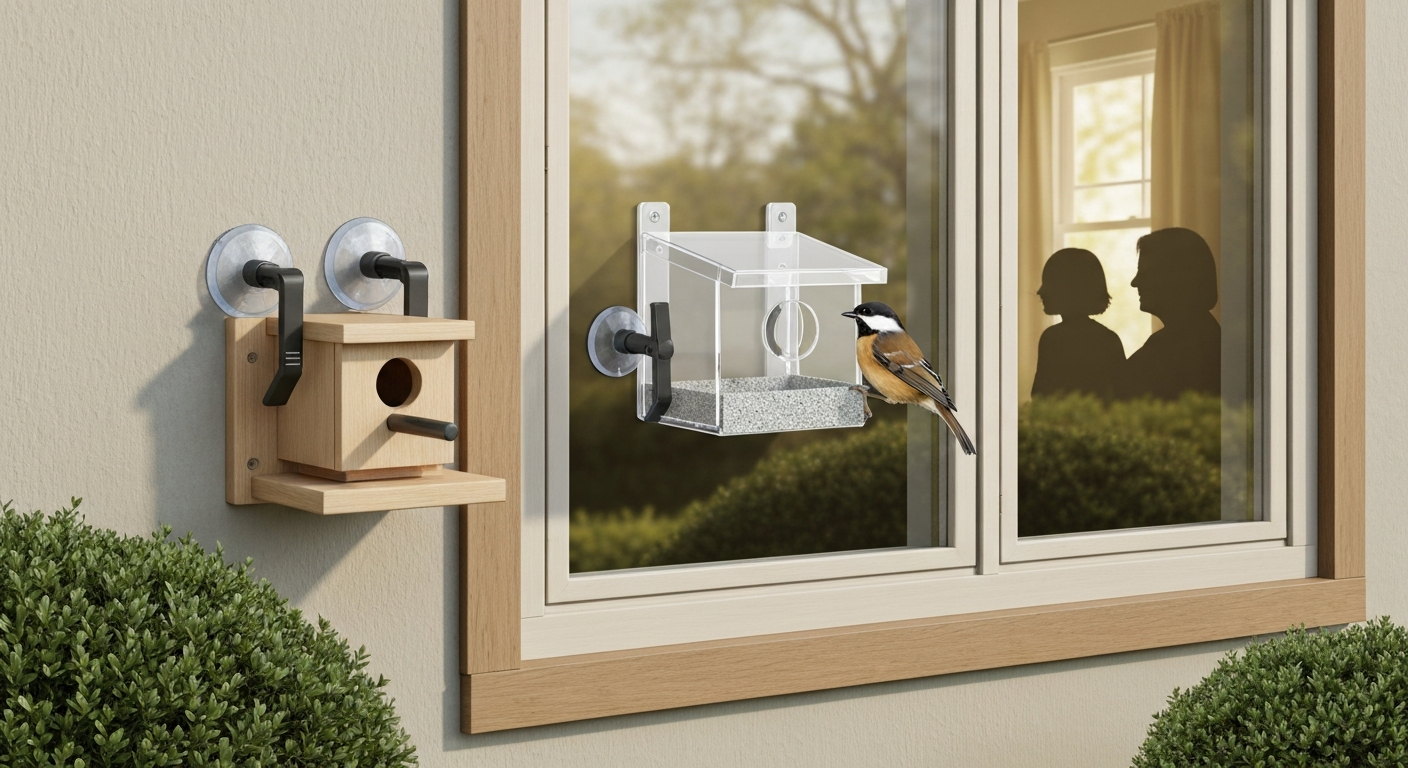
Mount failure is the second major risk. Standard suction cups rated for light indoor use are not reliable on outdoor glass through temperature swings, UV exposure, and rain. A falling box during the nestling stage can kill an entire brood. Heavy-duty industrial suction mounts with locking levers and cups 4 inches or larger in diameter perform better, but a bracket screwed into window trim or a clamp-style frame mount is mechanically more secure for anything weighing more than a few ounces, especially a box loaded with nesting material, eggs, or chicks.
Heat buildup is the third serious concern. Research on nest microclimate shows that internal temperature increases of just 2 to 3 degrees Celsius above optimal can impair nestling growth and alter parental behavior, with stronger effects documented in direct-sun boxes. A box pressed against south- or west-facing glass in summer acts as a solar collector. The mitigation is straightforward: choose a north- or east-facing window, shade the box with a generous roof overhang, and ensure ventilation holes are open and not blocked by the mounting hardware.
Indoor activity disturbance matters more with a window box than a yard box. Birds can see movement through glass, and repeated close-up human activity, such as children pressing their faces to the pane, can cause adults to abandon a nest or reduce feeding frequency during critical brooding days. NestWatch's monitoring protocol recommends keeping disturbance minimal; with a window box, that means setting behavioral rules for everyone in the household before the box goes up.
Finally, lease and legal considerations: beyond the renter situation described above, some local ordinances govern structures attached to building exteriors. This is uncommon for a small nest box, but worth a brief check in areas with strict HOA rules.
Safety and welfare guidelines before you install anything
Treating the glass to prevent collisions
The American Bird Conservancy and Cornell Lab both endorse the '2x4 rule' for external window markings: dots, stripes, or patterns spaced no more than 2 inches apart vertically and 4 inches apart horizontally on the outside surface of the glass. For the smallest species using window boxes, such as house wrens and chickadees, 2-inch-by-2-inch spacing is safer. Critically, markings must be on the exterior face of the glass. Interior decals alone are not effective because birds perceive the reflected sky in the outer surface, not the interior image. Acopian BirdSavers (vertical paracord strands hanging in front of the glass at roughly 4-inch spacing) are an effective and reversible option for renters. Apply treatments across the full pane adjacent to the box, not just the immediate mount area.
Securing the mount
- Calculate the fully loaded weight of your box: box body + nesting material (up to 2–3 oz for wrens, more for bluebirds) + up to six eggs or nestlings.
- If using suction cups, use industrial-grade cups at least 4 inches in diameter with a locking lever mechanism; rate the combined cup capacity at 3x the fully loaded box weight as a safety margin.
- Clean the glass with isopropyl alcohol and let it dry completely before pressing cups; recheck adhesion every 2 weeks during the season.
- For frame mounting, use stainless steel screws driven into solid window trim (not drywall or vinyl alone); a wooden shelf bracket provides a load-bearing ledge under the box floor.
- Position the box so the entrance hole faces away from the glass pane, ideally perpendicular to it or angled outward, so birds approach and depart without flying directly toward the window surface.
Managing heat and microclimate
- Choose a north- or east-facing window as a first preference; avoid south- or west-facing glass in USDA hardiness zones 6 and warmer.
- Build or buy a box with a roof overhang of at least 2 inches beyond the entrance hole to shade the cavity.
- Drill at least four ventilation holes (3/8-inch diameter) near the top of each side wall, and confirm they are not blocked by the mount.
- Use 3/4-inch-thick wood minimum (1-inch actual cedar or pine preferred) rather than thin plywood, which heats faster.
- Do not paint the exterior a dark color; raw cedar, light gray, or buff tones reflect more heat than black or dark brown.
Minimizing disturbance
Install any monitoring camera or viewing panel before the nesting season begins, ideally at least two weeks before expected egg-laying, so birds habituate to the setup. Once eggs are present, limit direct viewing sessions to short windows (a few minutes at a time) and avoid pressing close to the glass or using flash photography. NestWatch's code of conduct advises against opening an active box at all unless you are an enrolled monitor following their specific protocol; with a viewing window built into the design, you never need to open the box during the active season. Train everyone in the household: no knocking on the glass, no sudden movements directly in front of the window during feeding visits.
Which species are actually suitable for a window box
Not every cavity-nesting species is a realistic candidate. Window boxes work best for small, bold, human-tolerant species that already nest near buildings. House wrens and black-capped chickadees are the most consistent performers in window or building-adjacent boxes in North America. Tree swallows and violet-green swallows accept boxes on or near structures when open-sky flight paths are available for their aerial feeding style. Eastern bluebirds, though often cited as a prime box species, are more conservative about close-building placement and generally do better on pole-mounted boxes with open field views. European users targeting blue tits and great tits have a long record of success with wall- and window-adjacent boxes, and the same principles apply.
| Species | Entrance Hole Diameter | Floor Size (interior) | Cavity Depth | Mount Height | Window Box Suitability |
|---|---|---|---|---|---|
| House Wren | 1-1/8" (29 mm) | 4" × 4" | 6–8" | 5–10 ft | Excellent |
| Black-capped Chickadee | 1-1/8" (29 mm) | 4" × 4" | 8–10" | 5–15 ft | Excellent |
| Carolina Chickadee | 1-1/8" (29 mm) | 4" × 4" | 8–10" | 5–15 ft | Excellent |
| Tree Swallow | 1-3/8" (35 mm) | 5" × 5" | 6–8" | 5–10 ft | Good (needs open sky nearby) |
| Violet-green Swallow | 1-3/8" (35 mm) | 5" × 5" | 6–8" | 5–15 ft | Good (needs open sky nearby) |
| Eastern Bluebird | 1-1/2" (38 mm) | 5" × 5" | 8–12" | 4–6 ft | Fair (prefers open field siting) |
| White-breasted Nuthatch | 1-3/8" (35 mm) | 4" × 4" | 8–10" | 5–20 ft | Fair |
| Blue Tit (UK/Europe) | 25–28 mm (~1-1/16") | 4" × 4" | 6–8" | 6–12 ft | Excellent |
| Great Tit (UK/Europe) | 32 mm (~1-1/4") | 4.5" × 4.5" | 8–10" | 6–15 ft | Excellent |
Tolerance ranges matter: an entrance hole that is 1/8 inch too large can allow house sparrows to take over a chickadee box, and a hole 1/8 inch too small prevents the target species from entering. Measure twice, cut once, and test the diameter with a drill bit or hole-saw check piece before drilling the actual box panel.
Design and dimensions: a practical build plan
Materials and tools checklist
- Wood: 3/4-inch (actual) untreated cedar or white pine; one 6-inch-wide board, 4 feet long covers most small-species boxes
- Fasteners: 1-5/8-inch exterior-grade stainless steel screws (not galvanized, which corrodes); avoid nails for joints under stress
- Hardware: stainless steel hinges or a pivot screw for a cleanout panel (one side wall should open for annual cleaning)
- Drill and bits: 1-1/8", 1-3/8", or 1-1/2" spade or Forstner bit for entrance hole; 3/8" bit for ventilation and drainage
- Saw: circular saw or hand saw for straight cuts; jigsaw if cutting a curved roof
- Sandpaper: 80-grit to roughen the interior below the entrance hole (helps fledglings grip and climb out)
- Finish: raw cedar needs no finish; pine can receive one coat of water-based exterior latex in a light color on exterior surfaces only; never finish interior surfaces
- Mount hardware: heavy-duty suction cups (4"+ diameter with locking lever) OR stainless L-brackets and screws for frame mounting
- Optional: nest camera (wide-angle, infrared) installed before the season begins
Step-by-step cut list and assembly (house wren / chickadee dimensions)
- Cut the floor panel: 4 inches × 4 inches. Bevel or trim all four corners by 3/8 inch to create drainage gaps; alternatively drill four 3/8-inch drainage holes near each corner.
- Cut the front panel: 4 inches wide × 9 inches tall. Mark the entrance hole center at 7 inches from the bottom edge. Drill a 1-1/8-inch hole (for wrens and chickadees) using a Forstner bit for a clean edge. Roughen the interior face below the hole with 80-grit sandpaper or score horizontal grooves with a chisel.
- Cut the back panel: 4 inches wide × 11 inches tall (the extra 2 inches extend above and below the box for mounting to a frame bracket or suction-cup plate).
- Cut the two side panels: 4 inches wide × 9 inches tall, with the top edge cut at a 15-degree angle (front lower, back higher) to match a sloped roof.
- Cut the roof panel: 6 inches wide × 6 inches deep (the 6-inch width provides a 1-inch overhang on each side and the 2-inch forward overhang shades the entrance).
- Drill ventilation holes: two 3/8-inch holes near the top of each side panel, at least 1/2 inch from any edge.
- Assemble with exterior screws: attach side panels to floor, attach front to sides and floor, attach back to sides and floor. Make one side panel hinged with a pivot screw at top and bottom for seasonal cleanout access.
- Attach roof with two screws at the back panel; do not glue the roof so it can be removed for deep cleaning.
- For the window mount: attach two industrial suction cups (4"+ diameter) to the back panel using stainless bolts through pre-drilled holes, OR screw the extended back panel to a wooden ledge bracket that itself screws into solid window trim.
Scaling dimensions for other species
For tree swallows, increase the floor to 5 inches by 5 inches, raise the front panel height to 10 inches, and use a 1-3/8-inch entrance hole centered 6 inches from the floor. For eastern bluebirds, use a 5-inch by 5-inch floor, a 12-inch front panel, and a 1-1/2-inch entrance hole centered 9 to 10 inches from the floor. European blue tit boxes use a 25 to 28 mm hole on a 4-inch by 4-inch floor with 15 mm minimum timber thickness, as recommended by the BTO.
Predator-proofing a window box
A window box cannot use a stovepipe baffle (the standard best-practice guard for pole mounts), so predator proofing has to come from other directions. An entrance-hole extender, a 1-inch-thick wooden block or metal plate drilled to the same diameter as the entrance hole and screwed flush to the exterior front panel, increases the tunnel depth and makes it much harder for a raccoon paw or squirrel head to reach eggs or nestlings. Research published in the Wildlife Society Bulletin using NestWatch data found that predator guards increased nest success by an average of about 6. Large-scale analysis of 24,114 NestWatch records found predator guards increased nest success by about 6.7%, with cone/stovepipe baffles and entrance-hole extenders among the most effective Large-scale analysis of 24,114 NestWatch records found predator guards increased nest success by about 6.7%, with cone/stovepipe baffles and entrance-hole extenders among the most effective.. 7 percent, with entrance-hole extenders among the effective types. A metal hole guard also prevents squirrels from enlarging a wooden hole. Additionally, mounting the box high enough (above 8 feet on a smooth wall surface with no adjacent climbing route) reduces access for cats and raccoons.
How birds find and fit into a window box
Birds searching for a nest site are primarily responding to cavity size, entrance-hole diameter, location relative to cover and open space, and prior experience with a site type. They do not need to be guided to a window box in any special way. House wrens and chickadees are year-round residents in most of their range and begin scouting cavities weeks before egg-laying begins. If the entrance hole matches the species' body width and the interior volume is appropriate, a bird investigating the area will enter, assess the space, and return repeatedly if the site is competitive.
The fit through the entrance hole is tighter than it looks. A chickadee entering a 1-1/8-inch hole compresses its feathers and tilts its head slightly; the hole diameter is matched to its shoulder width, not its head width. This tight fit is a feature, not a flaw: it slows predator access and reduces heat loss. Roughening the interior surface below the hole, as described in the build steps above, is important for fledglings. Smooth wood offers no grip for young birds climbing toward the exit on fledging day, and a smooth-walled box can trap a fledgling that falls to the floor. Score horizontal grooves at 1/2-inch intervals or glue a small strip of window screen to the interior front wall below the hole.
Birds are more likely to discover a window box if you place it within their existing territory or along a route they already travel. Mounting the box near native shrubs, a brush pile, or an existing feeding station increases exposure. It is worth noting that the question of how birds find nest boxes at all, and what cues they use to evaluate a site, is covered in more depth in the broader nest-box guidance on this site. For more on how birds select and physically fit into cavities, see our detailed guide on how do birds fit in bird houses. See our detailed guide on how do birds find bird houses for a deeper look at the cues and behaviors birds use to locate and evaluate cavities. The short version: they scout during daylight hours in late winter and early spring, and they favor boxes they can approach and retreat from without flying directly toward a reflective surface, which is another reason the glass-collision treatment described above is essential before the box goes up.
When birds will use a window box: timing, seasons, and regional notes
The single most common reason a new nest box sits empty for a full season is incorrect timing: the box went up after local birds had already committed to a natural cavity or a competing box. For more on timing and regional cues, see our detailed guide on when will a bird use a birdhouse. Install a window box in late winter, well before local pair formation and nest-site prospecting begin. In the southern United States, that means January through February. In the upper Midwest and New England, late February through early March is the target window. In the Pacific Northwest, early February works for wrens and chickadees. In the UK, January through February is the recommended BTO installation window for tit boxes.
Local phenology matters more than calendar dates. A practical rule: install your box before the earliest local wildflower blooms or before the first consistent daytime temperature above 50 degrees Fahrenheit (10 degrees Celsius), whichever comes first. Both of these cues correlate with the period when cavity-nesting birds begin serious site assessment in most temperate regions. A box that has been in place for several weeks before scouting begins is treated as an established feature of the landscape rather than a novel object.
House wrens are among the last cavity nesters to begin nesting in spring, arriving on breeding grounds in late April to May across much of their North American range. If you are targeting wrens specifically, a box installed in March still gives plenty of lead time. Tree swallows arrive on breeding grounds in March through April across the northern United States and Canada; they are highly competitive for boxes and will often beat wrens to a new cavity. Bluebirds begin nest-building in February in the Deep South and March to April in the northern states. In all cases, the guidance on when birds use nest boxes generally, including multi-attempt and second-brood timing, applies to window boxes without modification.
Seasonal maintenance schedule
- Late winter (before installation): inspect box for mount integrity, replace any cracked suction cups, recheck entrance hole size, apply collision-deterrent markings to the glass.
- Pre-season (2 weeks before expected arrival): install or reinstall the box, confirm ventilation holes are clear, check that the cleanout panel opens freely.
- Active nesting season: do not open the box; observe only through the window; recheck suction-cup adhesion every 2 weeks; note behavioral changes that could indicate heat stress (adults panting at entrance, reduced visit frequency).
- Post-fledging (within 2 weeks of nest vacancy): open the cleanout panel, remove all old nesting material, scrub interior with a stiff brush and a 1:9 bleach-water solution, rinse, and let dry completely before closing.
- Late autumn: apply a single coat of water-based exterior latex to any bare pine surfaces (exterior only); cedar requires no finish; store the box indoors if the mount will be unused until spring.
Monitoring, attraction, and troubleshooting
A nest camera installed before the season, ideally a wide-angle infrared model that captures the full floor area, eliminates the temptation to open the box during active nesting and gives you far better data than occasional peeks through the window. NestWatch explicitly recommends camera installation prior to nesting and cautions against disturbing active nests. Run camera cables through a small hole drilled in the back panel and seal the penetration with silicone caulk to keep moisture out.
If the box sits unoccupied after a full season, work through this diagnostic list before assuming the location does not work. First, confirm the entrance hole diameter is within 1/16 inch of the recommended size for your target species; even a slightly oversized hole invites house sparrows in competitive areas. Second, assess the thermal environment: if the box gets direct afternoon sun, that alone will deter most cavity nesters. Third, check for competing natural cavities (loose bark, a woodpecker hole in a nearby tree) that may be preferred. Fourth, confirm the glass collision treatment is complete and correct; birds avoid areas near glass that has caused strikes they have witnessed.
Window box versus yard-mounted box: a quick decision guide
| Factor | Window Box | Yard / Pole Box |
|---|---|---|
| Viewing quality | Excellent close-up, no nest camera needed | Requires camera for close-up view |
| Installation complexity | Moderate (mount preparation critical) | Simple (post or baffle system) |
| Predator guard options | Entrance extender + height; no baffle possible | Full baffle + pole system available; most effective |
| Heat management | More challenging; orientation-dependent | Easier with open-air placement and shading |
| Glass collision risk | Present; must treat adjacent glass | Absent or low |
| Mount reliability | Lower (suction cups) or good (frame bracket) | High (cemented post or T-post) |
| Suitable for renters | Possibly (check lease; suction-cup only) | Usually no (ground installation needed) |
| Species range | Small, human-tolerant species only | Full range including bluebirds, kestrels |
| Disturbance management | Requires household behavioral rules | Low disturbance with standard placement |
If you have outdoor ground or post access, a yard-mounted box with a stovepipe baffle is the lower-risk, higher-success-rate choice for most species. Choose a window box when ground mounting is not possible, when close-up viewing is the primary goal, or when you are specifically targeting human-tolerant species like house wrens in an urban setting. In a well-run backyard program, the two approaches complement each other rather than compete.
FAQ
Do window bird houses work — are they effective for attracting nesting birds and providing close-up viewing without harming birds?
Short answer: Sometimes — but only under strict species-, design-, mounting- and timing-sensitive conditions. There are no peer-reviewed studies directly comparing occupancy or reproductive success of glass-mounted boxes versus standard pole/tree mounts. Trusted nest-box guidance (Cornell/NestWatch, Audubon, USDA, BTO/RSPB) shows that proper box design (ventilation, drainage, hole size), predator protection, microclimate, and secure mounting are the main determinants of success. Window-mounted boxes can work for a few adaptable cavity-nesters (e.g., house sparrows, some chickadees, house wrens, and occasionally tree swallows or bluebirds) if you eliminate collision risk, avoid heat buildup, prevent predator access, and follow monitoring and sanitation best practices. If any of those protections can’t be met, a standard yard-mounted box is usually safer for birds and more reliable for viewers.
Which species are most likely to use window-mounted boxes?
Species most likely to accept window or near-window boxes are small, flexible cavity-nesters that tolerate human proximity: house wren, black-capped chickadee (or local chickadee species), some tit species (U.K./Europe), house sparrow (where present), and occasionally tree swallows or bluebirds. Large, territory-sensitive, or deep-forest species are unlikely to use glass-mounted boxes. Always follow region-specific nest-box dimension guidance from Cornell/NestWatch, USDA or BTO when building for target species.
What are the main pros and cons of window-mounted bird houses (summary)?
Pros: close-up viewing/photography; educational value; options for apartment dwellers; can be installed without yard space. Cons/risks: increased glass-collision risk (if outside glass not treated), elevated internal temperatures if against sunny glass, suction/attachment failure risk, reduced predator protection (unless designed), disturbance from indoor activity, and higher chance box is unsuitable microclimate-wise. Net benefit only when collision mitigation, secure mounting, ventilation/shading and predator guards are in place.
How do window collisions influence whether I should mount a box on/near a window?
Glass collisions are a major bird mortality source. If you mount a box on or adjacent to a window you must treat the outside of the glass with visible markers meeting the 2×2/2×4 guidance (dots/strips spaced ≤2" vertically and ≤4" horizontally; use 2" spacing for very small species). External markers or Acopian-style vertical cords reduce collisions. Do not rely solely on interior decals. If you cannot mark the outside glass or control reflections, choose a window-adjacent (pole or wall) box instead of directly glass-mounted.
What precise design and dimension guidelines should I follow for window/viewing boxes?
Follow species-specific dimensions from Cornell/NestWatch, USDA/extension or BTO. General design features (all species): - Entrance hole sized to species (see species table below). - Interior floor area and depth per species plans. - Ventilation: at least two small vent holes near the top on opposite sides or beneath the roof; holes ~6–8 mm (1/4"–5/16") or per local plans. - Drainage: at least four 9–12 mm (3/8"–1/2") holes in the floor. - Materials: exterior-grade 3/4" (≈18 mm) untreated cedar or pine; avoid pressure-treated wood; paint or stain only outside with water-based, non-toxic finish. - Predator-proofing: overhanging roof, 1/8"–1/4" metal entrance-guard for hole-size maintenance, and mount- or cage-based predator guards for climbing predators. - Interior: rough-sawn lower wall below hole so fledglings can climb. - Roof: waterproof with small overhang to keep rain out. Use official species plans (NestWatch/Audubon) for exact floor/depth/hole combos.
Can you give a short table of common species and recommended entrance-hole sizes and interior floor minima?
Common species (North America & U.K. examples) — recommended entrance hole / approximate interior floor (minimum): - House wren: 1 1/8" (29 mm) / 4"×4" (10×10 cm) - Black-capped chickadee: 1 1/8" (28 mm) / 4"×4" (10×10 cm) - Tree swallow: 1 3/8" (35 mm) / 4.5"×4.5" (11.5×11.5 cm) - Eastern bluebird: 1 3/8" (35 mm) / 5"×5" (12.5×12.5 cm) - Great tit (U.K.): ~32 mm / ~14×14 cm floor - Blue tit (U.K.): ~25–28 mm / ~12×12 cm floor Note: use local authoritative charts (NestWatch, USDA, BTO) for full plans and mounting heights.
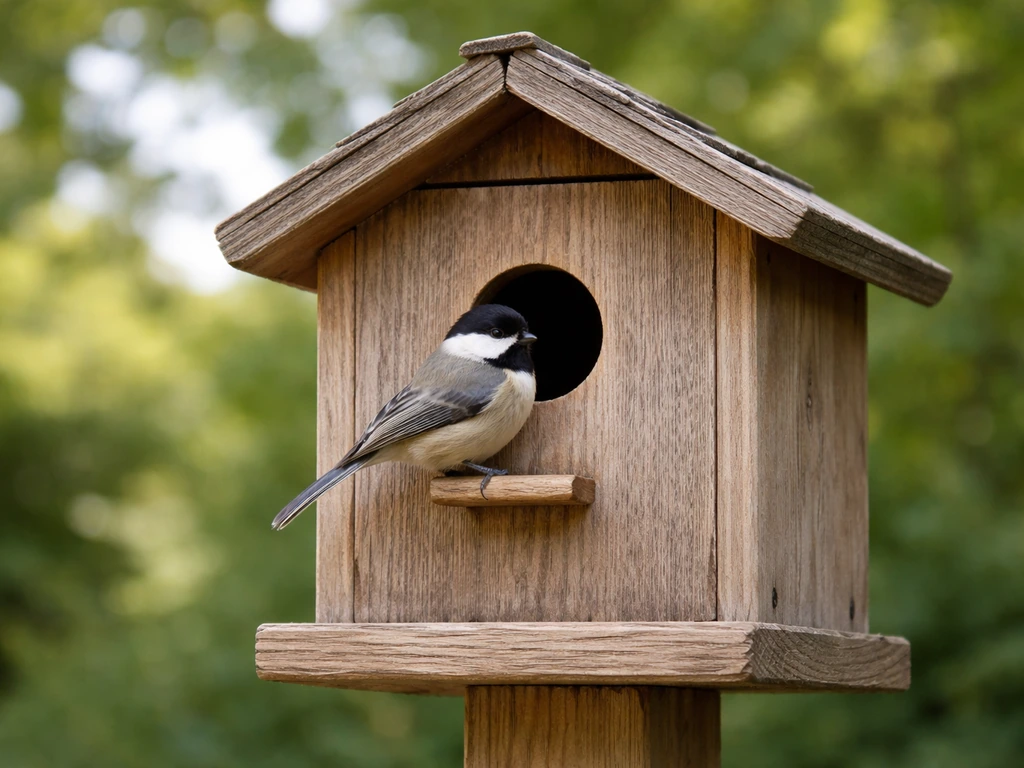
Learn how birds fit in bird houses: correct hole size, dimensions, ventilation, placement, and fixes for no or wrong nes
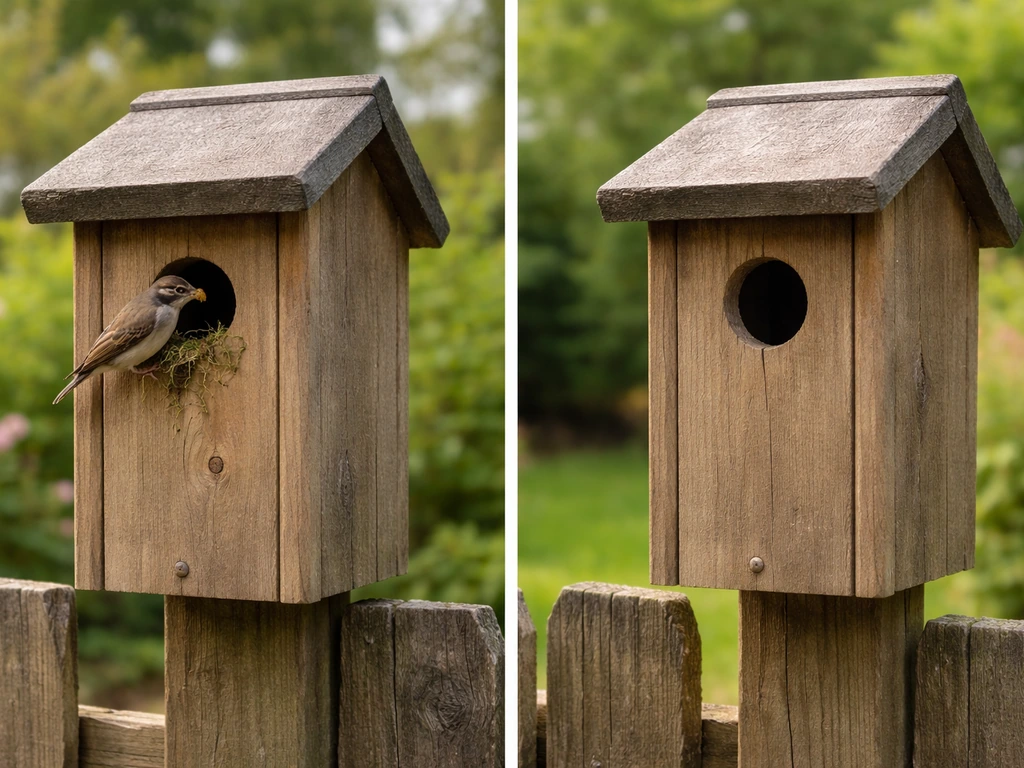
Evidence-based verdict on whether bird houses work, plus what drives success or failure and a troubleshooting checklist.
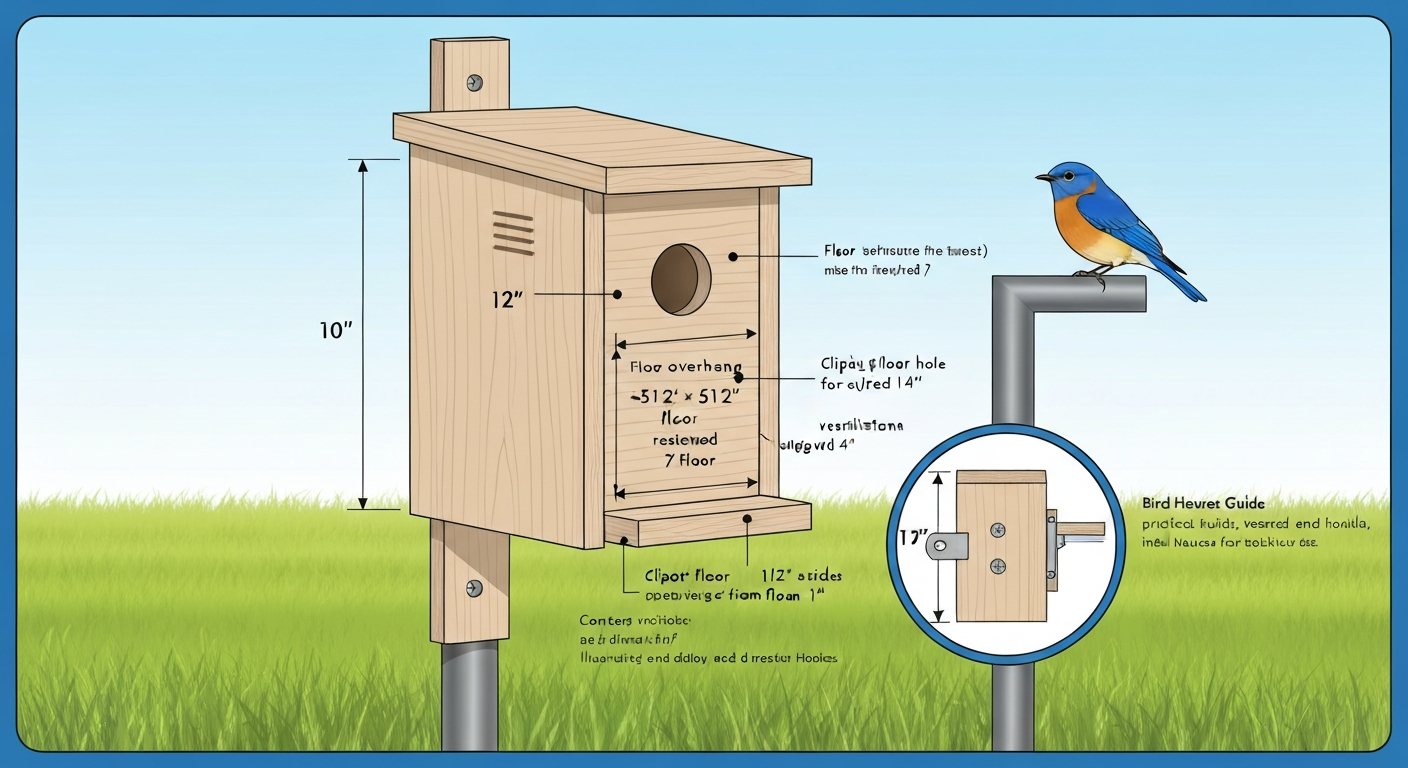
DIY bluebird house: step-by-step build, exact cuts and hole sizes, mounting, predator guards, cleaning, and care.