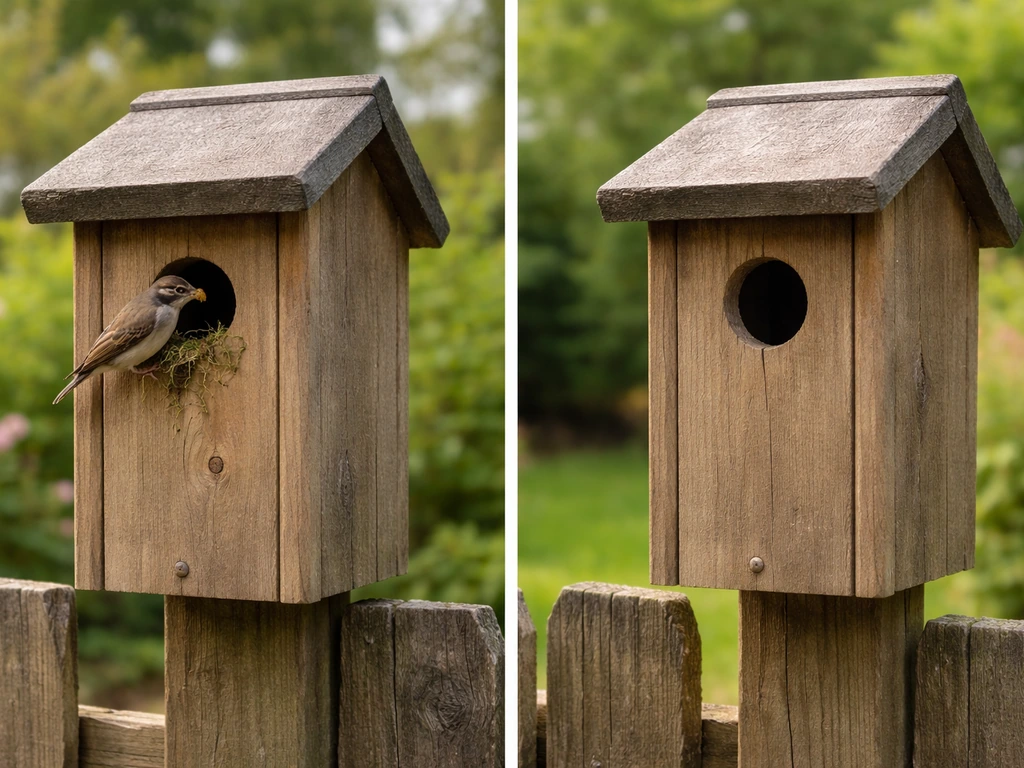
Birds fit in bird houses when three things line up: the entry hole matches the species' body size, the interior floor space and depth give enough room to build a nest and raise chicks, and the house is placed at the right height and orientation so the target bird actually feels safe using it. Get any one of those wrong and the house either sits empty, gets taken over by the wrong species, or becomes a trap instead of shelter. This guide walks you through every part of that equation so you end up with a house that works.
How Do Birds Fit in Bird Houses? Sizing and Setup Guide
Maya Thompson
17 Jun 2026
How birds actually use a bird house
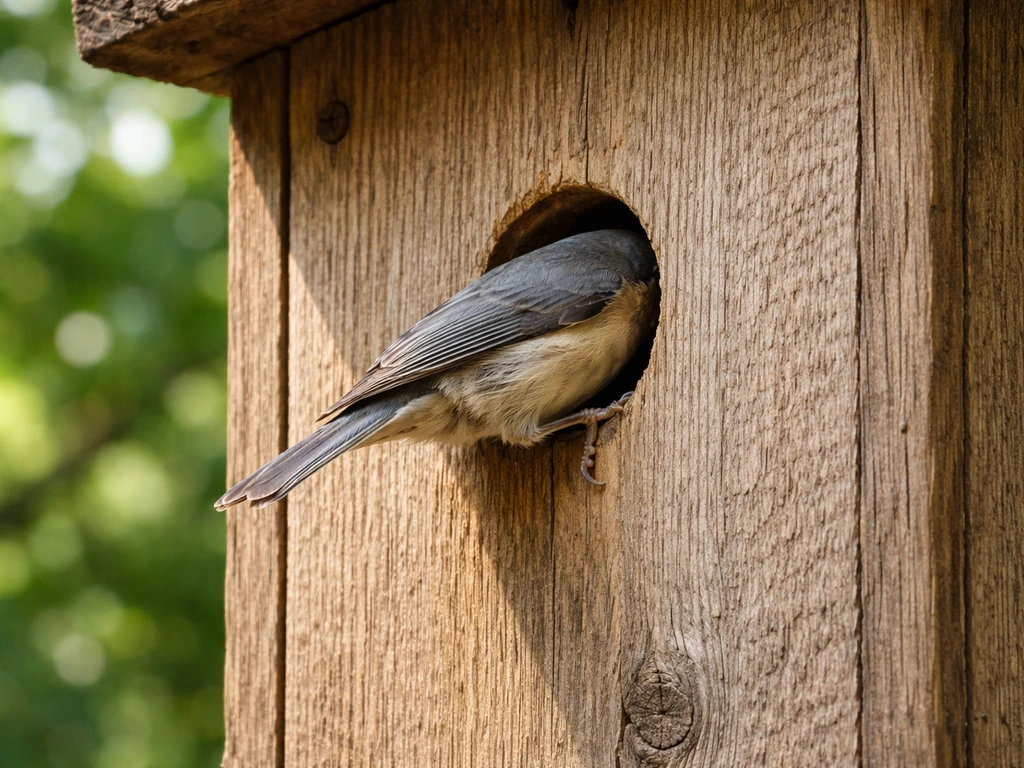
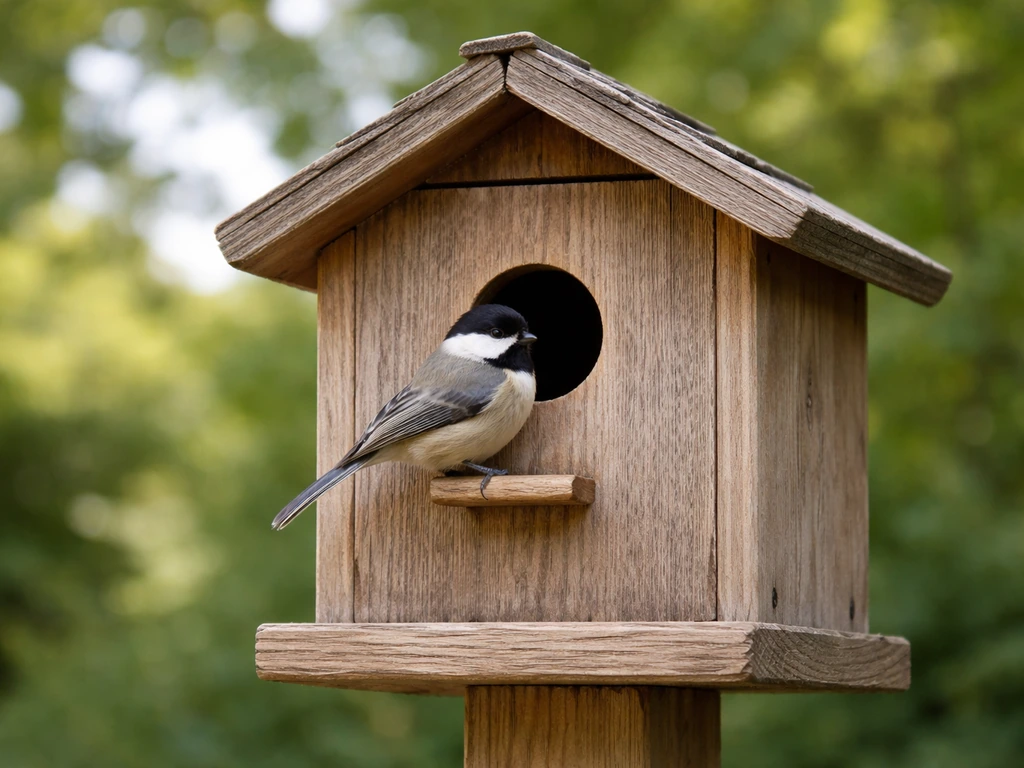
Cavity-nesting birds don't use a bird house the way a human uses a shed. They're looking for a space that mimics a natural tree hollow: a narrow entrance that keeps out predators and weather, a dark interior that feels sheltered, and enough room on the floor to build a cup of nesting material and lay eggs. The bird squeezes through the hole, drops down onto the floor, and constructs a nest from grass, moss, feathers, or wood chips depending on the species. The floor space and interior depth determine whether there's room for a full clutch of eggs and growing chicks.
One question beginners ask a lot is whether birds can actually fit through the hole. Also check whether the hole and box design are aligned with the do window bird houses work question, since entry dimensions affect who actually moves in. The answer is yes, cavity nesters are surprisingly good at compressing themselves through tight openings, and a snug hole is a feature, not a flaw. A hole that's just right for a bluebird or chickadee is too tight for a starling or house sparrow to muscle through, which is exactly the point. The hole acts as the first line of defense. What matters is that the hole diameter is precise, not just approximate.
It's also worth knowing that birds scout potential nest sites well before they commit. They'll hover at the entrance, peer inside, and visit repeatedly over days or weeks before moving in. If you're wondering why birds haven't moved in yet, the related question of when birds will use a birdhouse comes down partly to timing and partly to whether the box feels safe and correctly placed, both of which are covered below. When you know the timing and choose a safe, properly placed spot, you can figure out when will a bird use a birdhouse for your local species when birds will use a birdhouse.
Which species use what kind of house
Not all cavity nesters want the same house. The dimensions below come directly from published wildlife agency and ornithological research. If you build or buy outside these ranges, you're either locking out your target species or inviting the wrong ones in.
| Species | Floor (inches) | Interior Depth (inches) | Entrance Hole Diameter (inches) | Hole Height from Floor (inches) | Mount Height (feet) |
|---|---|---|---|---|---|
| Eastern Bluebird | 4 x 4 | 10 | 1 1/2 | 8 | 4–6 |
| Carolina Chickadee | 4 x 4 | 9 | 1 1/8 | 7 | 5–15 |
| Tree Swallow | 5 x 5 | 6–8 | 1 1/2 | 4–6 | 4–10 |
| House Wren | 4 x 4 | 6–8 | 1 to 1 1/4 | 4–6 | 5–10 |
| Downy Woodpecker | 4 x 4 | 9–12 | 1 1/4 | 7–9 | 5–15 |
| American Kestrel | 8 x 8 | 12–15 | 3 | 9–12 | 10–30 |
| Wood Duck | 10 x 18 | 10–24 | 4 x 3 oval | 17–19 | 4–6 over water |
A few notes on that table. The entrance hole diameter is the most critical single measurement. The Alaska Department of Fish and Game specifically warns that an oversized hole lets in predators and mammals, and cavity-nesting birds may refuse to use the box entirely. A hole that's 1/8 inch too wide can be the difference between a bluebird nest and a house sparrow takeover. If you're buying a pre-made house, bring a drill and the right bit to resize the hole before mounting. If you're building, cut the hole last and test with a drill bit gauge.
Also worth noting: skip the perch. Perches on the outside of a nest box look charming but they actually help house sparrows and starlings gain a foothold. Bluebird societies and Michigan Bluebirds both make this point clearly. Target species don't need a perch; they land at the hole and enter directly.
Entry hole, ventilation, and drainage: the inside story
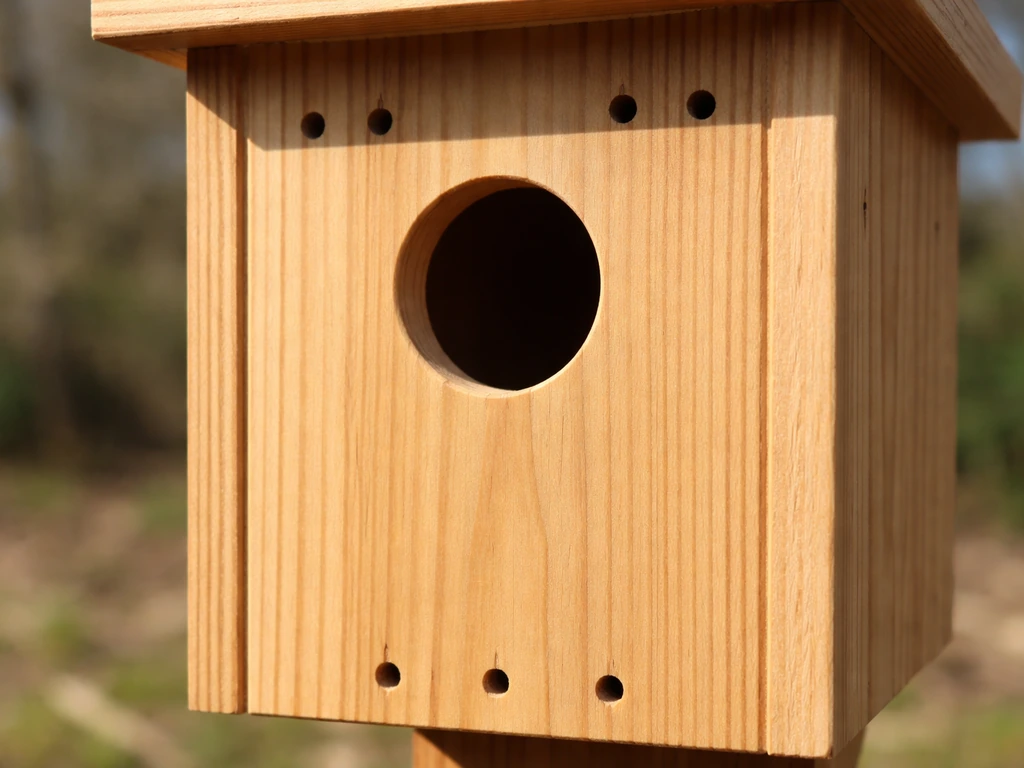
Beyond the hole diameter, the placement of that hole on the front panel matters. The distance from the bottom of the hole to the floor (listed in the table above as 'hole height from floor') determines how far a bird drops into the box. Too shallow and the nest is right at the entrance, exposed to predators. Too deep and chicks struggle to climb up and out when it's time to fledge. For most small species, a 7-to-9-inch drop from hole to floor is the target zone.
Ventilation and drainage are just as important as the hole size, and they're the features most often left out of cheap commercial boxes. A sealed box heats up fast in summer sun and can kill chicks. Excess moisture from rain causes mold and bacterial growth in the nest. Here's what good construction looks like, based on ADFG and NestWatch guidance:
- Drill ventilation holes (1/8 inch diameter) through each side wall, positioned about 1 inch below the top of the side panel. Two holes per side is a solid baseline.
- Add a ventilation gap at the top of the front panel by cutting the front panel 1/4 to 1/2 inch shorter than the roof overhang, or by leaving a small gap between the front and the roof.
- Drill at least four drainage holes through the floor, sized 3/8 to 1/2 inch in diameter, spaced across the floor to let any pooled water escape quickly.
- If you're adding wood shavings for species like bluebirds, use about 2 inches of plain unscented pine or cedar shavings on the floor before mounting.
- Make sure the roof overhangs the entrance by at least 2 inches to reduce rain blowing in.
Mass Audubon also recommends tilting the entrance hole very slightly downward when mounting, so the face of the box leans about 5 degrees forward. This keeps wind-driven rain from pouring straight through the hole into the nest. A small but effective detail.
How to place and mount a bird house
Placement is where a lot of well-built boxes fail. The right species-specific height, the right direction, the right habitat, and enough spacing between boxes all matter. Here's how to get it right.
Height and orientation
Use the height range from the table above for your target species. For bluebirds, Connecticut DEEP recommends 5 feet above ground on a galvanized metal pole, or 7 to 8 feet on metal stakes with a predator guard. For chickadees, 5 to 15 feet is the range, with mid-range (8 to 10 feet) on a tree or post being a practical choice. Face the entrance hole away from prevailing winds, which in most of North America means pointing it somewhere between north and southeast. Avoid facing it directly west or southwest into afternoon sun, which superheats the box.
Habitat and spacing
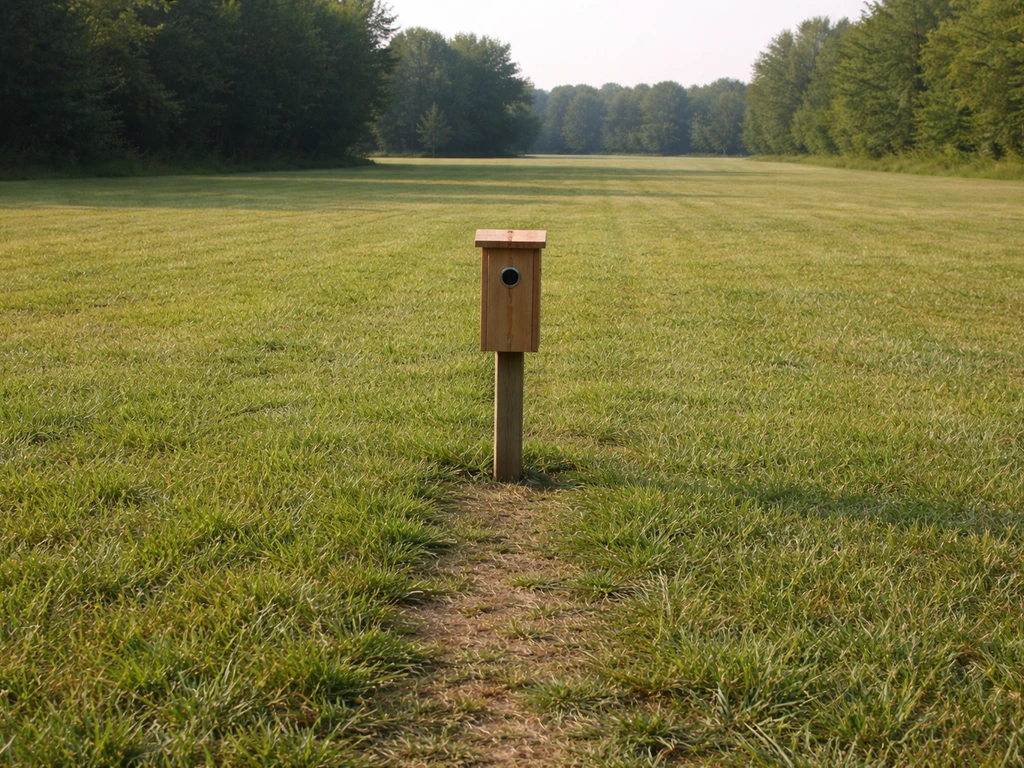
Match the habitat to the species. Bluebirds want open fields with short grass and a clear flight path to the entrance; trees and shrubs within 100 feet of the box help chicks land safely after fledging. Tree swallows tolerate more edge habitat and will nest near water. Wrens like brushy areas and woodland edges with nearby shrubs. Wood ducks need water, and their boxes should be mounted 4 to 6 feet above the water surface or on a pole rising from the bank.
For spacing, Audubon recommends placing individual bluebird nest boxes at least 300 feet apart, or out of line of sight from each other. Putting two boxes too close triggers territorial disputes and both may go unused. Tree swallows and bluebirds, however, can sometimes be paired 20 to 25 feet apart because they don't compete with each other directly. A pair of boxes like this, called a bluebird trail pair, can result in one species per box.
Predator-proofing at the mount
A birdhouse on a wooden fence post or tree trunk is accessible to raccoons, squirrels, and snakes. The North American Bluebird Society is direct about this: boxes mounted less than 5 feet from the ground increase predator access significantly. Use a smooth metal pole rather than wood, and add a predator baffle (a cone or cylindrical sleeve) below the box. Raccoons and opossums can reach inside a nest box entrance with one arm and pull out eggs, chicks, or the adult bird. A metal baffle on the pole below the box and a metal hole guard around the entrance are the two most effective physical deterrents.
Timing and site selection: when birds actually move in
The single most common reason a new bird house sits empty for a full season is that it was put up too late, or in the wrong spot for the local bird population. Getting boxes up early matters more than most people realize.
For most of the continental United States, late winter to very early spring is the right window. Bluebirds start scouting nest sites in February or March in the southeast, and a month later in the northeast. The Smithsonian National Zoo's nest monitoring guidelines note that long-distance migratory birds begin nesting roughly one month later for each region further north, so mid-April nesting in the southeast shifts to mid-May in the northeast. Tree swallows arrive in March through April depending on latitude. Wrens are a bit more forgiving and will move into boxes later in spring, sometimes through June.
The practical rule: have your boxes mounted and ready by late February in southern states, by late March in the mid-Atlantic and Midwest, and by mid-April in northern states and Canada. If you're just getting a box up now in June, you may still attract late nesters like wrens or second-brood pairs from other species, but your best shot at a full nesting season is to have boxes in place before the birds arrive. This is also why how birds find bird houses matters, since they're actively searching and scouting well before nesting begins. How do birds find bird houses? They scout and search for suitable cavities well before nesting begins how birds find bird houses.
Site selection also means avoiding places with heavy foot traffic, nearby outdoor cats, or dense shrub cover right at the entrance. A clear flight path (at least 5 to 10 feet of open air in front of the hole) helps birds feel confident enough to commit to the site. Resist the urge to mount the box on a tree in the middle of your yard. Squirrels and raccoons live in trees. A freestanding metal pole with a baffle is a much safer mount.
Maintenance, cleaning, and keeping things working
Putting the box up is the start, not the finish. A nest box that isn't maintained becomes a health hazard for birds and a magnet for parasites, mites, and competing species.
When and how to clean
The Cornell Lab's NestWatch recommends cleaning nest boxes at the end of the breeding season, after the birds have left. Kent Wildlife Trust goes a step further and recommends scalding the box interior with boiling water to kill parasites and blowfly larvae. Don't use pesticides or bleach inside the box. Let it dry completely before closing it back up.
If you know a box had multiple broods, the ICPRB notes that cleaning between each brood can actually encourage a second or third nesting pair to use the same box within a single summer, since a fresh box is more attractive than a fouled one. A Reddit Birdfy thread discusses timing for cleaning after fledging and notes that some species may use the box again later in the same season.
Sialis.org makes a good practical point: cleaning the box also tells you what's happening inside it. When you remove the old nest and examine it, you can tell which species used it, how many eggs were laid, whether chicks fledged successfully, and whether there are signs of predator damage or parasite infestation. That information helps you adjust placement, hole size, or predator guards for the next season.
Mid-season monitoring
Check boxes weekly or bi-weekly during the breeding season. Before opening the box, tap on it gently and wait a few seconds so the adult bird can exit without panicking. The U.S. Fish and Wildlife Service recommends this approach: give the parent a moment to slip out before you open the panel. Keep checks brief, no more than 30 seconds, and make note of egg count and chick development without handling.
If you find house sparrow nests (a messy, domed pile of grass and debris with chicken feathers), remove them immediately. House sparrows are not native to North America, not protected under the Migratory Bird Treaty Act, and are aggressive competitors that will kill bluebird and tree swallow adults and nestlings. Removing sparrow nests repeatedly will often discourage them from a box while your target species establish.
Troubleshooting common failures
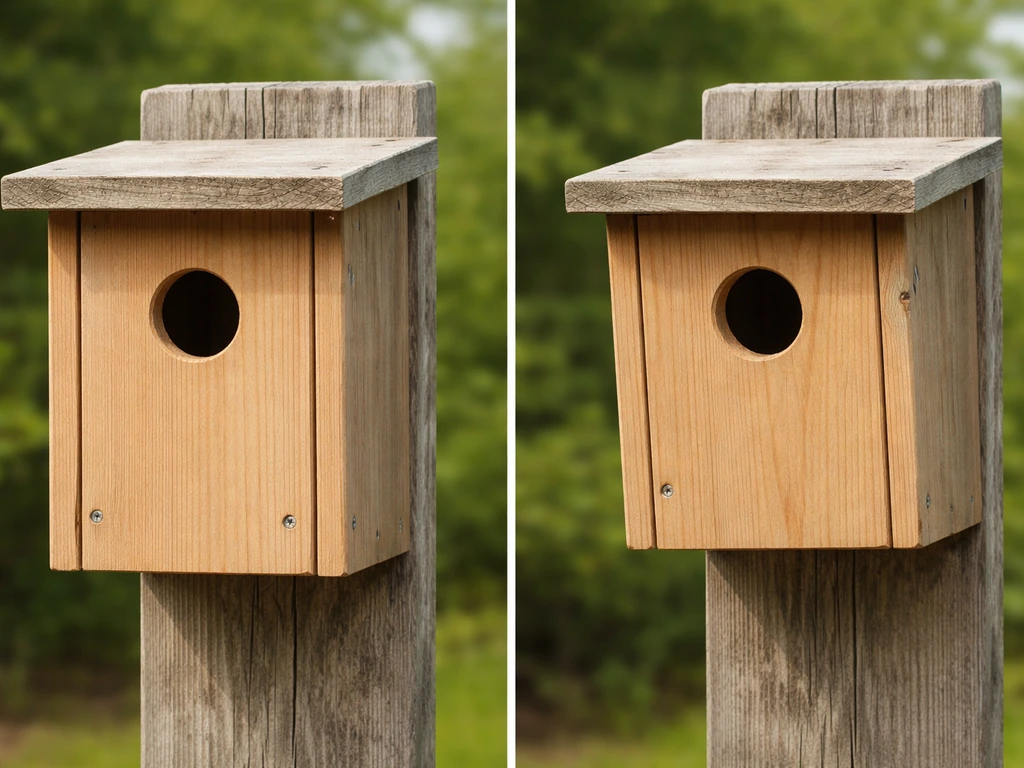
If birds scout but don't commit, the most likely causes are an oversized or undersized hole, a box that swings or wobbles on its mount (which signals instability to the bird), too much shade or too much direct sun, or predator activity nearby. Check for scratch marks around the entrance hole, which signal a predator has been testing the box.
If chicks are dying in the box, overheating is the most common culprit in summer. Add ventilation holes if they're missing, reorient the box away from afternoon sun, and consider adding a second roof layer with an air gap to reduce heat transfer. Wet nests that never dry out mean drainage holes are missing or blocked. Drill them out or add additional holes. U.S. Fish and Wildlife Service also recommends adding fresh bedding material after cleaning and before the next season, which gives the box a head start on moisture absorption.
Finally, if the wrong species keeps taking the box despite your efforts, reconsider the habitat. Wrens colonize boxes in shrubby, wooded edges regardless of what you intended. If you're in bluebird territory, that open-field placement and 5-foot metal pole with a baffle is the best filter you have. Get the placement right and the hole size exact, and the species mix will follow.
FAQ
Can birds use a bird house if the hole is the right size but the interior is too shallow or too small?
Yes, but only if the box is built or purchased for cavity nesters, not open-front feeders. If there is no suitable entrance hole for the target species, birds cannot “fit” into the cavity safely, and they will avoid it or use it as a roost instead of a nest site.
What should I do if I bought a pre-made bird house and it seems like the hole fits, but birds still do not move in?
If the entrance fits but the nest cavity is undersized, birds may repeatedly inspect and then abandon it after finding insufficient room for eggs and chick growth. For many species, the floor space and cavity depth determine whether a full clutch can be incubated and whether chicks can move toward the entrance for fledging.
Are “about the right” entrance-hole sizes good enough for getting the right birds?
A slightly snug fit is usually better than a loose one, because cavity nesters can compress themselves through a tight opening but predators can exploit larger gaps. The key is to match the hole diameter precisely to the species you want, since even small oversizing can invite house sparrows or other unwanted competitors.
Should I keep or remove a perch on the front of a nest box?
Take the perch off or avoid purchasing perches. Many target species will land at the entrance and enter directly, while perches can give aggressive competitors (especially house sparrows and starlings) easier access and better footing during takeovers.
How often can I check the nest box without stressing the birds?
Avoid opening the box when birds are actively provisioning or when it risks trapping the parent inside. During checks, tap, wait for a moment, then limit your time to about half a minute, and do not handle nestlings unless the article indicates immediate emergency care.
When is the best time to clean a bird house, and should I clean between broods?
Do it after the breeding season, and if there were multiple broods, cleaning between broods can sometimes encourage reuse. Do not use bleach or pesticides, allow the interior to dry fully, and consider scalding only if you already know the container can withstand it and you can do it safely.
Why do predators still get into the box even after I chose the correct hole size?
Yes. Starlings and house sparrows can exploit boxes that are mounted too low, too accessible from nearby vegetation, or without physical deterrents. Add a predator baffle on the pole and a metal guard around the entrance, and mount high enough for your target species while staying away from climbable surfaces within reach.
My box looks perfect, but it stays empty. What are the most common non-sizing reasons birds won’t commit?
If the box “sits empty” even though your timing seems right, the box may be unstable (swaying or wobbling), facing into heavy afternoon sun, or poorly placed for the habitat preferences of your local species. Also look for predator signs like scratch marks near the entrance, which can cause birds to avoid the site.
What if chicks are present but dying, what is the most likely cause and first fix?
Most overheating issues are driven by direct sun and insufficient airflow. Add or improve ventilation features, reduce heat gain by reorienting away from afternoon sun, and consider a design with an air space under the roof if the box overheats quickly.
How can I tell if my bird house has a drainage problem, and what should I adjust?
Yes, and it’s a common reason for long-term failure. If drainage holes are missing or blocked, the nest can stay wet, leading to mold or bacterial growth. Clear or re-drill drainage openings and ensure the box is mounted so water does not collect inside.
What should I do if I find a house sparrow nest in my bird box?
Remove house sparrow nests immediately because they can aggressively take over and harm native cavity nesters. Wear gloves if you handle materials, discard nest material away from the box, and prevent reuse by keeping the entrance and guard setup correct for your target species.
If birds scout the box but never start a nest, how long should I wait before adjusting something?
Birds will often scout and visit over multiple days before committing. If you still do not see nesting after scouting, re-check entrance diameter precision, box stability, sun exposure, predator activity, and whether the surrounding habitat matches the bird you want to attract.
Next Article
Do Bird Houses Work? What Controls Success and Failure
Evidence-based verdict on whether bird houses work, plus what drives success or failure and a troubleshooting checklist.