In Old School RuneScape, the answer is 4. There are exactly four designated birdhouse placement spots on Fossil Island, so a standard birdhouse run means crafting, baiting, and placing one birdhouse in each of those four spots. That is the complete in-game answer. If you landed here while grinding Hunter XP between runs and started wondering how many real nest boxes you should put up in your backyard, you are in exactly the right place for both.
How Many Bird Houses OSRS, Real Nest Box Guide for Yards
Maya Thompson
27 Jul 2026
The OSRS Birdhouse Run: Quick In-Game Facts
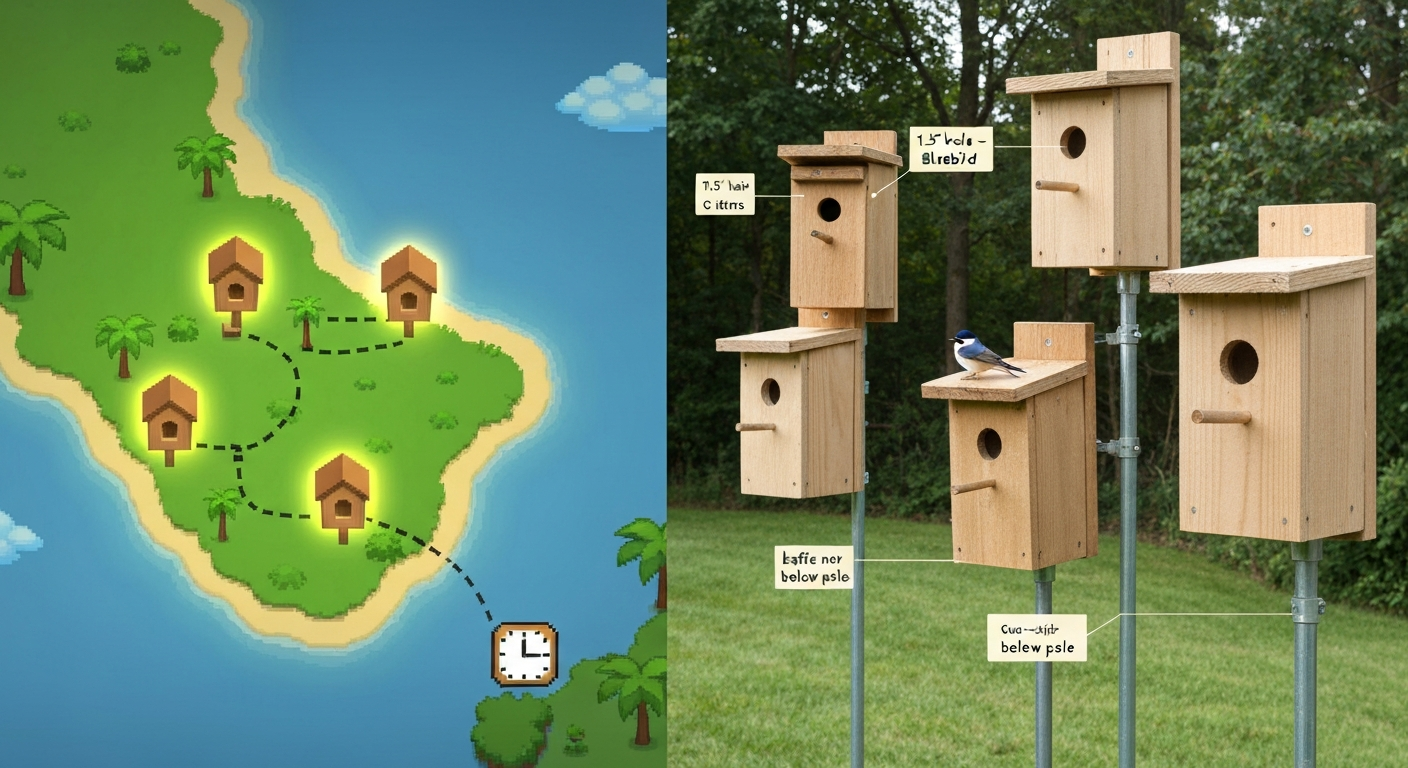
Four birdhouses per run is the standard because Fossil Island has four and only four designated placement spaces. You craft birdhouses from logs using a Crafting level appropriate to the tier (oak through redwood and magic), bait each one with up to 10 hop, allotment, flower, or low-level herb seeds (or 5 high-level herb seeds), and return after roughly 50 minutes to check them for nests and passive Hunter experience. The official item description from Jagex reads: 'Feed and catch the birds by placing this in the right spot.' Higher-tier birdhouses (teak, mahogany, magic, redwood) require higher Crafting and Hunter levels but yield better nests and more XP per run. Community calculators exist to figure out which tier and seed combination gives you the best XP-per-hour or most profit, based on Grand Exchange prices.
- How many birdhouse spots on Fossil Island? Four.
- How many birdhouses do you need per run? Four (one per spot).
- How long does a birdhouse take to fill? Approximately 50 minutes.
- What bait do you use? Up to 10 hop/allotment/flower/low-level herb seeds, or 5 high-level herb seeds per house.
- What tiers are available? Oak, teak, mahogany, magic, and redwood, each with different level requirements and reward rates.
- Where are the spots? All four are located on Fossil Island, accessible after completing the relevant quest content.
From a Gaming Search to Real Nest-Box Stewardship
Reddit threads on r/osrs and r/2007scape regularly show players mid-birdhouse-run suddenly asking about real bluebird boxes and actual backyard birdhouse builds. That crossover makes complete sense: you are already thinking about birds, timing, and placement mechanics. The jump from Fossil Island to your own backyard is a short one. This guide exists because the principles underneath a good nest box plan are just as satisfying to optimize as any in-game system, and the stakes are real. A well-placed, correctly sized, predator-proofed nest box can directly support declining cavity-nesting populations like Eastern Bluebirds and American Kestrels. Think of this as your real-world birdhouse trapping guide, except the loot is live fledglings and the XP is knowing you actually helped.
The rest of this article covers everything a backyard steward needs: how many boxes to install, species-specific dimensions and spacing, site selection by habitat type, mounting options, and predator-proofing. For step-by-step plans, species-specific templates, and downloadable box diagrams, see a guide to bird homes. Whether you are a complete beginner or have had a few boxes up for years, this is designed to help you build a more effective, conservation-minded setup. Our bird house basics and bird house rules pages go deeper on individual topics if you want to drill down after reading this. See the bird house rules page for deeper legal and ethical guidance on nest management. For more in-depth how-tos on construction, dimensions, and maintenance, see our bird house basics (content ID 9ac66d27-10a3-49c3-80a1-464a50b1ddbb).
How Many Nest Boxes Should You Actually Install?
The honest answer is: start with one or two, sited correctly, rather than scattering ten boxes at random. More boxes do not automatically mean more birds. Overcrowding can cause territorial conflict, waste your time on unoccupied boxes, and create sanitation problems you will struggle to keep up with. That said, a yard with diverse habitat zones and the right spacing can productively support several species simultaneously.
Rules of Thumb for Most Backyards
- Start with one box per target species unless you have confirmed that species present and enough territory for more.
- For colonial or closely-tolerant species like Tree Swallows, pairs of boxes placed 10-15 feet apart can work because Tree Swallows will defend one box against competing Tree Swallows but tolerate a neighbor of the same species nearby.
- For territorial species like Eastern Bluebirds, space boxes at least 300 feet (about 91 meters) apart.
- For large raptors like American Kestrels, territories may span up to half a mile (about 0.8 km), so one box per property is realistic for most homeowners.
- A small suburban yard (under 0.25 acres) realistically supports 1-2 boxes for small cavity nesters.
- A larger property with open meadow, woodland edge, and a water source can support a 'bluebird trail' of 4-10 boxes spaced appropriately across the landscape.
- Monitor occupancy each season and remove or relocate boxes that go unused for two full seasons.
A Simple Decision Tree for Planning Your Install
- Identify which cavity-nesting species are present or historically recorded in your region (Cornell Lab's eBird is useful for this).
- Assess your habitat: open lawn, shrubby edge, woodland, wetland margin, or a mix.
- Match species to habitat (see the species table below).
- Check spacing requirements for your target species and measure your available area.
- Calculate how many boxes fit within that spacing requirement without overlap.
- Start with that number, monitor for two full seasons, then add boxes only where habitat and occupancy data support it.
- If boxes go unoccupied, move them before adding new ones.
Species-by-Species: Counts, Spacing, and Pairings
Below are the most commonly targeted backyard cavity nesters in North America, with evidence-based spacing and count guidance drawn from NestWatch (Cornell Lab of Ornithology) and Audubon Society recommendations. These are the species most nest-box programs focus on because they readily accept artificial boxes and include several species in genuine population decline.
| Species | Min. Spacing Between Boxes | Practical Count for 0.5-Acre Yard | Best Pairing Partner | Notes |
|---|---|---|---|---|
| Eastern Bluebird | ~300 ft (91 m) | 1-2 | Tree Swallow (paired box nearby) | Face east, open habitat essential |
| Tree Swallow | ~35 ft (11 m) per pair | 2-4 (in paired clusters) | Eastern Bluebird | Place near water or unmowed grass |
| Black-capped / Carolina Chickadee | Variable, 30-650 ft by region | 1-2 | Titmouse (same hole size) | Woodland edge or shrubby areas |
| Tufted Titmouse | Similar to Chickadee | 1-2 | Chickadee (same box dimensions) | Requires nut/seed food source nearby |
| House Wren | Close spacing tolerated in shrubs | 1-2 | Best kept away from bluebird boxes | Can displace other species; site carefully |
| White-breasted Nuthatch | Mature woodland; 1 per territory | 1 | Chickadee (shared woodland edge) | Needs large trees or fence-mounted boxes |
| American Kestrel | ~0.5 mile (0.8 km) | 1 per property (most yards) | None practical at this scale | Open farmland or large meadow ideal |
| Eastern Screech-Owl | ~0.5 mile or more | 1 per property | None practical at this scale | Mount in mature trees away from high-traffic areas |
The Bluebird/Tree Swallow pairing is one of the most productive strategies in nest-box programs. Place two boxes about 15-25 feet apart: one will typically be claimed by bluebirds, the other by Tree Swallows, and the swallows will actively deter competing swallows from both boxes, giving the bluebirds a calmer nesting environment. NestWatch recommends Tree Swallow boxes with a 1 3/8" (≈35 mm) entrance hole, ~9" internal depth, 5.5"×5.5" floor, mounted 5–6 ft high and spaced about 35 ft (≈11 m) apart, ideally near water or unmowed grass NestWatch recommends Tree Swallow boxes with a 1 3/8" (≈35 mm) entrance hole, ~9" internal depth, 5.5"×5.5" floor, mounted 5–6 ft high and spaced about 35 ft (≈11 m) apart, ideally near water or unmowed grass.. This is sometimes called 'box pairing' and is widely recommended by bluebird trail managers across the eastern U.S. and Canada.
Box Dimensions and Entrance Hole Sizes by Species
Getting the entrance hole right is arguably the single most important dimension. Too large and you invite House Sparrows and European Starlings, both non-native species that will kill native birds and destroy eggs. Too small and your target species physically cannot enter. The floor size and internal depth matter for nest success and chick survival: too shallow and nestlings overheat or fall out prematurely; too small a floor and clutch sizes are restricted. Use untreated wood (cedar, pine, or exterior-grade plywood work well) and avoid pressure-treated lumber inside the box.
| Species | Floor Size | Internal Depth | Entrance Hole (Round) | Mounting Height | Material Notes |
|---|---|---|---|---|---|
| Eastern Bluebird | 5.5" x 5.5" | ~9" | 1.5" round or 2.25" x 1.375" oval | 4-6 ft on pole | Cedar or pine; no perch needed |
| Tree Swallow | 5.5" x 5.5" | ~9" | 1 3/8" (35 mm) | 5-6 ft on pole | Smooth interior walls preferred |
| Black-capped Chickadee | 5.5" x 5.5" | ~8" | 1 1/8" (28 mm) | 4-15 ft on tree or post | Fill box partway with wood shavings to simulate cavity |
| Carolina Chickadee | 5.5" x 5.5" | ~8" | 1 1/8" (28 mm) | 4-15 ft | Same plan as Black-capped |
| Tufted Titmouse | 5.5" x 5.5" | 8-12" | 1 1/8" (28 mm) | 5-15 ft | Woodland edge; add shavings |
| House Wren | 4" x 4" to 5" x 5" | 6-8" | 1" to 1 1/8" | 5-10 ft in shrubby areas | Small box; multiple dummy nest sites tolerated |
| White-breasted Nuthatch | 5.5" x 5.5" | 8-10" | 1 1/4" (32 mm) | 6-20 ft on tree | Mature woodland edge |
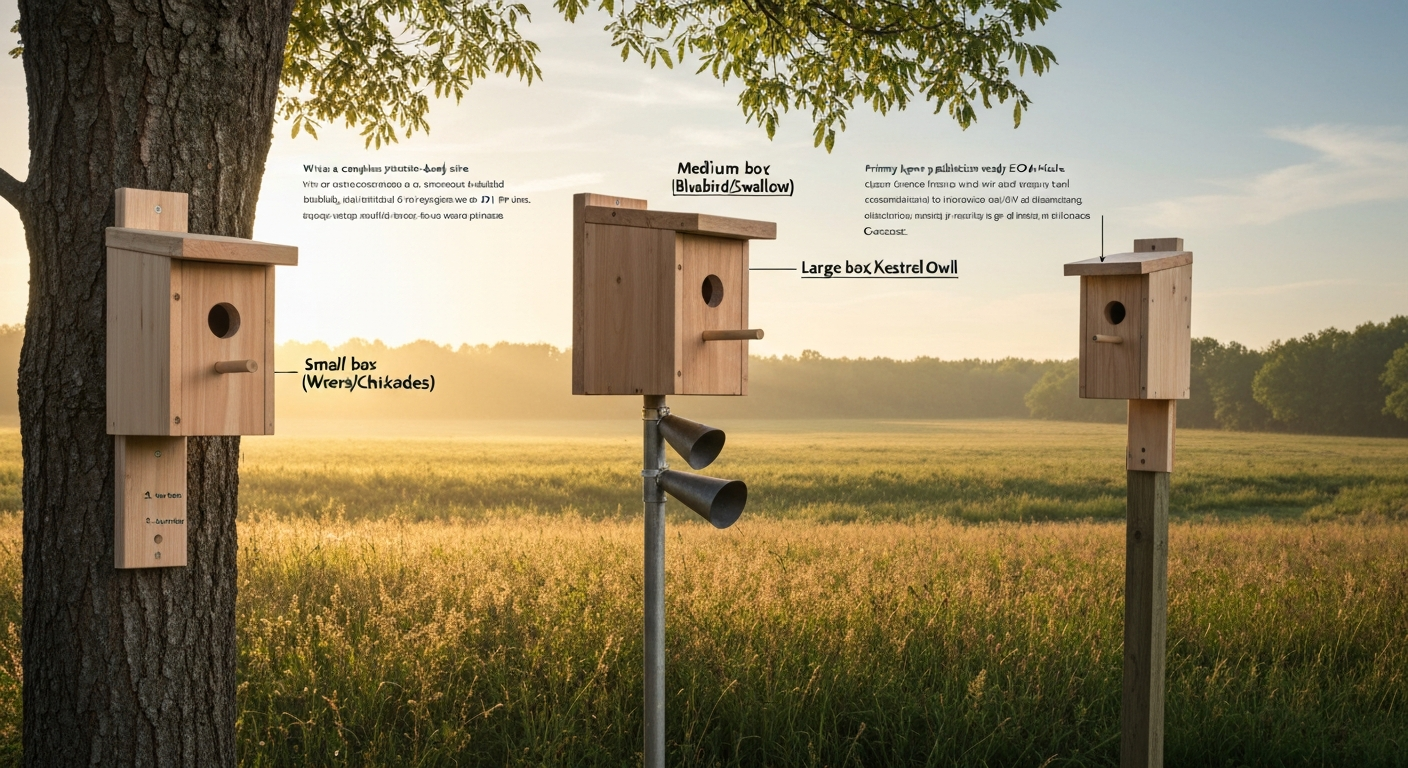
| American Kestrel | 8" x 8" to 9" x 9" | 12-16" | 3" round | 12-20 ft on pole or tree | Add 3" of wood shavings; open farmland or meadow |
| Eastern Screech-Owl | 8" x 8" | 12-15" | 3" round | 10-30 ft in mature tree | Add wood shavings; avoid direct sun |
One practical note on tolerances: entrance holes should be cut within 1/16 inch of the target dimension. A cheap hole saw bit will usually get you close enough, but test it with a physical gauge or caliper before drilling the final piece. Roughening the interior wall below the entrance hole with a chisel or saw kerfs helps fledglings grip the wood when exiting, which is especially useful in deeper boxes for kestrels and owls.
Choosing Your Site: Habitat Mapping by Yard Type and Region
Placement is where most beginner nest-box efforts go wrong. A perfectly built bluebird box nailed to a shaded tree in a densely wooded backyard will sit empty for years, not because bluebirds don't live nearby but because their foraging and nesting habitat requirements aren't met. Before you pick up a drill, spend 20 minutes walking your property and identifying what you actually have.
Habitat Types and Best Species Match
| Habitat Type | Best Target Species | Placement Notes | Region Notes |
|---|---|---|---|
| Open lawn with low grass | Eastern Bluebird, American Kestrel | Pole-mount facing east, 300+ ft spacing for bluebirds | East of Rockies for bluebirds; kestrels widespread |
| Suburban yard with shrubs and trees | Chickadee, Titmouse, House Wren | Tree or fence mount at 5-15 ft; partial shade acceptable | Widespread; select species by local range |
| Meadow or field edge | Bluebird, Tree Swallow, Kestrel | Pole-mount in paired clusters for swallows; open sight lines | Great Lakes and eastern meadows especially productive |
| Woodland edge (partial canopy) | Chickadee, Nuthatch, Titmouse, Screech-Owl | Tree-mount or post at 6-20 ft; 50-75% shade acceptable | Adjust species by eastern vs. western range |
| Near water (pond, stream, wetland margin) | Tree Swallow, Wood Duck, Prothonotary Warbler | Low pole or post over or beside water; flood risk planning needed | Southeast/Gulf Coast for Prothonotary |
| Urban yard (small, paved surroundings) | House Wren, Chickadee, Nuthatch | Fence or building mount; prioritize predator guards heavily | Everywhere; expect House Sparrow pressure |
One region-specific note: if you are in the western U.S., swap Eastern Bluebird for Western or Mountain Bluebird and adjust hole size to 1.5 inches for Western Bluebird or up to 1 9/16 inch for Mountain Bluebird. Violet-green Swallows replace Tree Swallows in much of the west and use the same box dimensions. The Cornell Lab's NestWatch site has region-specific plans and species accounts worth bookmarking. Our bird house guide page goes deeper on regional species selection if you need a more detailed breakdown by state or province.
Mounting and Placement Options
How you mount a box matters almost as much as where you put it. The wrong mount makes predator-proofing nearly impossible and may expose the box to excessive heat, moisture, or wind. Here is a practical rundown of the most common mounting approaches and where each works best.
Conduit or Electrical Metal Tubing (EMT) Poles
This is my top recommendation for Eastern Bluebirds, Tree Swallows, and Kestrels. A half-inch or three-quarter-inch EMT conduit pole (available at any hardware store for a few dollars) driven 18-24 inches into the ground gives you a smooth-sided metal shaft that is incompatible with climbing baffles designed for PVC pipe predator guards. Mount the box at the top with a wood or metal adapter. The pole can be repositioned easily if the location proves unproductive, which matters a lot in those first two seasons of monitoring. Aim for 4-6 feet of exposed pole height for bluebirds and swallows, 12-20 feet for kestrels (which may require a longer pipe or a stacked conduit setup).
Tree Mounts
Chickadees, nuthatches, titmice, and screech-owls accept tree-mounted boxes well. NestWatch (Cornell Lab) recommends for Black‑capped Chickadees an entrance hole of about 1 1/8" (≈28 mm), an internal floor ~5.5"×5.5" with ≈8" depth, mounting roughly 4–15 ft high, and species-dependent spacing NestWatch (Cornell Lab) recommends for Black‑capped Chickadees an entrance hole of about 1 1/8" (≈28 mm), an internal floor ~5.5"×5.5" with ≈8" depth, mounting roughly 4–15 ft high, and species-dependent spacing.. Use a lag screw or through-bolt rather than nails, which work loose over time. A single lag screw through a backing board allows the box to swing slightly and avoids girdling the tree if you use a spacer. Do not wrap wire around the trunk. Mount on the shaded north or east side of the trunk where possible to reduce interior heat. The main downside of tree mounting is that predator-proofing is significantly harder: squirrels, raccoons, and snakes all use trees as highways. A metal cone baffle below the box (minimum 18 inches diameter) is essential on any tree-mounted box.
Fence and Building Mounts
House Wrens and some chickadees will readily accept boxes mounted on fence posts or the eave of a shed or garage. Keep these at 5-10 feet and face the entrance away from prevailing weather. The downside is that fence lines often run along property edges with dense vegetation, which gives predators easy concealed access. Add a metal baffle below any fence-post box and keep vegetation cleared for at least 5 feet around the post.
Water-Side Supports
For Tree Swallows nesting near ponds or wetlands, a pole driven directly into a shallow water margin with a standard baffle is highly effective. Raccoons and snakes typically avoid crossing open water, which makes these some of the safest nest sites available. Keep the box 5-6 feet above the water surface and face the entrance over the open water rather than toward shore. Wood Duck boxes are also traditionally mounted over water on poles for the same predator deterrence reason, typically at 4-6 feet above the high-water line.
Predator-Proofing: Baffles, Hardware, and Best Practices
In my experience, the single biggest reason nest boxes fail is predation, not poor location or wrong dimensions. Raccoons, opossums, rat snakes, climbing squirrels, and even domestic cats can destroy an entire clutch or kill incubating adults. A few simple, low-cost measures eliminate the vast majority of predation attempts.
The Stovepipe Baffle
A stovepipe baffle (a section of 8-inch diameter sheet metal ductwork, about 24 inches long, centered on the pole below the box) is the most reliable mammal deterrent available. It is cheap, durable, and works on raccoons, squirrels, opossums, and climbing snakes. The smooth metal cylinder cannot be gripped from below and the top edge cannot be reached from above without the animal overbalancing. You can buy prefabricated versions from bluebird supply organizations or make one from hardware-store ductwork for under $15. The PVC pipe baffle (a capped PVC pipe segment on the pole) works similarly and is a common DIY alternative.
Entrance Hole Protectors
A metal entrance hole protector (a flat metal plate with the correct hole diameter, screwed over the wooden entrance hole) prevents squirrels and woodpeckers from enlarging the hole. This is especially important for bluebird and chickadee boxes where the tight hole diameter is your primary defense against House Sparrows and Starlings. Steel or aluminum plates cost $1-3 and last for years.
Entrance Tunnels and Extended Holes
An extended entrance tunnel (adding a block of wood 1.5-2 inches thick to the front panel so the entrance becomes a short tunnel rather than a flat hole) makes it harder for raccoons to reach in and hook eggs or nestlings with their paws. This is particularly effective for boxes mounted on trees or fence posts where baffle placement is awkward. The tunnel adds no measurable barrier to the target bird but substantially increases the reach required for a predator arm to contact the nest cup.
Hardware and Construction Choices That Help
- Use stainless steel or galvanized screws rather than nails. Nails loosen over time, creating gaps that snakes use as entry points.
- Avoid adding perches below the entrance hole. Perches help House Sparrows and Starlings more than they help target species.
- Ventilation slots near the top (two to four 1/4-inch holes or a gap between the front panel and roof) prevent overheating in summer, which is a genuine nest failure cause in dark-painted or unshaded boxes.
- Drainage holes (two to four 1/4-inch holes in each corner of the floor) prevent water pooling after rain.
- Do not paint the interior. Interior paint traps moisture and can off-gas chemicals harmful to chicks.
- For the exterior, raw cedar or pine weathers well without paint. If painting, use light colors on the roof only to reflect heat.
- Add a hinged side or front panel for monitoring and cleanout access. A single exterior screw or hook-and-eye latch keeps it closed but accessible.
- Place boxes at least 10 feet from feeders and birdbaths to reduce traffic from non-nesting birds near the nest site.
Deterring Snakes
Rat snakes and black racers are excellent climbers and responsible for a significant proportion of nest failures in pole-mounted and tree-mounted boxes in the eastern U.S. The stovepipe baffle deters many but not all snakes. For higher-risk areas, a cone baffle (a large inverted funnel of sheet metal, minimum 24 inches diameter) placed below the stovepipe adds another layer. Keep vegetation from touching the pole or overhanging the box, as this provides an alternate route that bypasses any baffle entirely. Avoid using grease or sticky substances on poles: these can contaminate bird feet and feathers.
Discouraging House Sparrows and Starlings
House Sparrows (HOSP) and European Starlings are invasive, non-native species not protected by the Migratory Bird Treaty Act in the U.S. or Canada. They kill native birds, destroy eggs, and overtake nest boxes aggressively. The first line of defense is entrance hole size: a 1.5-inch hole excludes Starlings completely. House Sparrows can enter any hole 1.25 inches or larger, so for chickadee and wren boxes with 1 1/8-inch holes, they are partially excluded. For bluebird boxes with 1.5-inch holes, HOSP can still enter. Active monitoring, nest removal for HOSP (which is legal), and trapping programs run by local bluebird societies are the most effective management tools. Our bird house rules page covers the legal and ethical framework for nest management in more detail.
FAQ
What is the exact in‑game answer to “how many bird houses OSRS”?
On Old School RuneScape (OSRS) there are four designated birdhouse placement spaces on Fossil Island. A standard birdhouse run places one bird house in each of those four spots (so four bird houses per run). Bird houses must be filled with allowable seeds and take about 50 minutes to fill before being checked for nests/loot.
How many real birdhouses (nest boxes) should I install in my backyard? (simple rule of thumb)
Decide your target species first, then follow these approximate counts: - Eastern Bluebird: 1 box per ~300 ft (≈91 m) of open habitat (one or two boxes for a typical suburban yard). - Tree Swallow: 1 box per ~35 ft (≈11 m) near water/open fields (a cluster of 2–6 near water increases occupancy). - Chickadees / Titmice / Nuthatches: 1–3 boxes per yard depending on available mature trees and territory size (space boxes 50–200 ft apart depending on density). - House Wren: add separate small‑hole boxes if you want wrens, but expect them to use many boxes close together; 1–3 boxes in shrubby areas. - American Kestrel: 1 box per ~0.5–1 mile (0.8–1.6 km) — not for most small yards; one pole box in appropriate rural/open habitat. If unsure, install 1–3 boxes sized for desired species, sited correctly; more boxes increase occupancy chances but avoid overcrowding of incompatible target species.
How do I choose the correct box size and entrance hole for specific species?
Use species‑appropriate dimensions from evidence‑based sources (NestWatch/Cornell). Common, reliable specs: - Eastern Bluebird: floor 5"×5–6", internal depth 9"; round hole 1.5" (38 mm) or oval 2.25"×1.375". Mount 4–6 ft, face open meadow or east. - Tree Swallow: floor ~5.5"×5.5", depth ~9"; hole 1 3/8" (≈35 mm). Mount 5–6 ft, near water. - Chickadees / Titmice: floor ~5.5"×5.5", depth 8–10"; hole 1 1/8" (≈28 mm). Mount 4–15 ft in trees/edges. - House Wren: small hole ~1"–1 1/8"; depth 8–10"; mount 5–10 ft in shrubs. - Nuthatches: hole 1 1/8"–1 1/4", floor ~5.5" square, mount 6–20 ft on trees. - American Kestrel: floor 8–9" square, depth 12–16", entrance ~3"; mount 12–20+ ft (pole or nest box platform). Adjust regional recommendations where local guides differ.
What are the recommended materials, tools and cut lists for a basic small‑bird box (bluebird / chickadee size)?
Materials (per box): - Exterior‑grade 3/4" rough‑cut cedar or pine (untreated) — one 1×6×6' board or equivalent. - Galvanized or stainless steel screws (1¼"–2"). - Hinges (1 small) for side or front cleanout. - Waterproof exterior glue (optional). - 1 1/2" or 1 3/8" hole saw or spade bit for entrance. - Ventilation/drainage: drill 1/4" holes. Tools: tape measure, square, circular saw or handsaw, drill, screwdriver, pencil, safety gear. Cut list (typical bluebird/chickadee box): - Front: 9" height × 7" width (1 piece) - Back: 14" × 7" (1 piece; extends for mounting) - Sides (2): triangle or trapezoid 9" bottom height × top 5.5" height × 7" depth - Floor: 5.5" × 5.5" - Roof: 10" × 8" (overhang to shed rain) - Cleanout panel: part of front or side with hinge. Exact dimensions vary by species — scale depth and hole size per species specs above.
Step‑by‑step DIY plan to build a bluebird/chickadee box (concise)
1) Cut pieces to the cut list. 2) Drill entrance hole in front piece at 6–8" above floor (1.5" for bluebird, 1 1/8" for chickadee). 3) Pre‑drill screw holes; assemble sides to back with screws. 4) Fit and attach floor with screws from underside; drill drainage holes in floor. 5) Attach front panel with screws or hinge for easy cleaning. 6) Attach roof with overhang, sealed but ventilated (leave small gaps or drilled vents near top). 7) Sand rough edges, do not paint inside; apply exterior finish sparingly only if needed on exterior surfaces. 8) Mount as recommended (see mounting section). Verify box is predator‑resistant before leaving in place.
How should I mount and place boxes for different habitats and regions?
General placement rules: - Open fields/grassland (bluebirds): mount on a 4–6 ft post, 300 ft spacing, face entrance east/southeast toward open space. - Near water (tree swallows): mount 5–6 ft on a post or pole within 50–100 ft of water. - Woodlands/edges (chickadees/nuthatches/titmice): mount 6–15 ft on a tree trunk (use a tree‑mounted box with a flush back), face away from prevailing wind into the woods or edge. - Shrubby yards (wrens): 5–10 ft in dense shrubs. - Raptors (kestrel): mount on poles 12–20+ ft in open country with clear flight approaches; use predator‑resistant poles. Use metal predator guards on poles or baffles. In cold climates place boxes lower (within species ranges) to reduce wind exposure; in hot climates provide shaded exposures and ventilation. Avoid placing boxes too close to busy human activity or areas where cats and raccoons are common.
Next Article
Bird House Guide: Build, Place & Maintain Safe Homes
Bird house guide: step-by-step plans, species-specific dimensions, predator-proofing, and maintenance tips.