The entrance hole diameter you need depends entirely on which bird you're targeting. For most backyard bluebirds, drill 1.5 inches (38mm). For chickadees and titmice, go with 1.125 inches (28-29mm). House wrens only need 1.0 inch (25mm) or even 0.875 inches (22mm). Get that one measurement right and you'll attract the birds you want while shutting out larger competitors and reducing predator access. Get it wrong and you'll either get no visitors or a house full of house sparrows.
Bird House Hole Size Guide: Pick the Right Entrance
Maya Thompson
4 Jun 2026
Why entrance-hole size is the single most important dimension
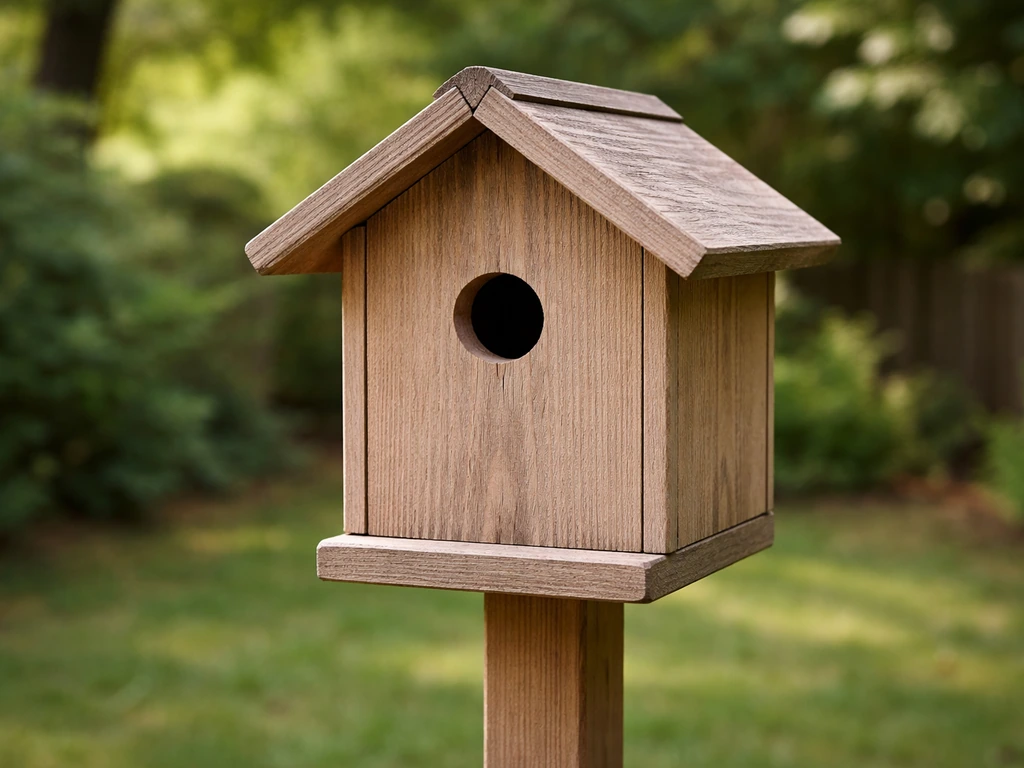
Every other birdhouse dimension matters, but nothing shapes which species moves in like the entrance hole. It acts as a species filter. A 1.5-inch hole lets Eastern Bluebirds enter but physically excludes European Starlings, which need at least 1.75 inches. A 1.125-inch hole keeps out house sparrows in some cases and definitely keeps out starlings. A 0.875-inch hole means only small wrens and similar tiny birds can squeeze through. This isn't a preference thing, it's basic physics. If the hole fits, the bird will try it. If it doesn't, it won't.
Hole size also affects predation risk directly. A larger opening gives raccoons, cats, and snakes a bigger target. It also makes it easier for a predator to reach an arm or head through to grab eggs or nestlings. Smaller, precisely sized holes create a natural first line of defense even before you add any predator-proofing hardware. Research on nest-defense behavior in cavity nesters confirms that birds nesting in tighter-fitting boxes show different (often more confident) defensive responses to predator approaches than those in loosely fitting boxes.
Beyond predators, hole size determines competition outcomes between species. House sparrows can usurp bluebird boxes with a 1.5-inch hole but can't get into a wren box with a 1.0-inch hole. Larger woodpeckers need 2-inch-plus openings. Getting the size precisely right isn't perfectionism, it's the most practical thing you can do for nest success.
Species-specific entrance hole diameter guide
Use this table as your primary reference. All measurements assume a round hole unless noted. Oval holes (like the NABS-recommended 1-3/8 x 2-1/4 inch oval for bluebirds) can substitute for round holes in some designs and offer extra starling resistance, so I've noted those where relevant.
| Species | Hole Diameter (inches) | Hole Diameter (mm) | Notes |
|---|---|---|---|
| House Wren | 0.875–1.0 in | 22–25 mm | Smaller end preferred; keeps out house sparrows |
| Carolina Wren | 1.125 in | 28–29 mm | Slightly larger body than House Wren |
| Black-capped / Carolina Chickadee | 1.125 in | 28–29 mm | Also suits Tufted Titmouse |
| Tufted Titmouse | 1.25 in | 31–32 mm | Will also use 1.125 in box |
| White-breasted Nuthatch | 1.25 in | 31–32 mm | Prefers wooded settings |
| Eastern / Western Bluebird | 1.5 in | 38 mm | Also suits 1-3/8 x 2-1/4 in oval (NABS-recommended) |
| Mountain Bluebird | 1.5625 in | 40 mm | Slightly larger than Eastern; 1.5 in works too |
| Tree / Violet-green Swallow | 1.5 in | 38 mm | Same box as bluebird works well |
| Purple Martin | 2.125 in | 54 mm | Colony houses; crescent-shaped entrance also used |
| House Finch | 2.0 in | 51 mm | Often uses open-front boxes instead |
| Downy Woodpecker | 1.25 in | 31–32 mm | Needs wood-chip fill inside |
| Hairy Woodpecker | 1.5 in | 38 mm | Deeper box required (10+ in floor to hole) |
| Northern Flicker | 2.5 in | 64 mm | Tall box, 14–16 in deep |
| American Kestrel | 3.0 in | 76 mm | Research confirms hole size affects prey-delivery success |
| Screech Owl | 3.0 in | 76 mm | Install high, 10–30 ft |
| Barn Owl | 6.0 in | 152 mm | Large box, barn or open structure preferred |
| Wood Duck | 4.0 x 3.0 in oval | 100 x 76 mm oval | Elliptical hole; near water, 4–6 ft high |
A quick note for UK and European readers: the BTO recommends a 32mm (1.25 in) entrance for most small garden hole-nesters like Great Tits and Nuthatches, and a 28mm (1.1 in) hole if you specifically want to target Blue Tits and exclude larger species. Those are the two most useful sizes to know for a standard garden nest box in the UK.
How to measure and verify your hole, and fix it if it's wrong
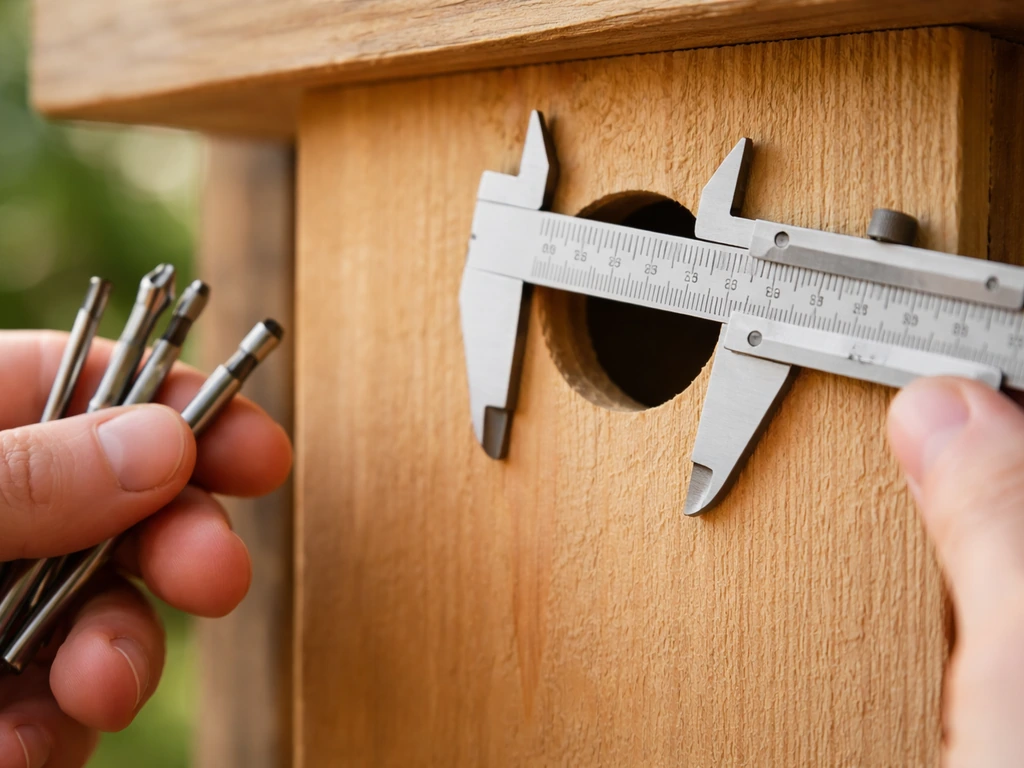
Before you drill anything or buy a box, take two minutes to measure. Most inexpensive birdhouses sold at garden centers have entrance holes that are either too large (starling-welcoming 2-inch openings) or poorly finished with rough edges that can injure birds. Here's how to check and correct yours.
Measuring an existing hole
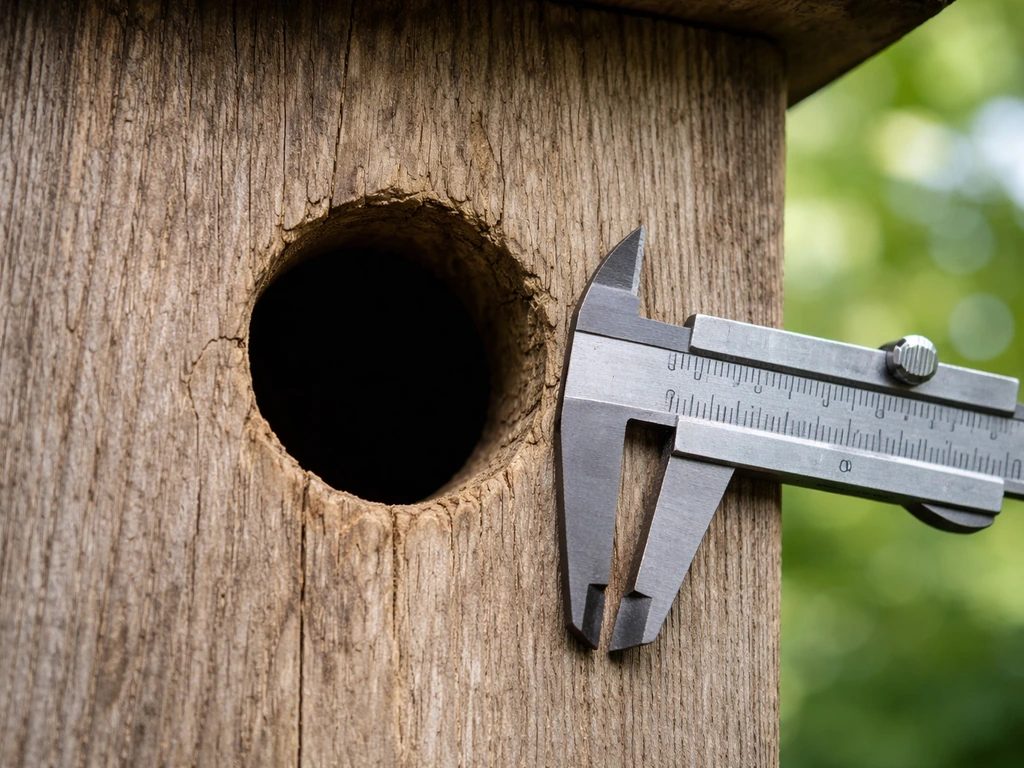
- Use a set of drill bits or a caliper. Slide the largest bit that fits cleanly through the hole without binding — the shaft diameter of that bit equals your hole diameter. A standard ruler placed across the opening works for a rough check but is less precise.
- For oval holes, measure the short axis (height) and the long axis (width) separately. An oval is defined by both measurements.
- Check the hole edges for rough wood, splinters, or paint. Run your finger around the inside rim. Sharp edges or paint buildup must be sanded smooth — birds can damage feathers or get stuck on rough openings.
- Check the hole height above the floor. This is a critical secondary measurement. For bluebirds, the hole should sit 6 inches above the floor. For chickadees, 6–8 inches. A hole placed too low puts nestlings within easy reach of a predator's arm.
Fixing a hole that's too large
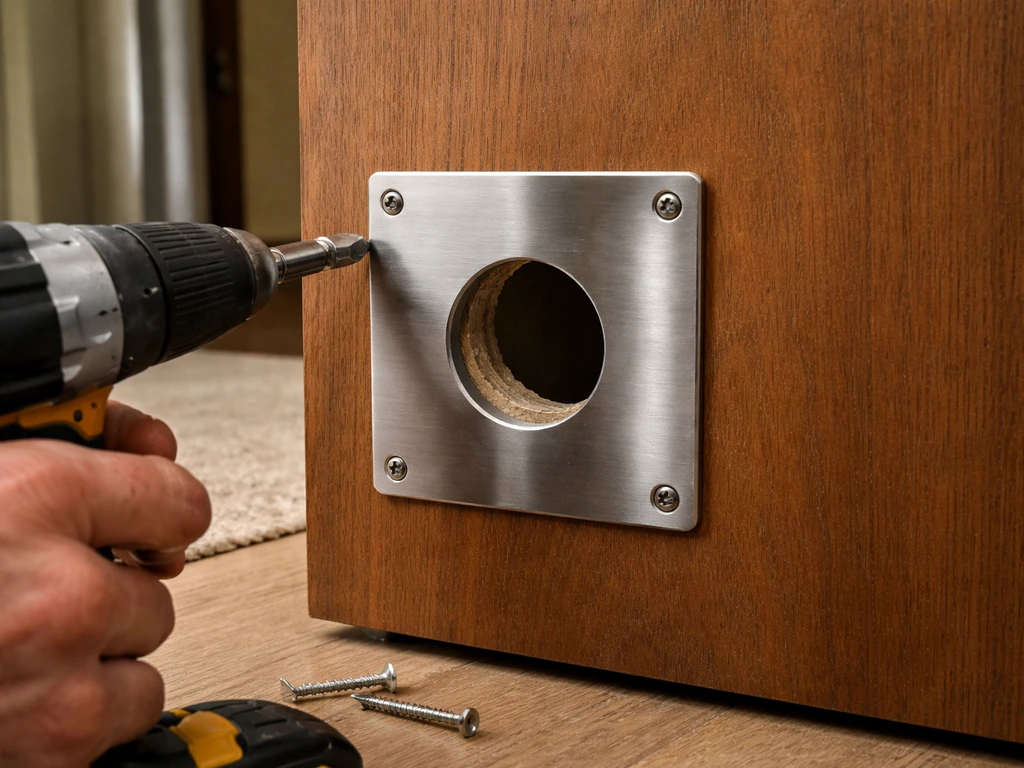
If your hole is too big, the best fix is a metal entrance plate (also called a hole reducer or entrance guard). These are flat metal plates with a correctly sized hole drilled through them, screwed over the existing opening. OSU Extension specifically recommends attaching a metal piece with the correctly sized hole over the entrance, this not only corrects the size but also prevents squirrels, rats, and other animals from gnawing the wood to enlarge the hole over time. You can buy these pre-made in common sizes (1.125 in, 1.5 in) or cut one from a thin aluminum sheet. Use galvanized screws and make sure the metal plate sits flush against the face of the box.
Another option is to glue and screw a short wooden block (at least 1 inch thick) with the correctly sized hole drilled through it over the existing entrance. This creates a short entry tunnel that also makes it physically harder for predators to reach inside, which is a real benefit. OSU Extension notes this tunnel effect specifically as a deterrent against squirrels and cats.
Drilling a new hole
- Use a sharp spade bit, Forstner bit, or hole saw sized exactly to your target diameter. Forstner bits leave the cleanest edges and are worth the small extra cost.
- Drill from the outside face inward. Place a scrap piece of wood behind the panel to prevent blowout on the interior side.
- Sand the hole edges inside and out with 120-grit sandpaper until smooth. Do not paint or stain the interior of the hole.
- Double-check with a drill bit shaft that the finished opening is the right diameter before mounting the box.
How to choose the right hole when you don't know the bird yet
If you're not sure which cavity-nesting birds are in your area, start with habitat and region. That narrows your options quickly.
Region and habitat decision guide
- Open fields and meadows in the eastern US or Pacific Coast: Start with a 1.5-inch hole for bluebirds and Tree Swallows. These are your most likely tenants in open country.
- Suburban backyard with trees and shrubs (eastern US): A 1.125-inch hole targets chickadees and Carolina Wrens. These birds are common in wooded suburbs and will use boxes reliably.
- Wooded edge habitat (mixed forest margins): Try 1.25 inches for Tufted Titmouse, White-breasted Nuthatch, and Downy Woodpecker. These species prefer boxes near tree canopy.
- Mountain west regions: Mountain Bluebirds use a 1.5–1.5625-inch hole. Western Bluebirds are fine at 1.5 inches, same as the Eastern.
- Near water (ponds, lakes, slow rivers): Wood Ducks need the 4x3-inch oval. Tree Swallows also frequent waterside locations and use a 1.5-inch hole.
- Barn or large open structure in rural area: Barn Owls need a 6-inch opening in a large box mounted inside the structure.
- Open grassland or farmland: American Kestrels use a 3-inch hole mounted on a post 10–30 feet high at the edge of open terrain.
- UK/European garden: Use 32mm for most species, 28mm if you specifically want Blue Tits.
If you're still unsure, check eBird or your local Audubon chapter's breeding bird map for your county. A ten-minute search will tell you which cavity nesters are confirmed breeders in your zip code, and you can drill specifically for those species.
Seasonal timing also matters. Boxes should ideally be in place by late winter or very early spring before the breeding season begins, February to March for most of the continental US. If you're reading this in June, it's not too late. Many species will use a box for a second clutch, and some wrens nest well into summer. Clean the box, install it now, and you may still get activity this season.
Common mistakes and how to troubleshoot them
Wrong species moved in
If house sparrows or starlings are using a box meant for bluebirds or chickadees, the first thing to check is hole size. Starlings cannot fit through a 1.5-inch round hole, if you're getting starlings, your hole is larger than 1.5 inches. Measure it. House sparrows can use a 1.5-inch hole, so a bluebird box is not sparrow-proof by size alone. The best additional deterrents for sparrows are monitoring frequency (check weekly and remove sparrow nests promptly), relocating the box away from buildings and shrubby cover that sparrows prefer, and pairing the box with a nearby box for bluebirds in more open terrain.
No activity at all
If nothing is using the box after 4–6 weeks in prime season, work through this checklist. Is the hole the right size for birds actually present in your habitat? Is the box in direct sun with no shade? (Most species avoid overheating boxes.) Is there a perch attached below the hole? Remove it, perches are not needed by cavity nesters and give predators and nest competitors a foothold. Is the box facing a busy area with lots of human foot traffic? Many species, especially bluebirds and swallows, need open sightlines. Is the entrance hole within view of a feeder or bird bath? Proximity to feeders can actually deter nesting in some species that prefer privacy.
Damaged or abandoned nests
Eggs or nestlings found outside the box, or nests with obvious disturbance, usually point to a predator raid. Check for claw marks or chew marks around the entrance hole. If the hole has been enlarged, add a metal entrance plate immediately. If the box pole shows claw marks, add a baffle (see next section). If nesting starts strong and then stops, it may be heat stress, add ventilation holes near the top of each side wall (about 0.25-inch holes, four per side) if they aren't already there, and make sure the box isn't in full afternoon sun.
Landing perches and gap problems
Avoid any birdhouse with a dowel perch below the entrance. Cavity-nesting birds don't need them, and they actively help house sparrows and predators access the hole. Remove any perch with pliers or a saw flush to the face. Also check for gaps between the front panel and side panels. Any gap wider than about 3mm lets in rain, cold air, and insects. Seal gaps with wood glue or a small strip of weatherstrip foam, not silicone caulk (which off-gasses chemicals harmful to nestlings).
Mounting, placement, and predator-proofing paired with hole size
Hole size and mounting height work together. A correctly sized hole on a box that's too low or lacks a predator guard gives false security. Here's how to pair them correctly.
Recommended mounting heights by species
| Species | Recommended Mounting Height | Facing Direction |
|---|---|---|
| Eastern/Western Bluebird | 4–6 ft on post in open area | North or east, away from prevailing wind |
| Mountain Bluebird | 4–6 ft on post | North or east |
| Chickadee / Titmouse | 5–15 ft on tree or post | Any direction, partial shade preferred |
| House Wren | 5–10 ft on post or tree | Any direction, near shrubs |
| Tree Swallow | 4–6 ft on post near water | Open area with clear flight path |
| Wood Duck | 4–6 ft on post over or near water | Facing water |
| American Kestrel | 10–30 ft on post or dead tree | Open grassland edge |
| Screech Owl | 10–30 ft on tree | Partially shaded woodland edge |
| Barn Owl | 12–20 ft inside barn or on post | Interior structure preferred |
The New York State Bluebird Society recommends a roof overhang of at least 5 inches above the entrance hole to reduce raccoon and cat predation. NABS design guidelines echo this, specifying an overhang that extends beyond not just the entrance hole but also any ventilation holes near the top of the front panel. If your box has a minimal or no overhang, adding a piece of exterior-grade plywood as an extended roof lip takes about ten minutes and makes a real difference.
Baffles and predator guards
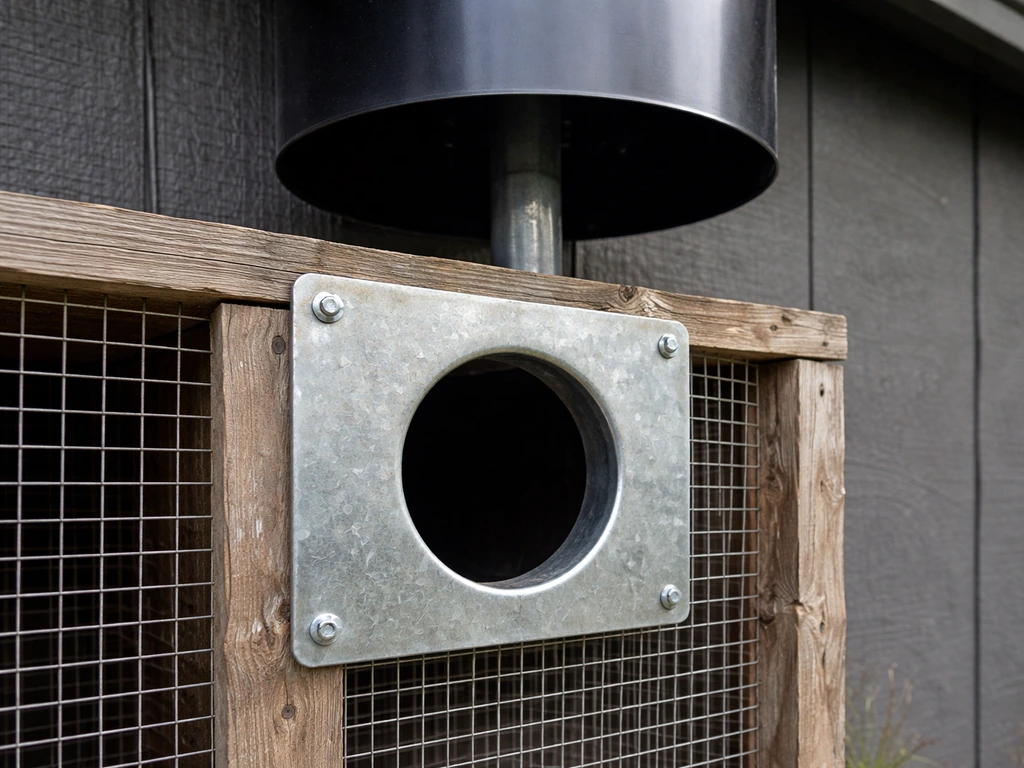
A pole-mounted baffle is the most effective single predator deterrent you can add. For a round pole or conduit, use a smooth metal stovepipe baffle (at least 8 inches in diameter, 24 inches long) placed 4–5 feet above the ground. The baffle must be smooth, raccoons can climb textured surfaces. For a wooden post, a cone-shaped metal baffle attached below the box works well. OSU Extension and multiple bluebird society guidelines all recommend baffles as standard equipment, not optional extras.
At the entrance hole itself, a metal entrance plate (hole reducer) serves double duty: it maintains your exact target diameter against gnawing damage and it provides a harder surface that a raccoon's paw can't grip as easily as bare wood. A recessed or extended entrance tube, a short block of wood or PVC pipe with the correctly sized hole, extending 1–2 inches out from the box face, adds another layer.
Research on predator-proofing interventions confirms that increasing the distance between the entrance and the nest contents (deeper box or extended entrance tunnel) consistently reduces predation success. A review of predator-proofing nestbox interventions reports that increasing the distance between the entrance and the nest contents, such as by using a deeper box or extended entrance tunnel, consistently reduces predation success.
Ventilation and drainage
Drill four 0.25-inch ventilation holes on each side wall near the top, and four 0.25-inch drainage holes in the floor corners. These are non-negotiable in warm climates. Overheating kills nestlings quickly, and standing water in the box breeds parasites. Make sure no ventilation holes are on the front face near the entrance, they create additional entry points for parasites and can allow driving rain inside. Ventilation belongs on the sides or back, up near the roof.
Cleaning and maintenance: what to do and when
A dirty birdhouse is one of the most common reasons boxes stop being used. Mites, blowfly larvae, and accumulated droppings from one nest cycle will deter new tenants and harm subsequent clutches in the same season.
During the nesting season
Check the box weekly if possible, open it briefly, count eggs or nestlings if present, then close it. If you find a house sparrow nest (loosely woven grasses, feathers, trash), remove it immediately and repeat as needed. If blowfly larvae are visible in the nest material (small white maggots in the nest base), you can carefully lift out the nest, remove the larvae, and place the nest back. Don't disturb eggs or nestlings that are close to fledging.
Between clutches and after the season
- Once nestlings have fledged (you'll know the box is empty — open it and check), remove all old nest material completely. Don't leave it in place for the next clutch. Old nests harbor parasites.
- Scrape out any droppings or debris with a stiff brush or putty knife.
- Wash the interior with hot water. OSU Extension recommends hot water washes specifically for removing droppings and insects. Let the box dry completely in sun and air before closing it up.
- Do not use bleach or chemical cleaners inside the box. If you feel disinfection is needed (after a disease outbreak or heavy parasite infestation), a very dilute bleach solution (1 part bleach to 9 parts water) can be used but must be rinsed thoroughly and the box must dry completely for at least 48 hours before birds can access it.
- Inspect the entrance hole, entrance plate (if you have one), and all joints for damage. Tighten any loose screws. Check that the baffle is secure and the pole hasn't shifted.
- After the final nest of the season (late summer to early fall in most regions), leave the cleaned box open or close it loosely. Some boxes are used by overwintering birds for roosting — chickadees and wrens will use clean, tight boxes as winter roost sites.
Annual inspection checklist
- Confirm entrance hole diameter is still correct (check for gnaw damage)
- Check that metal entrance plate (if used) is still firmly attached and has not corroded
- Inspect roof for water infiltration — caulk any seams that have opened
- Make sure ventilation and drainage holes are clear and not plugged with debris
- Verify baffle is tight and pole has not shifted or leaned
- Look for rot on the floor and lower side panels — these go first and may need replacing
- Check that the box is still at the correct mounting height and facing direction
Your action plan from here
If you're starting from scratch: pick your target species based on your habitat (use the region guide above), drill the correct hole size with a Forstner bit, add a metal entrance plate, mount on a baffled pole at the right height, and check it weekly once birds arrive. If you're doing this in Old School RuneScape, you can also look up the OSRS birdhouse steps and required items to set up your bird runs correctly.
If you already have a box: measure the hole today, fix it with a metal reducer if needed, remove any perch, add a baffle if you don't have one, and clean it out if it's been sitting used. If you're playing OSRS and want the best seeds for bird houses, you'll need to pick the right seed type for the birdhouse activity. Most birdhouse problems come down to three things, wrong hole size, no predator guard, and skipping the annual cleaning.
Use this bird house run guide alongside the hole size measurements so you can place, monitor, and troubleshoot the box for your target species all season birdhouse problems come down to three things. Fix those three and you're in a genuinely good position to attract and support cavity-nesting birds this season and every season after. Best seeds for bird houses in OSRS depend on which birds you want to attract and the right entrance hole size you are using.
If you want to go deeper on any one piece of this, the do's and don'ts of birdhouse design covers additional build and placement rules worth knowing, especially if you're building from wood and choosing materials. Use these bird house do's and don ts to make sure your entrance, placement, and maintenance choices help the right species move in do's and don'ts of birdhouse design. And if you're planning to put up multiple boxes as part of a backyard habitat project, thinking through the full birdhouse run, spacing, monitoring routes, species combinations, will help you avoid common setup mistakes before they cost you a season. To use the bird house run guide OSRS effectively, plan your monitoring route and timing so you check each box without missing active nests.
FAQ
Should I match the entrance hole size exactly, or is “close enough” okay?
Match as closely as you can. Small deviations matter because predators and competitors often exploit loose tolerances, and a hole that is just slightly larger than target can let in unwanted species over time.
How do I measure an entrance hole accurately before drilling or buying fixes?
Measure the clear opening from edge to edge (not the wood thickness). Use a caliper or insert gauge if you have one, and if the hole is oval or rough, measure the narrowest dimension since that controls what can actually enter.
Can I use an oval entrance hole instead of a round one for the bird house hole size guide values?
Yes, but compare against what the bird must physically pass through. An oval designed for a specific species can improve starling resistance, but you still need to keep the narrow dimension in the correct range for the target bird.
What if my finished box has a hole that is too small for the bird I want?
Avoid enlarging the existing hole unless you also add a proper entrance plate or reducer afterward. Even if you hit the right size, a raw enlarged opening can leave sharp edges and make predators easier to start gnawing.
If a reducer plate is used, does it change the predator risk?
It can lower risk. A metal reducer maintains the correct diameter against gnawing, and the harder surface makes it harder for some predators to grip and enlarge the opening compared with bare wood.
Do I need to remove any perch or landing feature even if it came with the box?
For cavity nesters, yes. A perch below the entrance can help both predators and competitor birds. Remove it flush with the front panel, then check for any remaining foothold gaps.
How deep should the entrance tunnel or block be for an added deterrent?
For a simple fix, a short wooden block of at least 1 inch thick works, because it increases distance between the entrance and the nest. Longer is not always better if it reduces airflow or creates an overly tight, hard-to-clean structure.
My box looks “used” already. Should I still clean it if it was empty last season?
Yes. Debris, old nests, blowfly residue, and leftover parasites can deter new tenants even if no eggs hatched. Clean out the cavity before the next breeding period, ideally before activity begins.
What should I do if blowfly larvae are present in the nest?
Carefully remove the nest contents with minimal disturbance, lift out visible larvae, and return the nest if eggs or nestlings are close to fledging. If larvae are widespread or the nest is failing, it may be safer to stop and monitor, rather than repeatedly handling the nest.
How do I handle the situation where I see nestlings or eggs outside the box?
Treat it as a high-priority predator or failure-to-nest sign. Look specifically for chew marks or claw marks near the entrance, then immediately tighten the entrance defense by confirming hole size and adding a metal entrance plate if any enlargement is suspected.
Does hole size matter if the box is mounted very high or has good predator protection?
Yes, but it becomes one part of a system. Good mounting height and baffles reduce access, but the hole still determines which species can physically enter and how easily predators can reach inside through the opening.
Where should I place ventilation holes if my box has overheating or stopping-nesting issues?
Put ventilation openings on the sides or back near the top, not on the front face near the entrance. This helps airflow without increasing parasite entry risk and reduces the chance of wind-driven rain entering at the opening.
What is the quickest diagnostic order when nothing uses the box for 4 to 6 weeks?
Start with the hole size for the likely local species, then check sun exposure and box microclimate, then remove perches, and finally review siting for sightlines and privacy relative to feeders or bird baths. The entrance diameter correction is usually the highest-impact fix if it was wrong.
Can I install a birdhouse later in the season and still succeed with the right hole size?
Often, yes. Even if it is past late winter, some species may re-nest or continue breeding into summer. Focus on cleaning first, ensuring the hole size matches your target species, and keep an eye out for active use.